

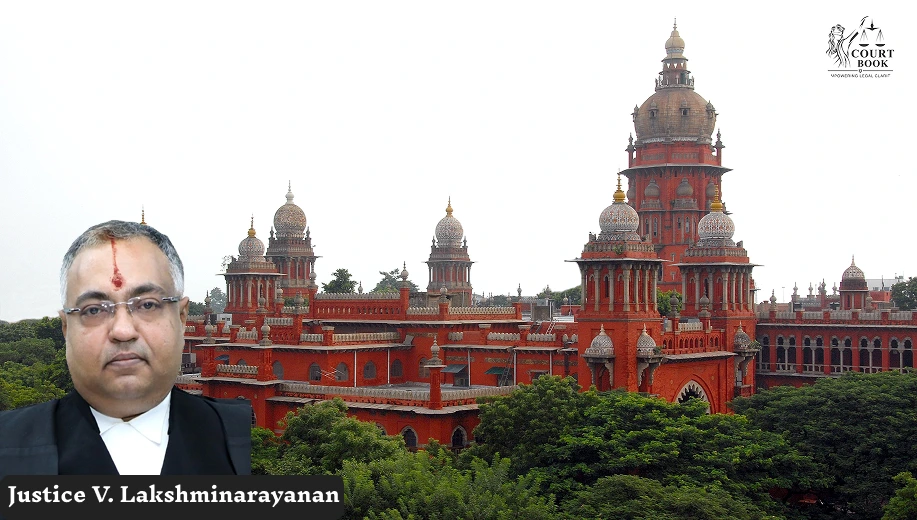
The Madras High Court directed the Greater Chennai Corporation to proceed with the removal of a roadside shrine after finding that it was built on a public road in north Chennai. The court made it clear that religious sentiment cannot override the law when an encroachment blocks a public pathway.
Justice V. Lakshminarayanan passed the order while allowing a writ petition filed by a Chennai resident who complained that the structure obstructed access to his home and caused inconvenience to pedestrians.
Background of the Case
The petitioner, A. Sarath, told the court that he purchased a house in Thiru.Vi.Ka. Nagar in November 2024 after being assured that a structure near his entrance was temporary. However, during renovation work, he discovered that a statue of Mother Mary had been installed there permanently, along with a tall pillar and amplifier.
Read also:- Delhi Court Acquits Medha Patkar in 2006 TV Defamation Case Filed by V.K. Saxena
According to him, the shrine stood on a public pavement and an electricity connection had been illegally drawn from a nearby house. He submitted a complaint to the Chennai Corporation in September 2025, but alleged that no action followed, forcing him to approach the High Court.
Shrine Custodian’s Stand
During the hearing, R. Daniel, who was later impleaded as a party, said the shrine had existed since 1995 and had become a place of faith for local residents. He argued that no objections had been raised for nearly three decades and claimed that its removal could disturb communal harmony.
Daniel also alleged that the petitioner had prior knowledge of the shrine when he bought the property and accused him of targeting only one religious structure in the area.
Read also:- SC/ST Act Bar Applies: Kerala High Court Refuses Anticipatory Bail in Onam Night Assault Case
Court Observation
After examining records, the court noted that a Corporation inspection confirmed the shrine was built on Sarkar Poramboke land, officially classified as a public road. The structure occupied about 8 square metres of the street.
Rejecting the argument that long existence or religious belief could protect the shrine, the court observed that,
“A road or a street does not have any religious character. Irrespective of the nature of the structure, an encroachment on a public place must be removed.”
Justice Lakshminarayanan relied on Supreme Court and High Court precedents to underline that the right to worship does not include the right to occupy public pathways.
Read also:- Punjab and Haryana High Court Refuses Anticipatory Bail in Chandigarh Beef Recovery Case
Decision of the Court
Allowing the writ petition, the High Court directed the Chennai Corporation to continue proceedings under Section 128 of the Tamil Nadu Urban Local Bodies Act. The court noted that a statutory notice had already been issued to Daniel on 19 January 2026.
The court ordered that the authorities must pass final orders and ensure removal of the structure on or before 10 February 2026, after considering any reply submitted within the notice period.
At the same time, the court clarified that allegations exchanged between the parties would not be examined in this case, leaving them free to pursue separate legal remedies if needed.
Case Title: A. Sarath vs Commissioner, Greater Chennai Corporation & Others
Case Number: W.P. No. 49192 of 2025
Date of Judgment: 22 January 2026
Download Order

