

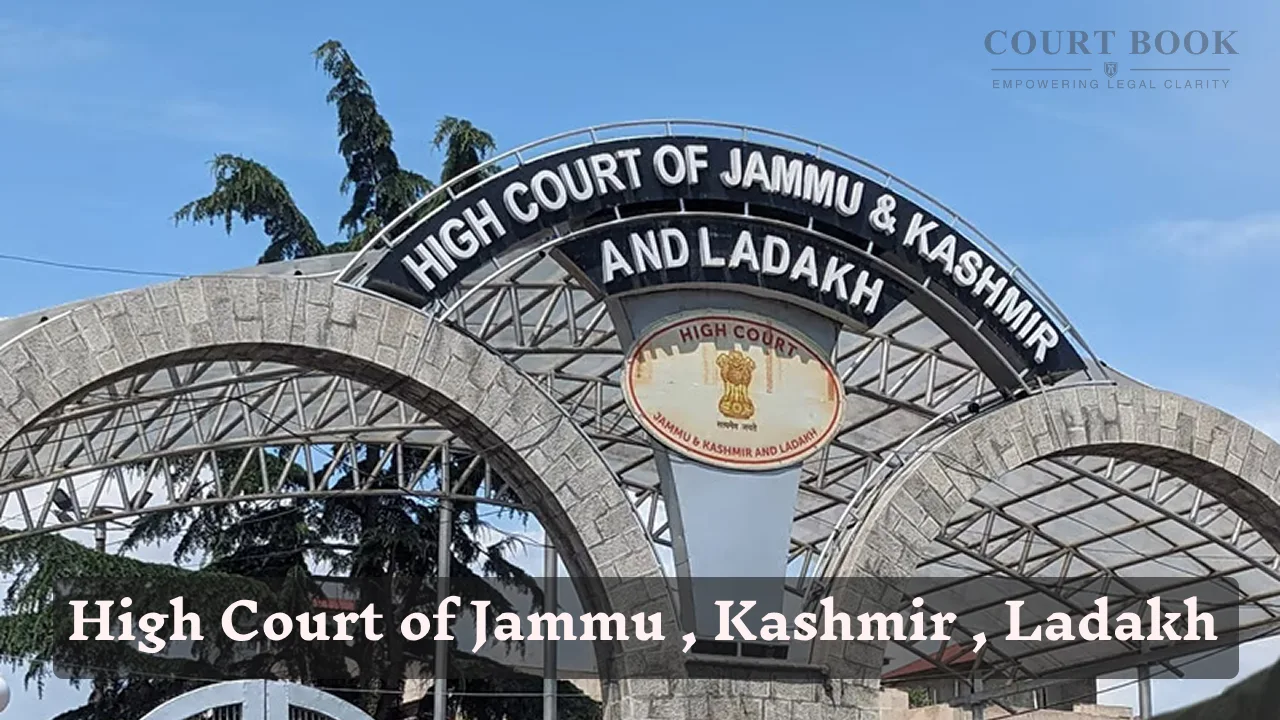
In a significant ruling, the High Court of Jammu & Kashmir and Ladakh at Jammu has restored a commercial suit that had been dismissed for non-prosecution after nearly 16 years of litigation. The Division Bench made it clear that when a case has reached the stage of final arguments, courts should lean toward deciding it on merits rather than shutting the doors on technical grounds.
The judgment was delivered in RFA No. 29/2023, titled M/s Ram Kour Behari Lal and Co. v. M/s Hakam Chand and Co. and others .
Read also:-Bombay High Court Allows Single Mother to Change Daughter’s Name, Caste in School Records
Background of the Case
The dispute began as a civil suit for recovery of ₹5.58 lakh. The suit was originally filed in 1996 and later transferred to the Court of the Additional District Judge (Commercial Court), Jammu.
Evidence from both sides had been completed. By 2010, the matter was listed for final arguments. However, after repeated non-appearances by the plaintiff’s side, the Trial Court dismissed the suit for non-prosecution on May 28, 2011.
More than a year later, the plaintiff filed an application seeking restoration of the suit along with a plea to condone (forgive) a delay of 560 days in filing that application. The Trial Court rejected the plea for condonation of delay on May 22, 2023. As a result, the restoration request also failed.
Challenging this order, the plaintiff approached the High Court.
Read also:-Rajasthan High Court Refuses Relief to New Nursing Colleges, Says Counselling Cannot Be Reopened
Arguments Before the High Court
Counsel for the appellant argued that the dismissal occurred due to confusion in legal representation. The advocate who had been handling the matter left his senior’s chamber to start independent practice around the time the case was fixed for final arguments. This led to a lapse in follow-up.
It was also submitted that the appellant had been diligently pursuing the case for 16 years. The suit was ripe for judgment, and there was nothing further left to be done from the plaintiff’s side. Dismissing it at such a stage, counsel argued, was too harsh.
On the issue of delay, the appellant cited Supreme Court precedents to argue that courts should adopt a “liberal and justice-oriented approach” when sufficient cause is shown.
On the other hand, the respondent’s counsel contended that internal arrangements within a lawyer’s office cannot excuse negligence. It was argued that the litigant himself has a duty to monitor his case. The respondents also questioned the validity of the restoration application, claiming it was filed without proper authorization.
Read also:-Jharkhand HC Seeks Answers on 437 Custodial Deaths, Orders Home Secretary to Clarify Judicial
Court’s Observations
The Bench carefully examined the record. It noted that the suit had reached the stage of final arguments and that evidence from both sides had already been completed.
The Court pointed out that under procedural law, when substantial evidence has been recorded, the Trial Court has discretion to decide the matter on merits even if a party is absent.
“Ordinarily, a suit poised at the stage of final arguments should be adjudicated on its merits rather than being dismissed for non-prosecution,” the Bench observed.
The High Court also took note of a procedural lapse. Notices in the restoration application had been issued despite the absence of a formal power of attorney (Vakalatnama). The Bench held that if the court registry had detected the defect in time, it could have been cured immediately.
Relying on the legal principle actus curiae neminem gravabit - meaning no one should suffer because of an act of the court - the Bench remarked, “There is no higher principle for the guidance of the Court than the one that no act of Courts should harm a litigant.”
The Court further found that the appellant had personally signed subsequent applications and affidavits, thereby confirming his intention to pursue the matter. The absence of a formal Vakalatnama was termed a technical irregularity, not a fatal defect.
On the question of delay, the Court observed that the explanation given - confusion due to change of counsel and health issues - was not imaginary or fanciful. The appellant had pursued the case for 16 years. Denying adjudication on merits merely because of delay would be “unjust and iniquitous,” the Bench said.
Read also:-Karnataka High Court Cuts Jail Term in ATM Cloning Case, Enhances Fine to ₹2 Lakh Each
The Decision
Allowing the appeal, the High Court set aside the Trial Court’s order dated May 22, 2023.
The delay of 560 days in filing the restoration application was condoned. Consequently, the restoration application was also allowed.
The suit has been restored to its original number and remanded to the Trial Court for adjudication on merits in accordance with law. The parties have been directed to appear before the Trial Court on March 2, 2026.
With this, the High Court ensured that the long-pending commercial dispute will now be decided on merits rather than ending on a technical default.
Case Title: M/s Ram Kour Behari Lal and Co. v. M/s Hakam Chand and Co. and others
Case No.: RFA No. 29/2023
Decision Date: 06 February 2026


