

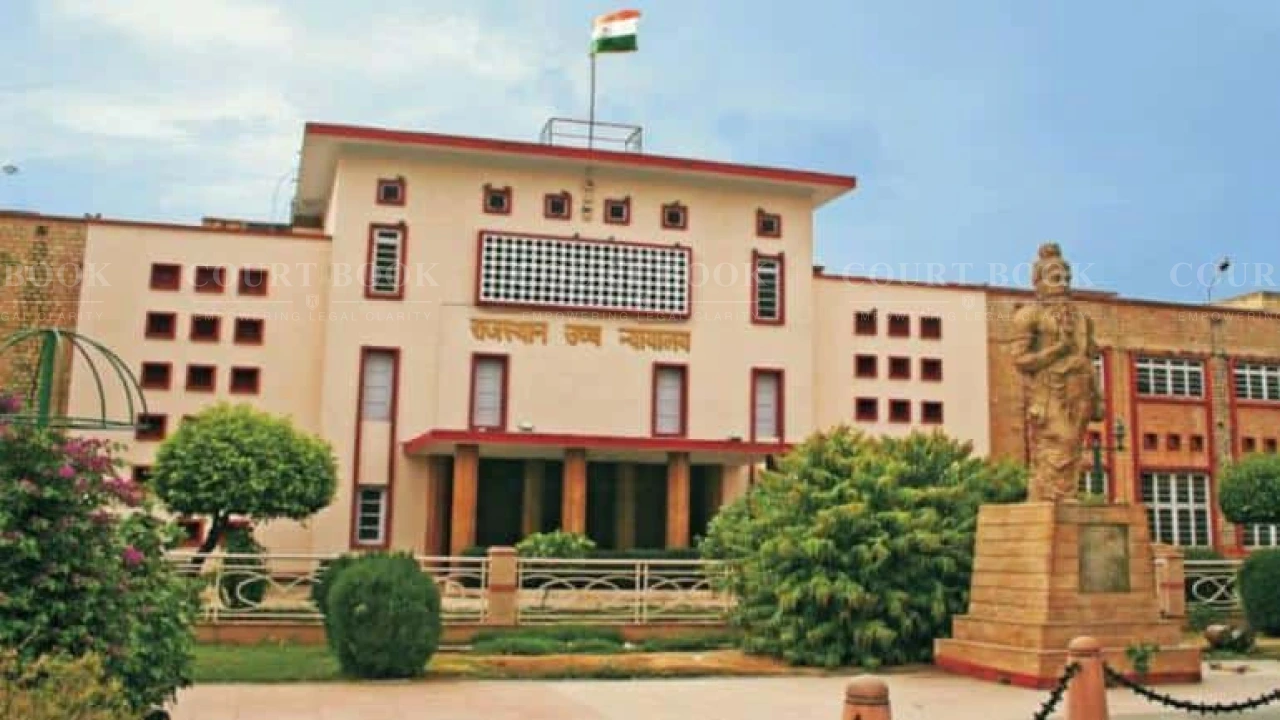
The Rajasthan High Court has sent a clear message to accident claimants: compensation can be claimed under only one law, not multiple forums for the same incident. In a detailed judgment delivered at the Jaipur Bench, the court quashed two compensation awards passed under the Workmen’s Compensation Act after noting that the claimants had already received money under the Motor Vehicles Act.
Justice Anoop Kumar Dhand, while hearing two connected appeals filed by National Insurance Company Ltd., ruled that pursuing parallel remedies amounts to misuse of the legal process.
Read also:-Supreme Court Revives Cheque Bounce Complaint, Says Justice Demands Restoration of Dismissed Case
Background of the Case
The dispute arose from two separate road accidents-one in 2003 and another in 2009-both involving workers who either died or sustained injuries while on duty.
In both cases, the families or injured persons first approached the Motor Accident Claims Tribunals (MACT) under the Motor Vehicles Act, 1988. The tribunals allowed their claims and awarded compensation, which was duly received.
Later, the same claimants approached the Workmen’s Compensation Commissioner under the Workmen’s Compensation Act, 1923, seeking additional compensation for the very same accidents. These claims were also allowed, leading to fresh awards with interest.
The insurance company challenged these second rounds of compensation before the High Court.
Read also:-Late Arbitration Award Can Survive: Supreme Court Clarifies Power to Extend Arbitrator’s Mandate
What the Insurance Company Argued
Counsel for National Insurance Company contended that the law clearly prohibits double claims for the same accident. Relying on Section 167 of the Motor Vehicles Act, the insurer argued that a claimant must choose either the Motor Vehicles Act or the Workmen’s Compensation Act.
“The claimants cannot be permitted to enjoy two parallel remedies for the same cause of action,” the counsel submitted, pointing out that Supreme Court rulings have consistently followed this principle.
Stand Taken by the Claimants
The claimants’ lawyers opposed the appeals, arguing that the parties involved were different and that compensation under the Workmen’s Compensation Act was claimed against the employer, not the vehicle owner.
It was also argued that amounts received under one law could be adjusted against the other, and therefore the second claim should not be rejected outright.
Court’s Observations
The High Court rejected these arguments after closely examining Section 167 of the Motor Vehicles Act.
“The statute gives a clear option to the claimant to choose one forum,” the bench observed. “Once that option is exercised, the claimant is barred from invoking the other remedy.”
Justice Dhand explained that the provision is rooted in the doctrine of election, which prevents a person from seeking the same relief through multiple legal routes.
The court also referred to Supreme Court judgments, including National Insurance Company Ltd. vs. Mastan, where it was held that a claimant cannot draw benefits under both enactments for the same accident.
The court made it clear that courts cannot be treated as bargaining platforms where a claimant moves from one forum to another in search of higher compensation.
“Such successive claims amount to abuse of the process of law,” the judgment stated.
The High Court firmly rejected the idea of adjusting compensation amounts across forums, holding that once compensation is accepted under one statute, the door to the other is legally closed.
Read also:-CLAT 2026 Answer Key Controversy Lands in Allahabad HC, Merit List to Be Revised
Final Decision
Allowing both appeals filed by the insurance company, the Rajasthan High Court:
• Quashed and set aside the awards passed by the Workmen’s Compensation Commissioner
• Held that the second set of claims was not maintainable in law
• Directed the claimants to refund the compensation amounts, along with applicable interest, to the insurance company without delay
With these directions, all connected appeals and pending applications were disposed of.
Case Title: National Insurance Company Ltd. vs. Manju Bai & Ors.
Case Numbers: S.B. Civil Misc. Appeal No. 143/2013 & 6491/2011
Decision Date: 28 January 2026


