

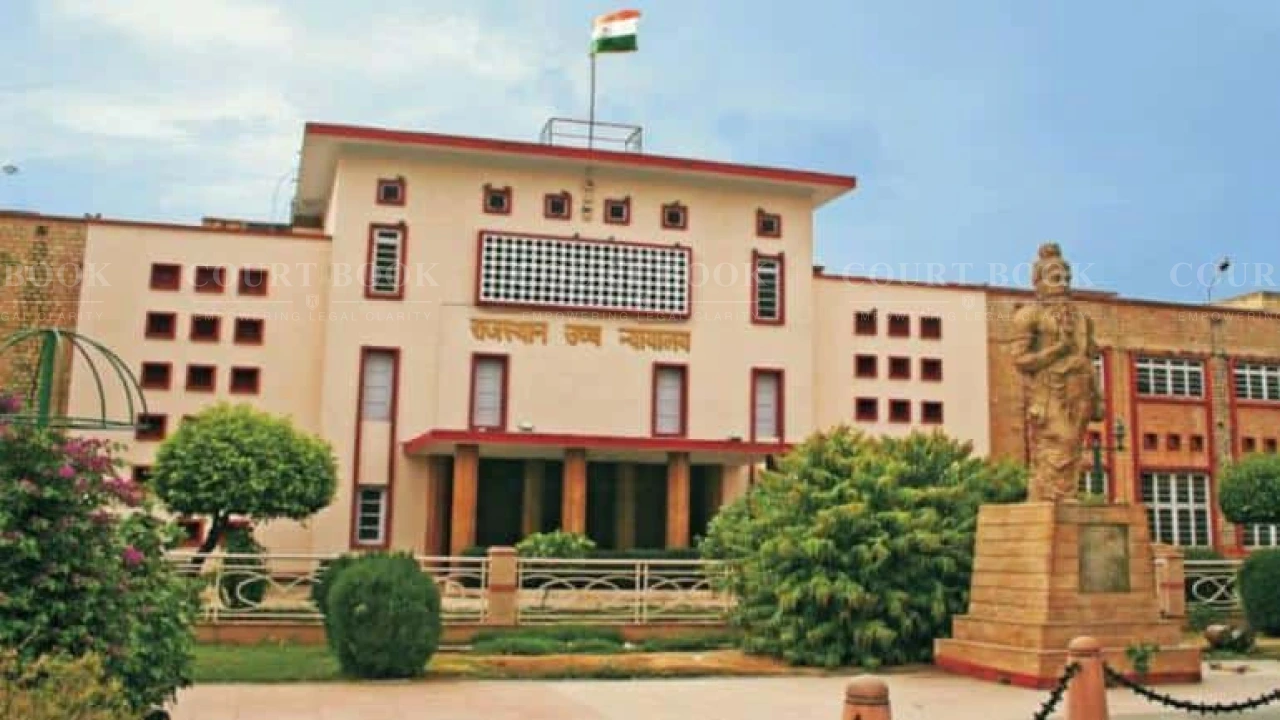
In a significant ruling for daily wage earners, the Rajasthan High Court has clarified that a ‘Beldar’ falls under the category of an unskilled worker and not a skilled one. At the same time, the Court held that while calculating compensation in motor accident claims, the monthly income of daily wagers must be assessed on the basis of 30 days, not 26.
Justice Anoop Kumar Dhand delivered the order on February 4, 2026, partly allowing an appeal filed by an injured claimant seeking enhancement of compensation.
Read also:-Bombay HC Disposes Unmarried Woman’s Abortion Plea, Cites Supreme Court Ruling on MTP Rights
Background of the Case
The appeal arose from a judgment of the Motor Accident Claims Tribunal (MACT), Beawar, which had awarded ₹2,87,625 as compensation to Laxman Kumawat, who suffered injuries in a road accident on August 27, 2020.
Kumawat, aged 38, was working as a Beldar (a manual construction worker). He sustained multiple injuries and underwent surgery. Medical evidence showed 13% permanent disability.
Before the High Court, his counsel argued two main points:
1. A Beldar should be treated as a skilled worker for wage calculation.
2. Monthly income of a daily wager should be calculated for 30 days, not 26.
The insurance company opposed the appeal, contending that a Beldar is an unskilled worker and that the Tribunal had correctly applied the 26-day formula based on labour notifications.
Read also:-Calcutta High Court Refuses to Quash Forgery Case Linked to 1963 Land Deed, Orders Police Prob
Key Issues Before the Court
The Court framed two clear questions:
• Is the work of a Beldar skilled or unskilled?
• Should monthly income of a daily wager be calculated on 26 days or 30 days?
Justice Dhand took up both issues in detail.
Court Observation on ‘Skilled’ vs ‘Unskilled’ Labour
The Court examined labour department notifications and classifications issued by the Ministry of Labour.
It noted that skilled labour refers to workers who have specialized training or technical qualifications. Unskilled labour, on the other hand, involves manual work that does not require formal training.
Referring to official classifications, the Court observed that ‘Beldar’ is specifically listed under the category of unskilled workers.
“The injured was working as a Beldar. As per the notifications issued by the Department of Labour, those workers fall within the category of unskilled labour,” the bench observed.
Rejecting the claimant’s argument, the Court held that a Beldar cannot be treated as a skilled worker merely because of the nature of physical labour involved.
Read also:-Bombay High Court Flags Flawed Tree-Felling Notices, Closes Pune Coconut Trees Case
“By no stretch of imagination can the job of a Beldar be treated as skilled labour,” the Court said.
Thus, the Tribunal was correct in treating the claimant as an unskilled worker.
The 26-Day vs 30-Day Wage Debate
The more substantial issue related to wage calculation.
The Tribunal had calculated the claimant’s monthly income by multiplying the minimum daily wage by 26 days. This method is based on the assumption of a six-day work week with one weekly rest day.
However, the High Court looked at the ground reality of daily wage earners.
Justice Dhand noted that daily wage workers are paid only for the days they actually work. Weekly offs are usually unpaid. Missing even a single day means loss of income.
“Daily wagers typically receive payment only for the days actually worked by them,” the Court observed.
The Court emphasized that it cannot be presumed that such workers take one leave every week. In reality, many work continuously to survive.
“They neither have any holidays nor they take leave even for a day in a week,” the bench remarked.
Calling the 26-day calculation “not justified,” the Court said minimum wages for daily wage earners should be counted for 30 days in a month.
The judgment also referred to earlier precedents of the High Court that had adopted the 30-day formula in similar cases.
Recalculation of Compensation
Applying the 30-day method and adding 40% towards future prospects (expected increase in earnings over time), the Court recalculated the compensation.
After considering:
• 13% permanent disability
• Pain and suffering
• Medical expenses
• Special care and nutrition
the total compensation was reassessed at ₹3,20,665.60.
Since the Tribunal had already awarded ₹2,87,625, the claimant became entitled to an enhanced amount of ₹33,040.60.
Read also:-Karnataka High Court Quashes Cheque Bounce Conviction After Finding Serious Gaps in Trial
Decision
The appeal was partly allowed.
The Court modified the Tribunal’s award and directed the respondents to pay the enhanced compensation of ₹33,040.60 with 6% annual interest from the date of filing the claim petition.
The amount must be deposited in the claimant’s bank account within two months.
Additionally, the Court directed that a copy of the order be sent to the Secretary, Ministry of Labour (Union of India) and the Secretary, Labour Department, Government of Rajasthan, to consider modifying their notification regarding 26-day wage calculation.
With this, the matter was disposed of.
Case Title: Laxman Kumawat v. Madan Singh & Anr.
Case No.: S.B. Civil Misc. Appeal No. 2560/2024
Decision Date: 04 February 2026


