

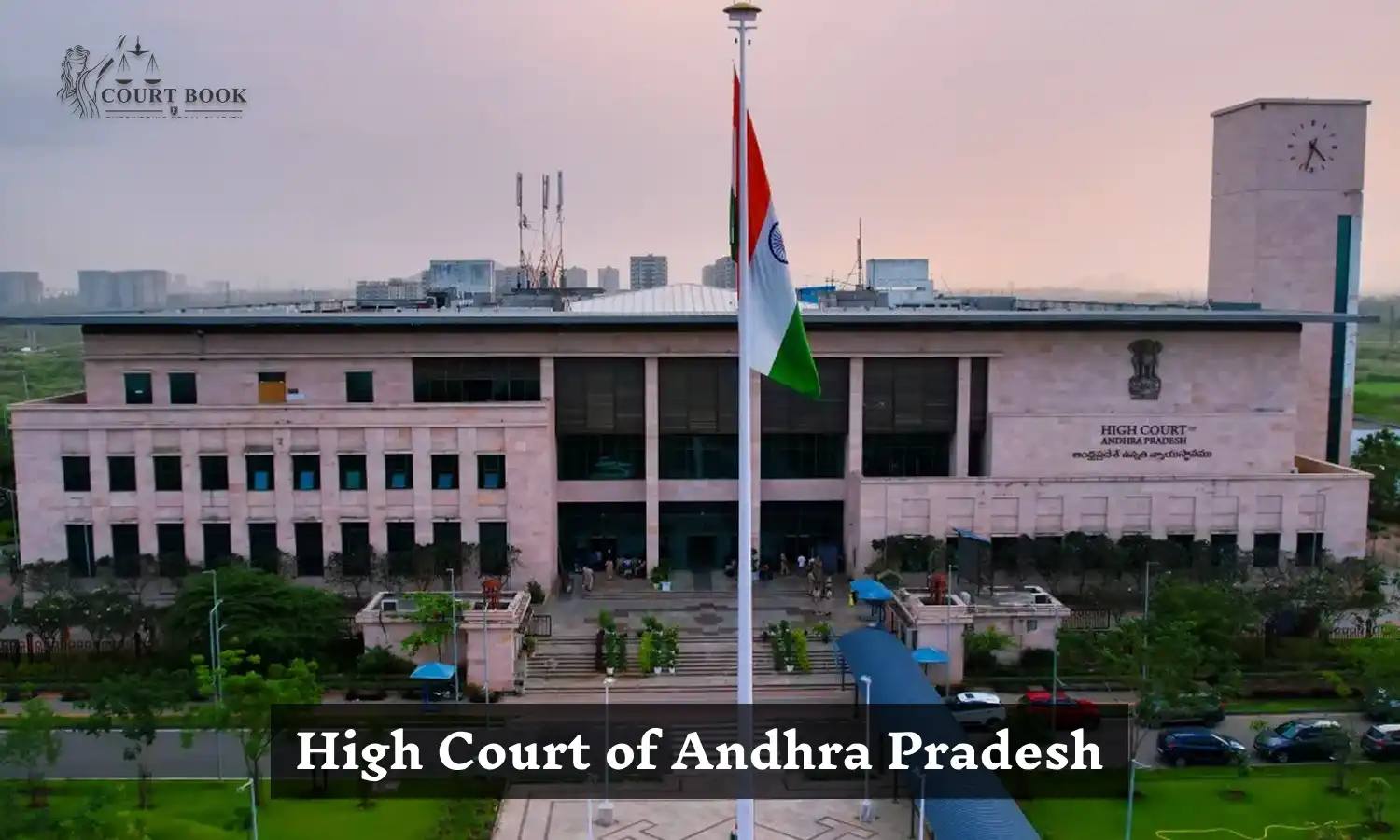
The High Court of Andhra Pradesh on Tuesday dismissed a Public Interest Litigation (PIL) that questioned the eligibility conditions in multiple high-value power infrastructure tenders issued by the state transmission utility.
A Division Bench comprising Chief Justice Dhiraj Singh Thakur and Justice Ravi Cheemalapati held that the petitioner, a practicing advocate, failed to establish arbitrariness or mala fide intent in the tender process.
Read also:-Bombay HC Disposes Unmarried Woman’s Abortion Plea, Cites Supreme Court Ruling on MTP Rights
Background of the Case
The PIL was filed by advocate Kanithi Deepak challenging four tender notifications issued by the Transmission Corporation of Andhra Pradesh (AP TRANSCO). The tenders related to large-scale underground cable laying and substation works in Guntur district, including diversion and installation of 220 KV underground cables.
The petitioner argued that the technical qualification criteria were structured in a way that effectively excluded most competitors and favoured a specific manufacturer. He contended that certain clauses required bidders to have executed infrastructure projects worth more than ₹300 crore and to have completed 100% of 220 KV underground cable work of similar scale within the last decade.
He further alleged that these conditions were “impractical” and “designed to eliminate competition,” claiming that only one manufacturer - Universal Cables Limited - would qualify under the combined criteria.
According to the petition, the structuring of the tender led to inflated quotes, and the eventual sub-contracting of the work to the manufacturer raised “serious concerns of arbitrariness, collusion and possible misappropriation of public funds.”
Read also:-Calcutta High Court Refuses to Quash Forgery Case Linked to 1963 Land Deed, Orders Police Prob
The petitioner relied on Supreme Court rulings including Tata Cellular and Vinishma Technologies Pvt Ltd to argue that judicial review was warranted where tender conditions violate fairness and transparency.
State’s Response
Appearing for the State, the Advocate General opposed the petition, arguing that courts must exercise restraint in tender matters.
He submitted that judicial review is meant to examine whether a decision is lawful, not whether it is commercially sound. “Evaluating tenders and awarding contracts are essentially commercial functions,” he argued, adding that courts do not have the technical expertise to second-guess such decisions.
The State also pointed out that the tenders were issued in 2024, while the PIL was filed only in December 2025, after contracts had already been awarded and work had commenced.
The Advocate General relied on the Supreme Court’s ruling in M/s N.G. Projects Limited to contend that courts should avoid interfering in contractual matters unless there is clear proof of mala fide intent.
Read also:-Bombay High Court Flags Flawed Tree-Felling Notices, Closes Pune Coconut Trees Case
Court’s Observations
Justice Ravi Cheemalapati, writing for the Bench, said that while the principles laid down by the Supreme Court on judicial review in tender matters are well settled, the burden to prove arbitrariness or bad faith lies heavily on the petitioner.
“Unless there is total arbitrariness or that the tender has been granted in a mala fide manner, the Court should refrain from interfering,” the Bench observed.
The judges noted that the petitioner had not specifically pleaded or proved mala fides with credible material. Citing the Supreme Court’s decision in E.P. Royappa, the Court reiterated that allegations of bad faith require a high degree of proof.
The Bench also found it significant that none of the participating bidders had challenged the tender conditions. “The petitioner, who did not even participate in the tender process, has questioned the tender conditions, that too without there being any basis,” the Court remarked.
It further held that the PIL did not espouse the cause of marginalised or disadvantaged groups but sought to represent the interests of contractors and firms who were capable of approaching the court themselves.
Referring to the Supreme Court’s caution in Jaipur Shahir Hindu Vikas Samithi, the Bench said that public interest litigation must not be misused for private or political motives.
“The Courts have to be very cautious and careful while entertaining public interest litigation,” the judgment noted, adding that misuse defeats the very purpose for which PIL jurisdiction was created.
Read also:- Kerala High Court Orders Probe Into ₹14 Lakh Sabarimala Staff Transfers During Mandala
Decision
Concluding that the petitioner had failed to demonstrate arbitrariness, mala fides, or irrationality in the tender process, the Bench held the PIL to be misconceived.
On February 4, 2026, the High Court of Andhra Pradesh dismissed the Public Interest Litigation at the admission stage itself. No costs were imposed. Pending miscellaneous applications, if any, were also closed.
Case Title: Kanithi Deepak v. State of Andhra Pradesh & Others
Case No.: WP (PIL) No. 239 of 2025
Decision Date: 04 February 2026


