

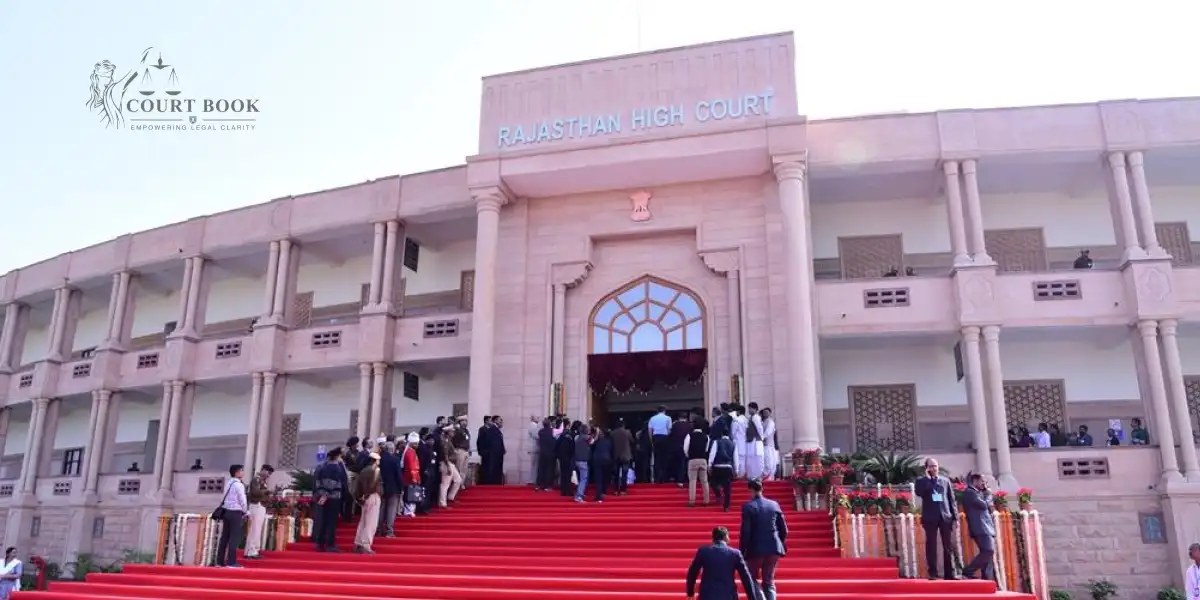
In a detailed order that revisits how courts must handle ex parte proceedings, the Rajasthan High Court has set aside a civil court decree passed more than a decade ago, holding that the defendants were not properly served before the case was decided against them.
Justice Anoop Kumar Dhand allowed a civil miscellaneous appeal filed by three brothers from Jaipur district, reopening a long-pending dispute over the cancellation of a registered sale deed.
Background of the Case
The dispute traces back to two registered sale deeds executed on the same day. After the death of the original purchaser, separate suits were filed seeking cancellation of the deeds. One suit went before a Civil Judge due to lower valuation, while the other - involving a slightly higher value - was filed before the Additional District Judge in Jaipur.
In the latter case, notices were reportedly issued to the defendants in March 2008. Within days, the process server submitted a report stating that the defendants had refused to accept the summons. Based on this report, the trial court proceeded ex parte and decreed the suit on 23 December 2011.
Years later, the defendants approached the court under Order 9 Rule 13 of the Civil Procedure Code, seeking to set aside the ex parte decree. That application was dismissed in April 2019, leading to the present appeal before the High Court.
What the Appellants Argued
Counsel for the appellants contended that the defendants had never refused service and were unaware of the proceedings. He pointed out that the refusal report was supported by two witnesses who were not residents of the defendants’ village.
“The witnesses named in the service report were from a different village altogether. Their presence at the defendants’ house was doubtful,” the counsel argued.
It was also submitted that neither the process server nor the witnesses were examined before the trial court accepted the refusal report and proceeded ex parte - a step mandatory under procedural law.
Another concern raised was that the ex parte decree relied heavily on the written statement of an attesting witness to the sale deed, who was neither a necessary nor a proper party to the dispute.
Stand of the Respondents
The respondents opposed the appeal, maintaining that the defendants were aware of the case and deliberately chose not to appear. They argued that the trial court had acted correctly and that there was no legal requirement to examine the process server unless the defendants specifically sought it.
They also questioned the explanation offered for the delay in challenging the decree.
Read also:-CLAT 2026 Answer Key Controversy Lands in Allahabad HC, Merit List to Be Revised
Court’s Observations
After examining the record, the High Court took a critical view of how service of summons was handled.
The bench noted that when a court relies on a refusal report, it is duty-bound to verify it. Referring to Order V Rules 17 and 19 of the Civil Procedure Code, the judge observed that acceptance of such a report “is a serious and solemn act and not merely an empty formality.”
Justice Dhand remarked that the very purpose of issuing summons is to ensure that a party is aware of the proceedings and gets a fair chance to contest the case. Deciding a matter behind a party’s back, without strict compliance with procedural safeguards, defeats principles of natural justice.
“The trial court neither examined the process server nor the witnesses. In such circumstances, proceeding ex parte was unsafe,” the court observed.
The High Court also accepted the defendants’ explanation for the delay in filing the application, holding that limitation rules should not be used to defeat substantive justice.
Read also:-No Application Needed for Citizenship by Birth, Says Delhi High Court While Ordering Passport Issue
Decision of the Court
Allowing the appeal, the Rajasthan High Court quashed both the 2019 order rejecting the defendants’ application and the original ex parte judgment and decree dated 23 December 2011.
The court restored the suit to the trial court for fresh adjudication after taking the defendants’ written statements on record. The defendants were directed to deposit ₹25,000 as costs and undertake specific conditions imposed by the court before the matter proceeds further.
Case Title: Devkrishna & Ors. v. Kaluram & Ors.
Case No.: S.B. Civil Miscellaneous Appeal No. 5868/2019
Decision Date: 19 January 2026


