

The Rajasthan High Court has granted divorce to a woman after setting aside a Family Court judgment that had rejected her plea for dissolution of marriage under Section 13 of the Hindu Marriage Act. The Court also made strong observations against the customary “atta-satta” marriage system, especially where minors are involved.
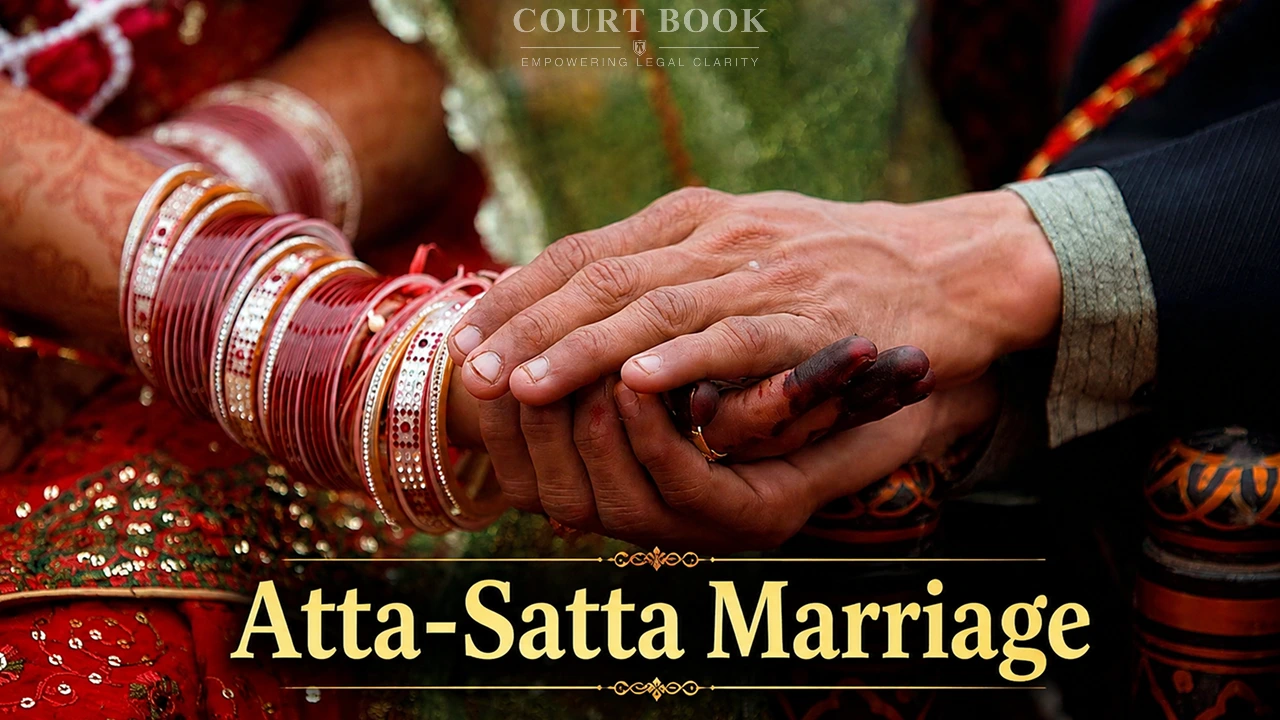
For context, “Atta-Satta” is a customary reciprocal marriage system followed in some communities, where one family exchanges a daughter in marriage with another family in return for a bride for their own son.
A Division Bench of Justice Arun Monga and Justice Sunil Beniwal held that the Family Court wrongly treated a dispute arising from the “atta-satta” arrangement as the sole reason behind the marital breakdown, while failing to properly examine allegations of cruelty and emotional trauma suffered by the wife.
The parties married in March 2016 in Bikaner. The wife alleged that she was subjected to harassment, dowry demands, physical assault and denial of her stridhan. She further claimed that she was thrown out of her matrimonial home along with her daughter in 2020. An FIR was later registered under Sections 498-A, 406, 323 and 34 IPC against the husband and his father.
The husband denied the allegations and argued that the dispute arose because his sister, who had been married to the wife’s brother under the “atta-satta” custom, refused to continue that marriage after attaining majority.
The Family Court dismissed the divorce petition, holding that the wife had voluntarily deserted the matrimonial home due to the dispute connected with the reciprocal marriage arrangement.
Before the High Court, the wife argued that the Family Court ignored evidence showing continuous cruelty and wrongly treated her legal proceedings as pressure tactics. The Bench examined whether the dispute connected to “atta-satta” could legally overshadow allegations of mental cruelty within the marriage itself.
The Court observed that many women continue living in difficult marriages because of economic and social compulsions, and such cohabitation cannot automatically negate cruelty.
The High Court sharply criticized the Family Court’s reasoning and held that it had conflated two separate issues - the customary “atta-satta” arrangement and the independent legal test for matrimonial cruelty.
The Bench stated:
“Endurance is often mistaken for consent and/or condonation.”
The Court noted that the parties had remained separated for nearly five years and mediation efforts had failed, indicating that reconciliation was no longer possible.
In significant remarks against the practice of “atta-satta,” the Court said such arrangements involving minors reduce children, particularly girls, into “bargaining instruments between families.”
The Bench observed that customs cannot override statutory protections under the Prohibition of Child Marriage Act, 2006 and constitutional principles of dignity and consent.
Allowing the appeal, the Rajasthan High Court set aside the Family Court judgment dated September 24, 2025, and dissolved the marriage under Section 13 of the Hindu Marriage Act. The Court clarified that its observations would not affect the pending criminal or custody proceedings between the parties.
Case Details
Case Title: Kiran Bishnoi v. Sunil Kumar
Case Number: D.B. Civil Miscellaneous Appeal No. 3506/2025
Judge: Justice Arun Monga and Justice Sunil Beniwal
Decision Date: 10 April 2026
Download Judgment

