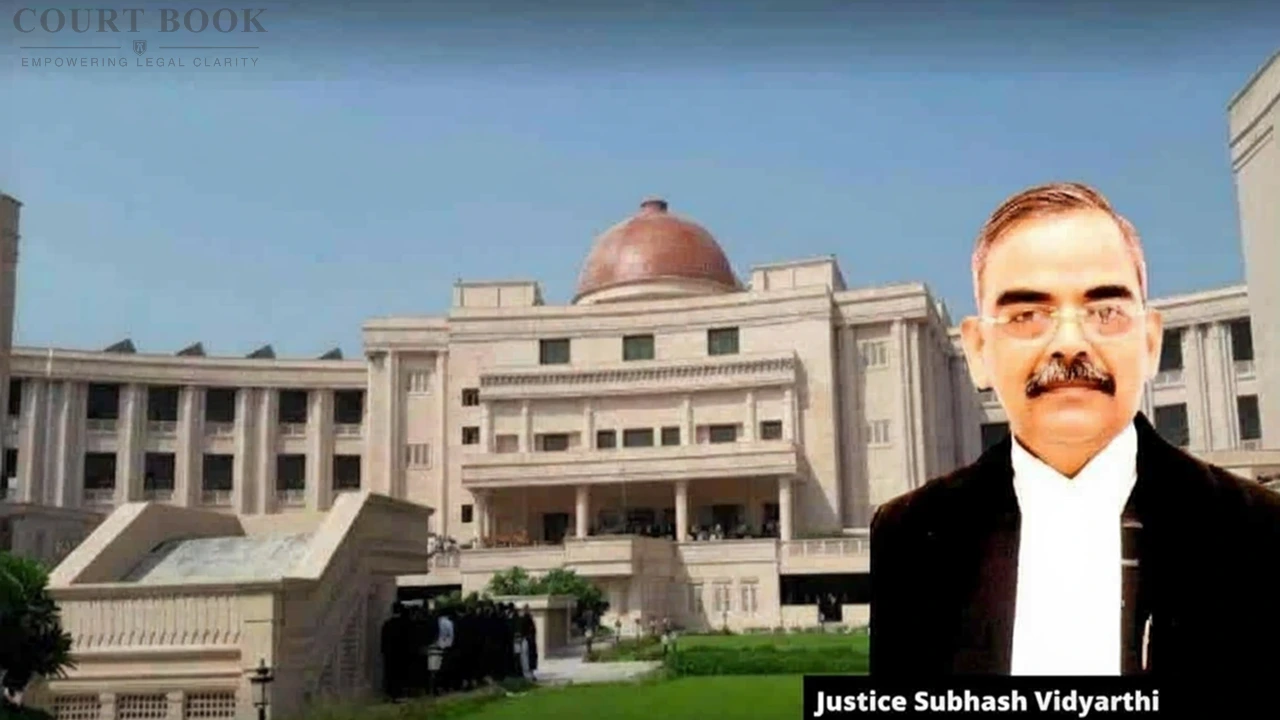
The Allahabad High Court has set aside the conviction of Bhaiya Lal Raidas under Section 366 of the Indian Penal Code, holding that the prosecution failed to establish that the woman involved was a minor when she left with him.
Justice Subhash Vidyarthi observed that the trial court had gone beyond the medical evidence by assessing age from physical features such as teeth and the presence of axillary and pubic hair. The High Court also found serious gaps concerning the alleged school marks-sheet relied upon to establish her date of birth.
Background of the Case
Raidas had challenged the February 8, 2013 judgment of the Additional Sessions Judge, Unnao, which convicted him under Section 366 IPC and sentenced him to seven years’ rigorous imprisonment along with a ₹10,000 fine. He had, however, been acquitted of charges under Sections 363 and 376 IPC.
The prosecution case arose from a complaint alleging that Raidas had enticed away the complainant’s daughter. The medical examination later recorded no injuries on her body, while the radiological examination assessed her age at about 18 years. The ultrasound report recorded a pregnancy of about 20 weeks.
In her statement before the Magistrate under Section 164 CrPC, the woman stated that she and Raidas were in a friendly relationship, wanted to marry and had gone to Ludhiana. She said they later married in Hardoi and lived together in Ludhiana.
High Court Examines Age Evidence
The High Court found that the complainant, who was her father, had not mentioned her age in the FIR and admitted during evidence that he did not know her age or date of birth.
Although the woman stated that her Class VIII marks-sheet showed her date of birth as September 25, 1993, the High Court found that neither the original marks-sheet nor its copy was available on the trial court record. It had no exhibit number and was not mentioned in the record index.
The Court therefore held that the trial court could not rely upon a document that was not actually part of the record. It further noted that the marks-sheet had not been properly proved through a school official.
“Trial Court Ought Not to Have Acted as a Super-Specialist”
The High Court disagreed with the trial court’s approach to the physical examination. The trial court had relied on the presence of axillary and pubic hair and the condition of the teeth to assess the woman’s age between 14 and 17 years.
Justice Vidyarthi held that merely recording the presence of such hair did not establish that it was not fully developed. He also said that the emergence of third molars was not essential for determining whether a person had crossed 18.
“When the doctor who had examined the prosecutrix and the radiologist stated her age to be about 18 years, the trial court ought not to have acted as a super-specialist so as to superimpose its own expert opinion over the opinion of the doctor and the radiologist,” the Court observed.
Medical Opinion and Benefit of Doubt
The High Court relied on Supreme Court decisions recognising that radiological age assessment carries a margin of error. Referring to Jaya Mala v. Government of J&K and subsequent decisions, the Court noted that an error margin of two years on either side may be considered.
The Court consequently held that the medical opinion placing her age at about 18 years did not establish that she was below 18 on the date of the incident.
Court Also Examines Her Statements
The High Court further considered inconsistencies between her earlier statements and her testimony during trial. In her statements to the investigating officer and Magistrate, she had said that she went with Raidas voluntarily and wanted to remain with him. During trial, however, she alleged that she had been made unconscious before being taken away.
The Court noted that although a conviction may rest on the testimony of a prosecutrix alone, such testimony must inspire confidence and meet the standard of a highly reliable witness. It found that the trial court had not properly considered the differences in her versions or the circumstances surrounding her stay with Raidas in Ludhiana.
Decision
Allowing the appeal, the Allahabad High Court set aside the February 8, 2013 conviction and sentence under Section 366 IPC and acquitted Bhaiya Lal Raidas of the charge.
The Court also directed him to furnish a personal bond and two sureties under Section 437-A CrPC and discharged the sureties furnished earlier.
Case Details
Case Title: Bhaiya Lal Raidas v. State of U.P.
Case Number: Criminal Appeal No. 301 of 2013
Judge: Justice Subhash Vidyarthi
Decision Date: August 31, 2026