

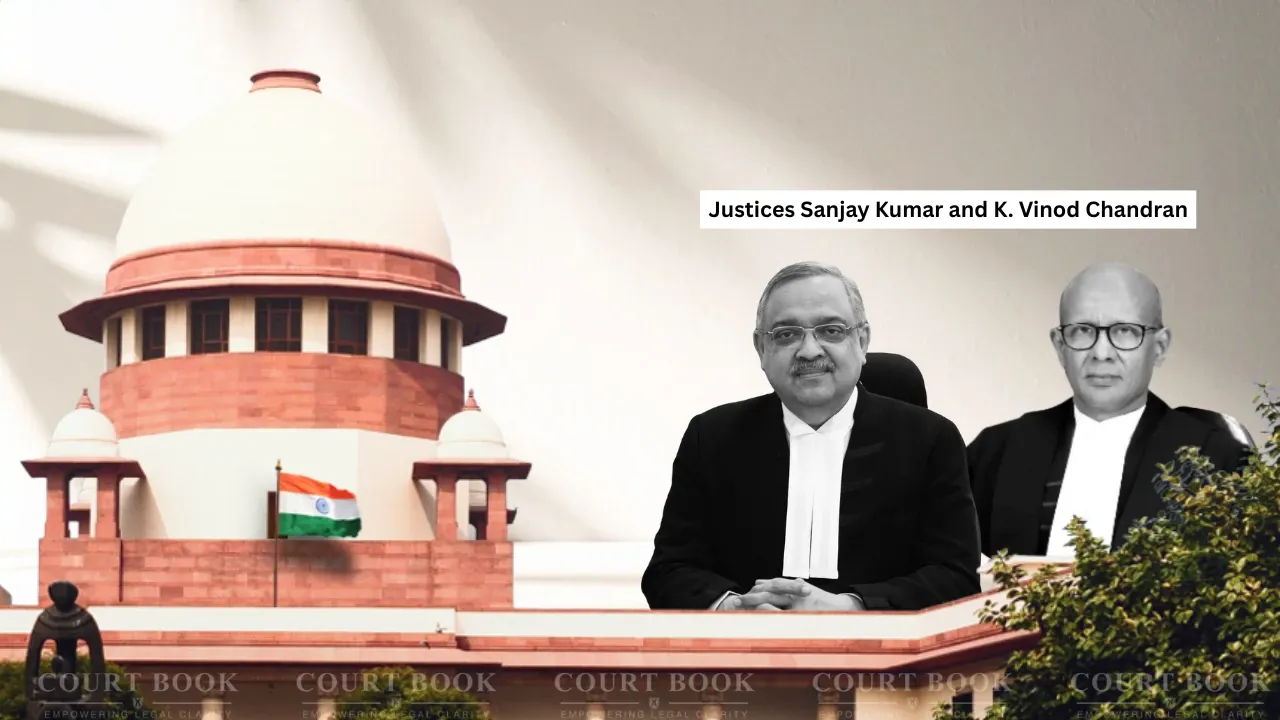
The Supreme Court has acquitted a man convicted under Section 498A of the Indian Penal Code in connection with the suicide of his wife, observing that the prosecution relied mainly on “general and omnibus allegations” without specific evidence of cruelty or unlawful demands.
A Bench of Justice Sanjay Kumar and Justice K. Vinod Chandran held that the evidence placed before the courts was insufficient to establish the offence of cruelty under Section 498A IPC.
Background Of The Case
The case arose from the death of a married woman in Odisha, who died after consuming pesticide. The husband and his family members were accused of subjecting her to harassment and torture linked to alleged dowry demands.
The trial court had acquitted the accused of the offence under Section 304B IPC relating to dowry death after finding no reliable proof of dowry demand. However, the court still convicted them under Section 498A IPC and Section 4 of the Dowry Prohibition Act on the basis of oral testimony and letters allegedly written by the deceased.
Later, the High Court upheld the conviction under Section 498A IPC, though it reduced the sentence.
The husband then approached the Supreme Court challenging the conviction.
The Supreme Court examined the testimony of family members and the letters relied upon by the prosecution. The Bench noted that the allegations regarding dowry demand and harassment were vague and lacked specific details.
“The testimony regarding demand of dowry was general and omnibus,” the Court observed while discussing the statements of prosecution witnesses.
The Court also pointed out inconsistencies regarding mediation meetings allegedly held between the two families and noted that even independent witnesses did not fully support the prosecution’s version.
On the letters allegedly written by the deceased, the Bench said the prosecution failed to properly establish their authenticity. The investigating officer had not taken steps to verify the handwriting, and the contents themselves did not clearly disclose cruelty or unlawful demands.
The Court remarked that while Section 498A does not require proof of dowry demand in every case, there must still be reliable evidence of mental or physical cruelty.
“We are conscious of the fact that to attract Section 498A, there need not be a demand of dowry,” the Bench stated, adding that the evidence in the present case still fell short of proving unlawful conduct by the accused.
Allowing the appeal, the Supreme Court set aside the judgments of both the trial court and the High Court.
The Bench held that the prosecution evidence did not satisfactorily establish the offence under Section 498A IPC and ordered the acquittal of the appellant.
The Court further directed that the accused be released immediately if not required in any other case.
Case Details
Case Title: Gandadhipa Sahu v. State of Odisha & Ors.
Case Number: Criminal Appeal arising out of SLP (Crl.) No. 21118 of 2025
Judges: Justice Sanjay Kumar and Justice K. Vinod Chandran
Decision Date: May 26, 2026


