

The Supreme Court on Friday set aside the conviction of two men accused in a 2012 murder case from West Bengal, holding that the prosecution failed to establish a complete chain of circumstances linking them to the crime. The Court said the evidence relied upon by the trial court and the High Court was weak, inconsistent, and insufficient to sustain a conviction in a case based entirely on circumstantial evidence.
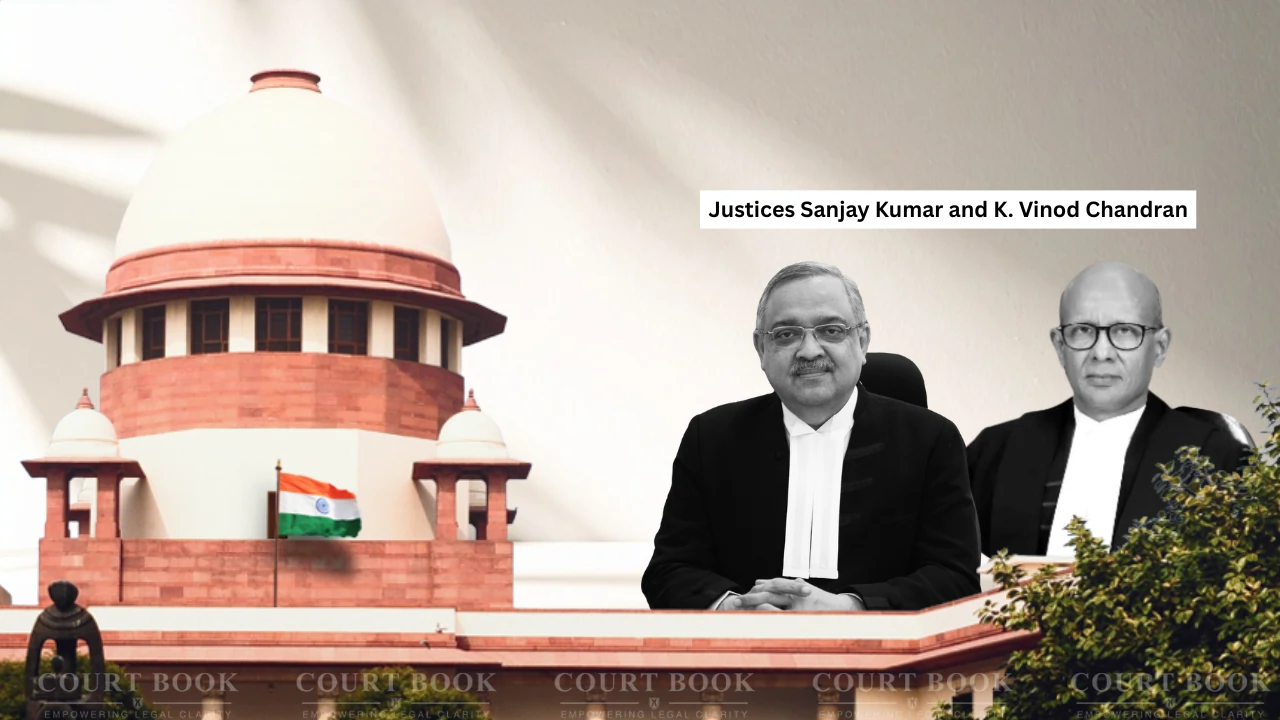
A Bench of Justice K. Vinod Chandran and Justice Sanjay Kumar delivered the judgment in appeals filed by two of the three convicted accused.
Background of the Case
According to the prosecution, the deceased had gone out with the three accused on the evening of October 30, 2012. The next morning, his body was found in a field. The prosecution case rested on several circumstances including the “last seen together” theory, alleged extra-judicial confessions, recovery of weapons, seizure of a motorcycle, and witness testimonies.
Both the trial court and the Calcutta High Court had earlier convicted the accused for murder after concluding that the chain of circumstances was complete.
Court’s Observation on “Last Seen Together” Theory
The Supreme Court closely examined the evidence of witnesses who claimed to have seen the deceased with the accused shortly before the death.
The Bench noted that the prosecution failed to prove the exact time of death with certainty. Referring to the postmortem report, the Court observed that the medical evidence only suggested that “24 hours had not passed” since death at the time of examination, leaving a large possible time gap.
“The time frame being quite large to term death as proximate, there can be no conviction based on the last seen together theory in the present case,” the Bench observed.
The Court also expressed doubts about the testimony of a witness who claimed to have seen the accused and deceased drinking together in a public area. The Bench said her cross-examination raised “grave suspicion” about the reliability of her version.
Extra-Judicial Confession Found Unreliable
The Court then examined the alleged extra-judicial confession made by one accused before villagers.
It found major inconsistencies in the statements of prosecution witnesses regarding what was actually confessed. While one witness claimed the accused admitted participation in the murder, others stated that he blamed the co-accused and attempted to distance himself from the offence.
The Bench observed that such statements were unreliable, particularly because the accused had been detained by a mob at the time and were allegedly under pressure.
“The extra-judicial confession by its very nature being a weak piece of evidence has not at all been proved in the present case,” the Court said.
Recovery of Weapons and Motorcycle Questioned
The Court also rejected the prosecution’s reliance on the alleged recovery of weapons and a motorcycle.
It noted that the recoveries were made from an open field accessible to anyone and that the prosecution failed to establish concealment, a necessary requirement under Section 27 of the Evidence Act.
The Bench further pointed out that the alleged weapons were not properly linked to the injuries found during the postmortem examination.
On the motorcycle recovery, the Court observed that the vehicle was never produced before the court and even its ownership was not properly proved.
Supreme Court’s Decision
After examining all circumstances, the Supreme Court concluded that none of the prosecution evidence formed a complete and reliable chain pointing only towards the guilt of the accused.
“In the totality of the circumstances… none of those projected having qualified as incriminating,” the Court said while reversing the conviction.
The Court allowed the appeals and directed the immediate release of the two appellants unless required in any other case.
The Bench also directed legal aid authorities to assist the third accused, who had not filed an appeal, in approaching the Supreme Court within two months.
Case Details:
Case Title: Papan Sarkar @ Pranab v. State of West Bengal
Case Number: Criminal Appeal No. 2507 of 2026 with Criminal Appeal No. 2508 of 2026
Judges: Justice K. Vinod Chandran and Justice Sanjay Kumar
Decision Date: May 22, 2026
Download Judgment

