

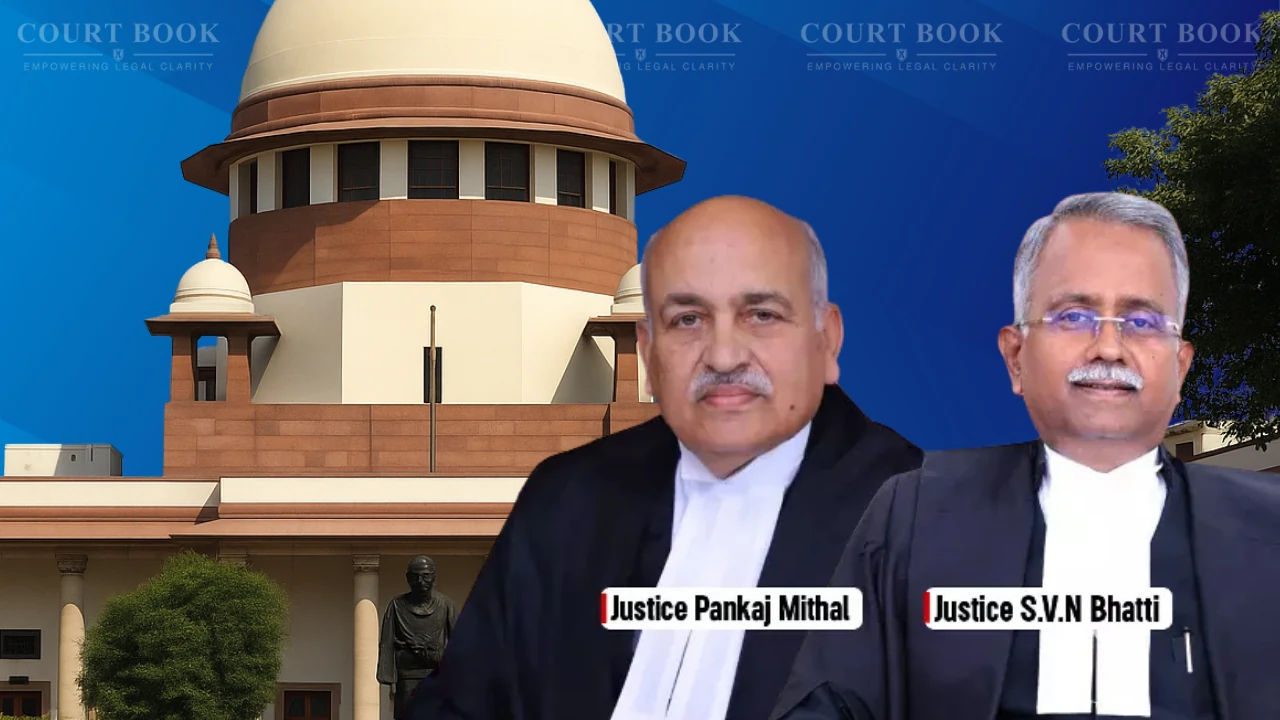
The Supreme Court has refused to grant blanket regularisation to thousands of para teachers working under the Sarva Shiksha Abhiyan (SSA) in Jharkhand, holding that courts cannot direct automatic absorption into government service contrary to statutory recruitment rules. At the same time, the Court directed the Jharkhand government to conduct regular recruitment drives every academic year for posts specifically reserved for para teachers.
A bench led by Justice S.V.N. Bhatti and Justice Pankaj Mithal passed the judgment while deciding a large batch of appeals arising from petitions filed by para teachers seeking permanent appointment as Assistant Teachers or Sahayak Acharyas in government schools.
Background of the Case
The lead matter, Sunil Kumar Yadav and Others v. State of Jharkhand and Others, was filed by para teachers engaged under the SSA scheme across Jharkhand. The teachers argued that many of them had been serving for over a decade, possessed qualifications such as B.Ed. degrees, and had also cleared the Teacher Eligibility Test (TET).
They told the Court that despite severe teacher shortages in the state, they continued to receive a fixed honorarium ranging between ₹7,400 and ₹8,400 without regular service benefits. The petitioners also claimed that they performed duties similar to regular Assistant Teachers and worked the same school hours.
Read also:- Delhi High Court Issues Notice to NDTV in Anil Ambani’s ₹2 Crore Defamation Suit
The Jharkhand High Court had earlier dismissed their plea for regularisation in December 2022, leading to the appeals before the Supreme Court.
The State of Jharkhand opposed the demand for direct regularisation. It argued that para teachers were appointed on a contractual basis under a centrally sponsored scheme and not against permanent sanctioned government posts.
The State further submitted that recruitment rules already provided a 50 per cent reservation for eligible para teachers in appointments to regular teaching posts. According to the government, allowing direct absorption outside this framework would violate Articles 14 and 16 of the Constitution by affecting opportunities available to open-market candidates.
During the hearing, the State informed the Court that thousands of para teachers had already secured appointments through the existing recruitment process.
The Supreme Court examined several earlier judgments dealing with regularisation and public employment, including the Constitution Bench ruling in State of Karnataka v. Umadevi.
The bench observed that the main issue was whether courts could order regularisation in a manner contrary to statutory recruitment rules framed under Article 309 of the Constitution.
“The prayer for regularisation is a prayer for direct absorption from a scheme post of para-teachers to a State cadre post,” the Court noted.
The judges said such a direction would effectively create a new method of recruitment not recognised by law. The Court also observed that para teachers appointed under SSA could not automatically claim parity with regular Assistant Teachers merely because some duties overlapped.
However, the bench acknowledged the long years of service rendered by para teachers and stressed the importance of employment security in the education sector.
In a significant observation, the Court said,
“The sense of security of employment is a sine qua non for enhancing efficiency in any service, and education is no different.”
The Court further remarked that expecting para teachers to secure the future of children without stability in their own employment was “fallacious.”
While refusing blanket regularisation, the Supreme Court moulded the relief in favour of para teachers by directing the Jharkhand government to operationalise and periodically implement its own statutory recruitment framework.
The Court directed the State to issue notifications exclusively for para teachers against 50 per cent of earmarked vacancies for Assistant Teachers and Sahayak Acharyas under the 2012 and 2022 Rules.
The bench also ordered that this recruitment exercise should be conducted every academic year to ensure para teachers receive timely consideration for permanent appointments.
Disposing of the appeals, the Supreme Court upheld the Jharkhand High Court’s refusal to grant automatic regularisation to para teachers. However, it directed the State government to regularly fill reserved teaching posts meant for para teachers through annual recruitment exercises in accordance with statutory rules.
Case Details:
Case Title: Sunil Kumar Yadav and Others v. State of Jharkhand and Others
Case Number: Special Leave Petition (Civil) No. 4881 of 2023 and connected matters
Judge: Justice S.V.N. Bhatti and Justice Pankaj Mithal
Decision Date: May 7, 2026
Download Judgment

