

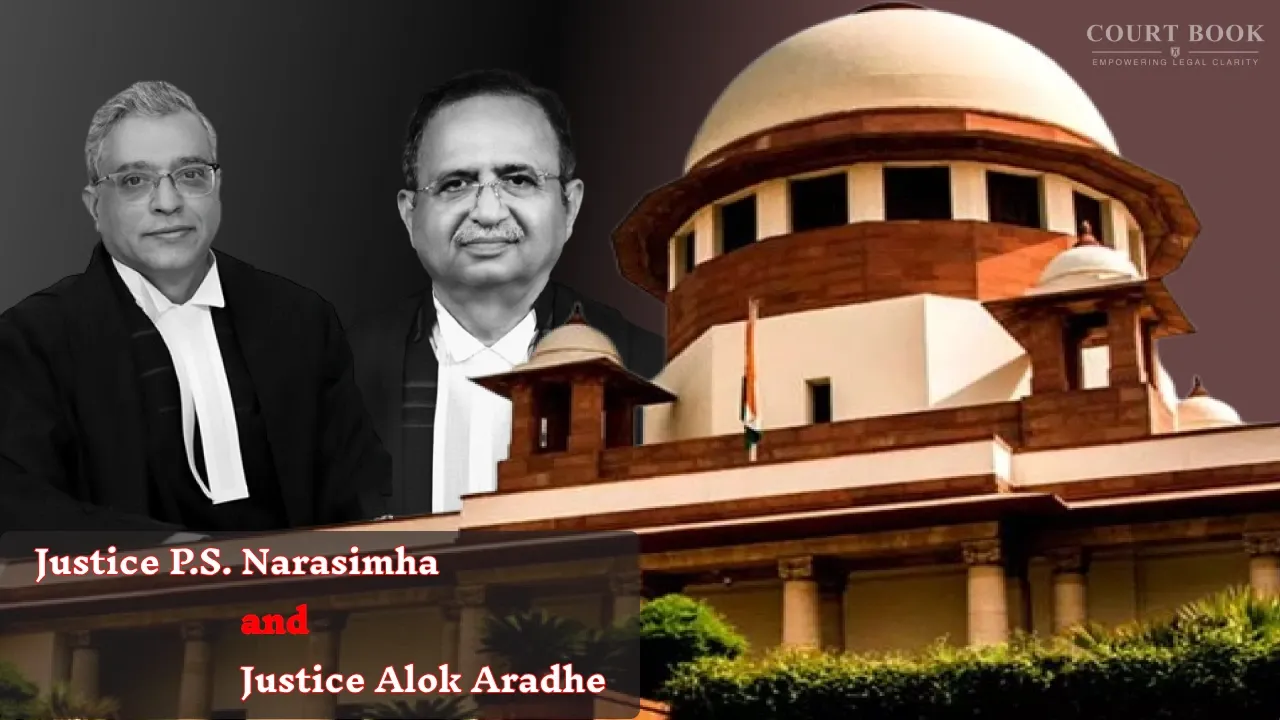
The Supreme Court has partly allowed appeals filed by the Gujarat Water Supply and Sewerage Board in a long-running arbitration dispute with Saryu Plastics Pvt. Ltd., holding that a Commercial Court had exceeded its powers by replacing “simple interest” with “compound interest” in an arbitral award.
A Bench of Justice P. S. Narasimha and Justice Alok Aradhe clarified that while the arbitral award itself remained valid, the later modification substantially increasing the Board’s financial liability could not be sustained in law.
Background of the Case
The dispute arose from contracts awarded by the Gujarat Water Supply and Sewerage Board to Saryu Plastics Pvt. Ltd. between 1998 and 2002 for the supply of PVC pipes across Gujarat.
An internal audit later pointed to alleged excess payments made to suppliers, following which the company was blacklisted by the Board in 2003. Years later, both sides agreed to resolve the dispute through arbitration and appointed a sole arbitrator in April 2012.
The arbitration proceedings continued for more than three years. During this period, the arbitrator repeatedly recorded delays, non-appearance, and incomplete replies from the Board.
In October 2015, the arbitrator passed an award partly in favour of Saryu Plastics, granting around Rs.1.01 crore along with interest.
Dispute Over Arbitrator’s Mandate
Before the Supreme Court, the Board argued that the arbitrator’s mandate had expired before the award was delivered. It claimed that no valid extension had been granted beyond September 2015.
The company, however, contended that the Board had continued participating in the proceedings and never objected to the arbitrator continuing with the matter until after the award was passed.
The Bench agreed with the company’s stand.
“The Board participated in the proceeding before the Arbitrator and had acquiesced with the alleged invalidity,” the Court observed while holding that the Board could not challenge the award after remaining silent during the proceedings.
The Court also noted that at the relevant time there was no statutory requirement mandating that extensions of an arbitrator’s mandate must be formally recorded in writing.
Court Rejects Natural Justice Challenge
The Board further argued that it was denied a fair hearing during arbitration.
Rejecting this contention, the Supreme Court pointed to repeated opportunities given to the Board over the course of more than three years.
“The Board’s failure to effectively utilize these opportunities is not a deficiency attributable to the Arbitrator,” the Bench said.
The Court recorded that several hearings had been delayed because of the Board’s conduct, including repeated absences and delayed filings
Supreme Court on Simple vs Compound Interest
The most significant issue before the Court concerned interest calculations.
The original arbitral award granted simple interest for the pendente lite period and compound interest only after the award until payment. Later, the Commercial Court modified the award and extended compound interest even for the earlier period, dramatically increasing the Board’s liability from about Rs.30 crore to nearly Rs.145 crore.
The Supreme Court ruled that such a modification was beyond the powers available under Section 33 of the Arbitration and Conciliation Act.
“The substitution of ‘simple interest’ with ‘compound interest’… is not, by any stretch of legal reasoning, a correction of a computational, clerical, or typographical error,” the Bench held.
Decision
The Supreme Court ultimately upheld the validity of the arbitral proceedings and the award but set aside the Commercial Court’s order modifying the interest component.
The Court held that Saryu Plastics would be entitled only to simple interest at the rate of 21.675% for the pendente lite period.
Case Details
Case Title: Gujarat Water Supply and Sewerage Board v. Saryu Plastics Pvt. Ltd.
Case Number: Civil Appeal Nos. 769-770 of 2026
Judges: Justice Pamidighantam Sri Narasimha and Justice Alok Aradhe
Decision Date: May 26, 2026


