

The Supreme Court has held that a provision under the Haryana Civil Services (Compassionate Financial Assistance or Appointment) Rules, 2019, dealing with suspension of compassionate financial assistance during criminal proceedings, cannot be stretched to deny or delay a claim for compassionate appointment.
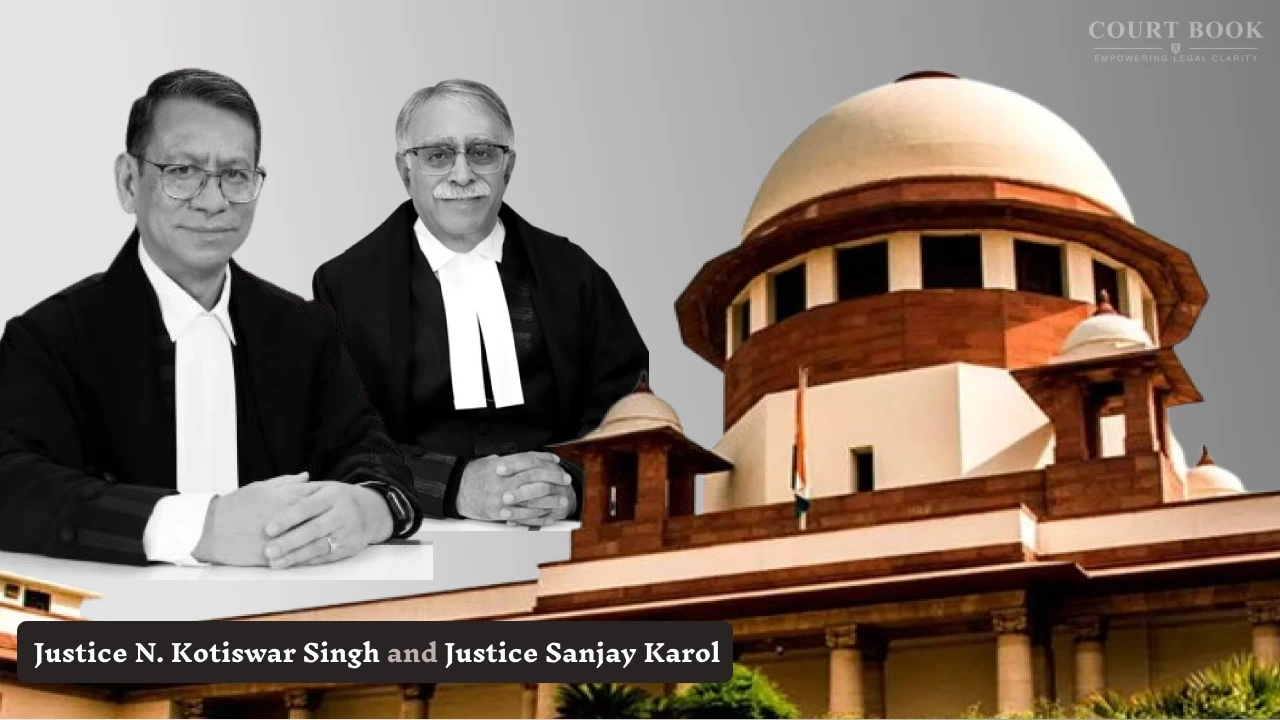
A Bench of Justice Sanjay Karol and Justice Nongmeikapam Kotiswar Singh allowed the appeal filed by Atul Chauhan and directed the Haryana authorities to consider his application for compassionate appointment within three months.
Background of the Case
The case arose after the death of the appellant’s father, a government school teacher in Haryana, who died in 2021. Following his death, the appellant’s mother was accused of conspiring in the alleged murder of her husband and faced criminal proceedings.
During the pendency of the case, the authorities declined to process the family’s claim for compassionate benefits. Although the mother was later acquitted by the trial court, an appeal challenging the acquittal remained pending before the Punjab and Haryana High Court.
Relying on Rule 23(1) of the 2019 Rules, the State kept the appellant’s request for compassionate appointment in abeyance. The Punjab and Haryana High Court upheld that decision, leading to the appeal before the Supreme Court.
Court’s Observation
The Supreme Court began by reiterating that compassionate appointment is not a vested right and can be granted only in accordance with the governing rules.
However, the Bench emphasized that authorities can refuse or defer such claims only when the rules specifically permit them to do so.
“The State cannot deny or defer a claim for compassionate appointment by invoking a provision which, on a proper reading of the rules, applies only to a different form of relief,” the Court observed.
Examining Rule 23(1), the Court noted that the provision repeatedly refers only to “compassionate financial assistance” and contains no reference to “compassionate appointment.”
According to the Bench, reading the rule as covering appointments would amount to rewriting the law rather than interpreting it.
“The language of Rule 23(1) is unambiguous and admits of only one reading,” the judgment stated. “Neither the body of the rule nor its heading makes any reference, whether express or implicit, to compassionate appointment.”
Distinction Between Financial Assistance and Appointment
The Court pointed out that the 2019 Rules consistently treat compassionate financial assistance and compassionate appointment as two separate forms of relief.
Separate definitions, eligibility provisions, procedures and authorities have been prescribed for each. Because the rule-making authority clearly distinguished between the two, the omission of compassionate appointment from Rule 23(1) had to be treated as deliberate.
The Bench held that a restriction applicable to financial assistance could not automatically be imported into the framework governing compassionate appointment.
Widow’s Claim Did Not Bar Son’s Application
The High Court had also concluded that the widow had the first claim to compassionate benefits and that the son’s request could be considered only after her claim was finally decided.
Disagreeing with this approach, the Supreme Court said the rule governing compassionate appointment does not create a strict hierarchy similar to the one applicable for financial assistance.
The Court noted that the appellant’s mother and brother had already filed affidavits relinquishing their claims in favour of the appellant. In those circumstances, there was no statutory bar preventing consideration of his application.
Court Upholds Validity of Rule 23(1)
While granting relief to the appellant, the Supreme Court nevertheless upheld the constitutional validity of Rule 23(1).
The Bench said the provision serves a legitimate purpose by temporarily suspending financial assistance where a claimant is facing allegations relating to the death of the government employee.
“A temporary, purpose-linked suspension of a statutory concession, confined to the duration of criminal proceedings, does not constitute invidious discrimination,” the Court observed.
At the same time, it clarified that a valid rule cannot be applied beyond the field for which it was enacted.
Decision
Allowing the appeal, the Supreme Court set aside the Punjab and Haryana High Court’s judgment dated 12 May 2025.
The Court directed the Haryana authorities to consider and decide Atul Chauhan’s claim for compassionate appointment on its own merits, in accordance with the 2019 Rules, within three months.
It further clarified that the direction does not create an automatic right to appointment and that the claim must still satisfy all eligibility requirements under the applicable rules.
Case Details
Case Title: Atul Chauhan v. State of Haryana & Ors.
Case Number: Civil Appeal arising out of SLP (C) No. 25892 of 2025
Judges: Justice Sanjay Karol and Justice Nongmeikapam Kotiswar Singh
Decision Date: 11 June 2026


