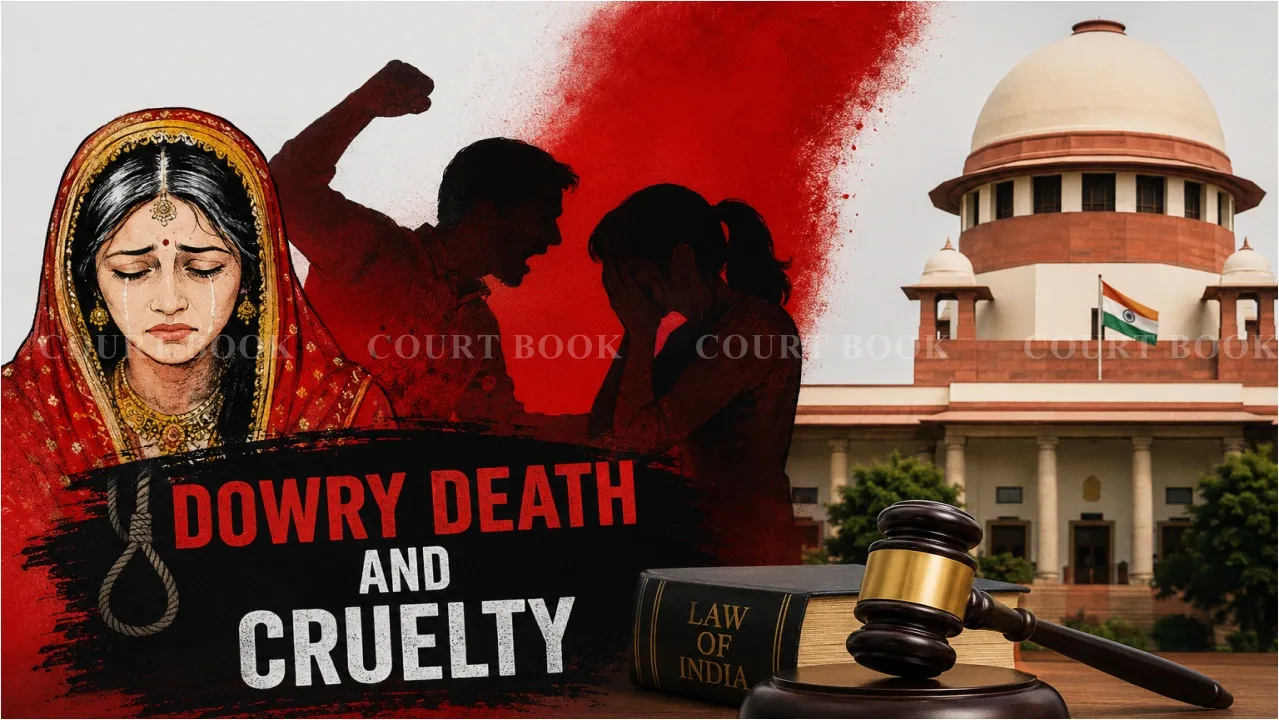
The Supreme Court has issued a detailed set of directions aimed at improving the investigation, trial and monitoring of cases involving dowry death and cruelty to married women. The directions apply to cases under Sections 304-B and 498-A of the Indian Penal Code (IPC), along with their corresponding provisions under the Bharatiya Nyaya Sanhita, 2023.
A Bench of Justice Sanjay Karol and Justice Augustine George Masih passed the order on August 20, 2026, in the pending proceedings arising from State of Uttar Pradesh v. Ajmal Beg. The Court's latest order follows affidavits and data submitted by several High Courts, States and Union Territories regarding compliance with its earlier directions.
Background of the Case
The proceedings trace back to a Supreme Court judgment dated December 15, 2025, in Criminal Appeals Nos. 132-133 of 2017. In that judgment, the Court allowed the appeals and restored the trial court's conviction under Sections 304-B and 498-A IPC.
While examining the case, the Court noted that the matter had originated in 2001 and had taken 24 years to reach its conclusion. It observed that similar delays could affect many other cases involving dowry-related offences. The Court therefore called for measures directed at both prevention and faster disposal of such proceedings.
The earlier directions included strengthening Dowry Prohibition Officers, training police and judicial officers, reviewing old pending cases and conducting awareness programmes at the grassroots level.
Supreme Court's Fresh Directions
After considering the compliance material placed before it, the Bench directed States and Union Territories to strengthen institutional support systems, including One Stop Centres, Family Counselling Centres, Women Help Desks, victim assistance mechanisms, helplines and online grievance redressal systems.
The Court also directed sustained awareness programmes concerning dowry, gender equality, constitutional values and women's rights, including through educational curricula, community outreach and legal literacy initiatives.
Time-Bound Approach to Pending Trials
A significant part of the order concerns the delay in criminal trials. Courts dealing with Sections 304-B and 498-A IPC, or Sections 80 and 85 of the BNS, have been asked, as far as practicable, to treat such matters as priority cases.
District courts have also been directed to identify cases pending for more than three years, particularly those stuck at the stage of framing of charges or recording evidence, and periodically review them.
The Court further said that trial courts should endeavour to secure the appearance of accused persons promptly after filing of the charge-sheet and consider framing charges preferably within 60 to 90 days. Evidence should thereafter commence within a reasonable period and, where possible, proceed continuously or on a day-to-day basis in accordance with law. The timelines were described as directory benchmarks, with exceptions permitted in circumstances such as multiple accused, supplementary charge-sheets, forensic delays or non-availability of an accused.
Court on Adjournments and Digital Monitoring
The Supreme Court directed courts to discourage unnecessary adjournments and record reasons in writing whenever an adjournment is granted. It also called for witness calendars after charges are framed to better organise the examination of material witnesses and reduce repeated delays.
High Courts were asked to make efforts to integrate stage-wise pendency tracking, digital dashboards, automated alerts for old cases and other monitoring systems into existing court technology infrastructure.
The Court also directed periodic training for judicial officers, police officials, prosecutors, Protection Officers and counsellors dealing with dowry-related cases. In appropriate matrimonial disputes not involving death, grievous physical violence or other serious offences, courts may explore mediation or counselling where legally permissible.
Decision
The Supreme Court directed all High Courts and States and Union Territories to file compliance and periodic reports on January 15, May 15 and September 15 until the pendency of cases under the relevant provisions is substantially reduced. The reports must include pendency and disposal figures, stage-wise case status, awareness initiatives, Dowry Prohibition Officer appointments and training measures.
The matters were directed to be listed along with the compliance-cum-periodic reports on October 15, 2026.
The Registry was directed to communicate a copy of the order to all concerned forthwith.
Case Details
Case Title: The State of Uttar Pradesh v. Ajmal Beg Etc.
Judges: Justice Sanjay Karol and Justice Augustine George Masih
Decision Date: August 20, 2026




-300x169.webp)