

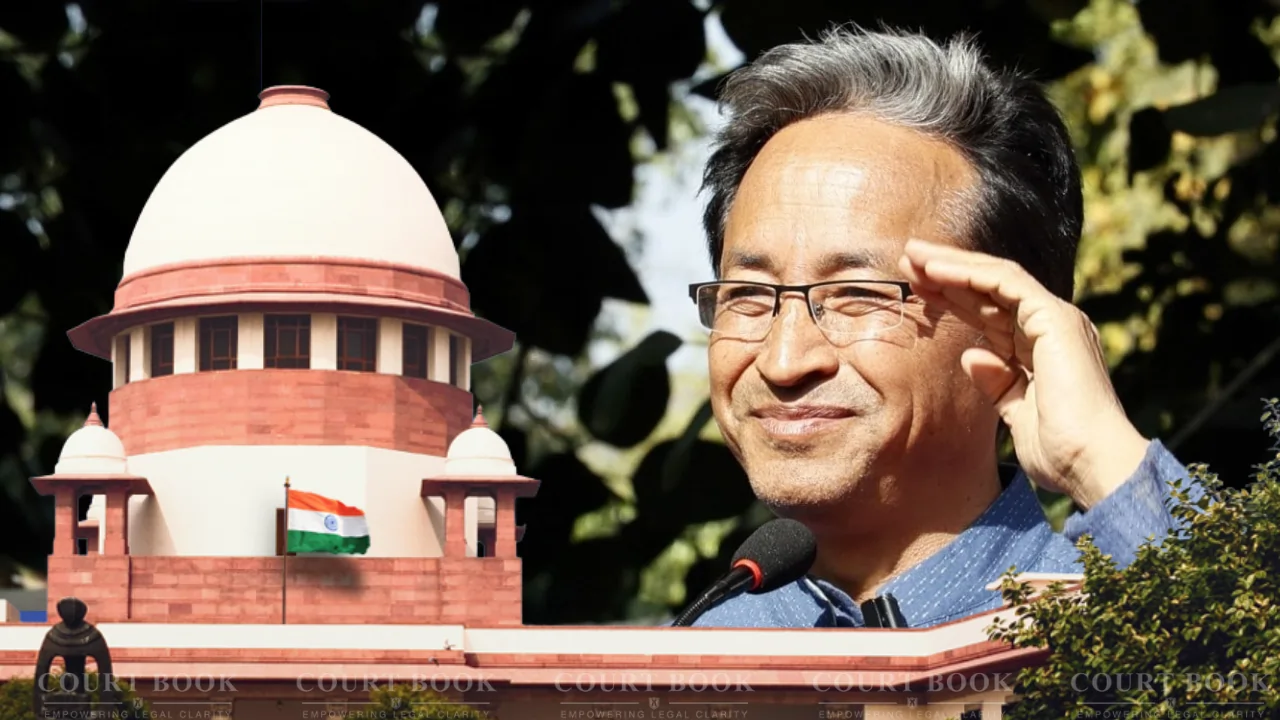
The Supreme Court of India on Monday directed that a pen drive handed over to Ladakh activist Sonam Wangchuk during his detention be produced before it in a sealed cover. The direction came after serious questions were raised about whether crucial video material relied upon for his detention under the National Security Act (NSA) was ever supplied to him.
A bench of Justices Aravind Kumar and P.B. Varale was hearing a habeas corpus petition filed by Wangchuk’s wife, Gitanjali Angmo, challenging the legality of his preventive detention.
Read also:-Gujarat HC Clears Way for Police Recruit, Says Minor, Quashed FIR Can’t Block Appointment
Background of the Case
Wangchuk was detained on September 26, 2025, by the Leh District Magistrate following violence during a Ladakh statehood protest. The detention order cited several speeches allegedly delivered by him, claiming they had the potential to disturb public order.
Senior Advocate Kapil Sibal, appearing for Angmo, argued that four videos mentioned in the detention order were not present in the pen drive given to Wangchuk on September 29 while he was in custody. According to Sibal, the absence of these videos meant that the detainee was not supplied with all the materials relied upon by the authorities - a serious procedural lapse in preventive detention cases.
“The very foundation of the detention order is missing,” Sibal submitted, adding that Wangchuk had made repeated representations seeking copies of the videos.
Court Orders Sealed Production of Pen Drive
Recording Sibal’s submission that the pen drive remained in Wangchuk’s custody, the Court directed the Jodhpur Jail Superintendent to collect the device, seal it in Wangchuk’s presence, and forward it to the Court in a sealed box.
The bench ordered that compliance be ensured by the Rajasthan Additional Advocate General. The matter has been listed for further hearing later this week.
Bench Questions Accuracy of Speech Transcripts
During the hearing, the judges turned their attention to the transcripts of Wangchuk’s speeches placed on record by the Union government.
Justice Kumar asked whether the translated versions relied upon by the Centre were reflected in the detention order itself. “If this is the basis on which you formed your opinion for detaining him, it should find a place,” he remarked.
Justice Varale went a step further, expressing concern over possible discrepancies between the original speeches and their translated transcripts.
“There should be at least the correct transcript of what he states,” the bench observed. “We expect the true translation. It should not be that what he said is for two or three minutes and your translation runs into seven or ten minutes. Then there is certainly a big variance.”
The Court has now called for the actual transcription of the speeches relied upon by the detaining authority.
Centre Defends the Detention
Appearing for the Union, law officers maintained that all safeguards under the NSA had been followed. They argued that preventive detention is not meant to punish but to prevent potential disruption of public order. The test, they said, is whether the acts complained of could disturb the “tempo of the community.”
The Centre also relied on Section 8(2) of the NSA, which allows withholding certain information if disclosure is considered against public interest.
Earlier, the Solicitor General had told the Court that Wangchuk’s health was stable and that release on medical grounds was not warranted.
At one stage, however, the bench remarked that the Centre appeared to be “reading too much into” some of the speeches, noting that parts of them reflected concern over youth moving away from non-violent protest.
Petitioners’ Stand
The petitioners have consistently argued that the detention order shows non-application of mind and relies on irrelevant or stale material, including old FIRs. They deny that Wangchuk ever incited violence. According to them, when unrest broke out, he appealed for peace and ended his hunger strike.
The Court has repeatedly sought clarity on how the speeches cited in the detention order are connected to the violence reported on September 24.
Read also:-Delhi High Court Suspends Rajpal Yadav’s Jail Term in Cheque Bounce Case After ₹1.5 Crore Payment,
Decision
The Supreme Court has directed that the original pen drive supplied to Sonam Wangchuk be produced before it in a sealed cover and has called for the actual transcripts of the speeches relied upon in the detention order. The matter stands posted for further hearing.
Case Title: Gitanjali J. Angmo v Union of India and Ors
Case No.: W.P. (Crl.) No. 399/2025
Decision Date: February 16, 2026


