

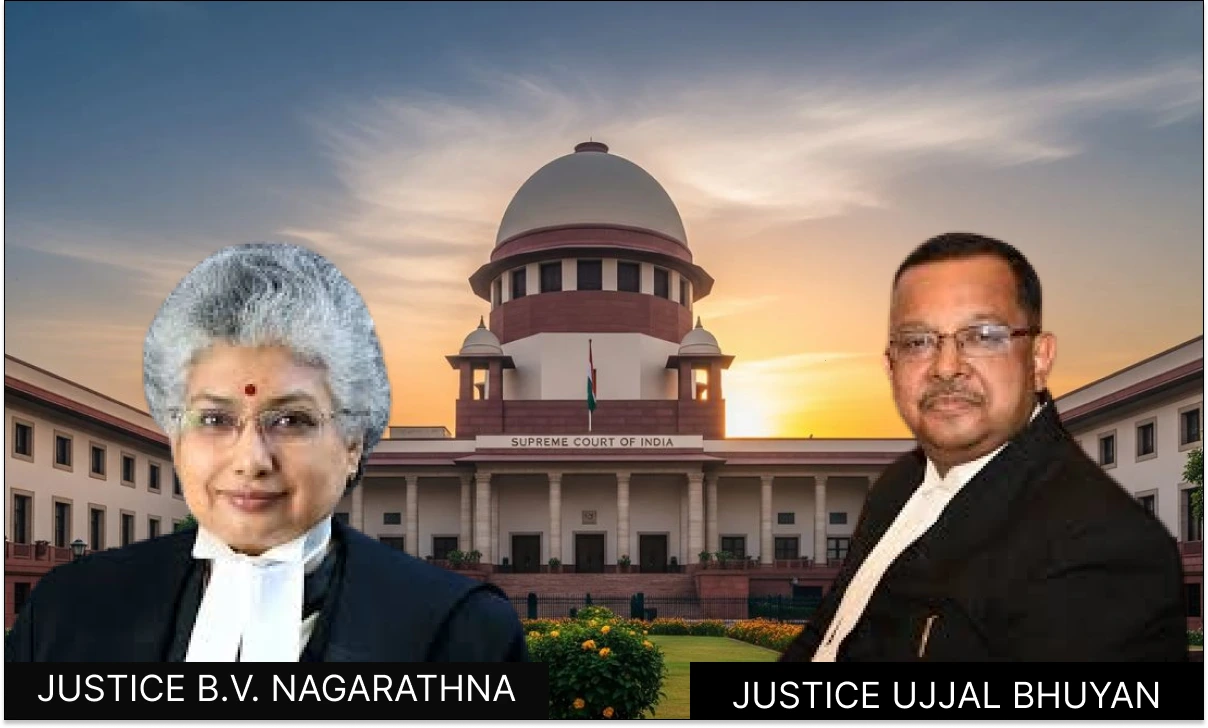
The Supreme Court of India quashed criminal proceedings under the POCSO Act against father and his family members, after finding that the allegations were vague, unsupported by evidence, and prima facie appeared to be part of a larger pattern of retaliatory litigation between estranged spouses.
The bench of Justice B.V. Nagarathna and Justice Ujjal Bhuyan used the occasion to sound a strong alarm about what they called a growing and troubling trend - parties in matrimonial disputes weaponising serious criminal laws, including the POCSO Act, to settle personal scores.
Background of the Case
The case stretches back over a decade. Ishwar Chand Sharma (Appellant No. 1) and his wife separated in 2011, just three years after their marriage. Their minor daughter, born in 2009, remained in the custody of the father and his family.
Over the years, both sides filed a string of cases against each other - dowry harassment, domestic violence, attempt to murder, and more. By the time the present complaint was filed, the two families had accumulated over ten civil and criminal proceedings between them.
In September 2024, the wife filed a fresh complaint before the Special Judge (POCSO Act) in Meerut, alleging that Appellant No. 1 - the girl's own father - had raped her when she was fourteen years old. She further alleged that another family member (Appellant No. 4, the girl's uncle) had also repeatedly sexually assaulted her. The girl's grandmother and aunt (Appellants No. 2 and 3) were accused of physically assaulting the child and threatening her into silence.
The trial court took cognizance in February 2025 and issued summons in August 2025. When the family moved the Allahabad High Court to quash the proceedings, it refused. They then came to the Supreme Court.
What the Court Observed
The Supreme Court examined the complaint closely and found it wanting on several fronts.
On the rape allegations, the bench noted that the complainant had made only a bare, sweeping statement that the father had raped the daughter. The bench observed,
"A blanket statement stating that appellant Nos. 1 and 4 had raped the prosecutrix, cannot, without any other supporting material, be considered sufficient to invoke such a grave and serious charge."
No date of the alleged incident was mentioned. No specific acts were described. No medical examination had been conducted - even though the complainant admitted the girl had been living with her for months before the complaint was filed.
The court also noticed something striking: the statements given by the complainant and the daughter before the Special Judge were almost word-for-word identical. The bench said this "parrot-like" repetition pointed not to consistency, but to tutoring.
"There has been no alteration, addition or subtraction from either of the three statements making each of them virtually identical to one another," the court noted.
On the allegation that Appellant No. 3 (the aunt) had inserted a hammer handle into the girl's private parts - a very serious charge - the court said no medical report or evidence of any kind had been placed on record to support it.
The Court's Broader Warning
The judges didn't stop at the facts of this case. They took the opportunity to call out what they described as a "matrimonial bouquet" - a pattern where estranged spouses file multiple criminal complaints, including under POCSO, as a pressure tactic.
"At the centre of this sort of litigation is a child who is often used by her mother against her father, against her will and wishes," the bench remarked. The court was careful to add that genuine cases of abuse must be pursued vigorously - but that courts have a duty to separate real cases from false ones.
The bench also directed lawyers to take responsibility, quoting an earlier Supreme Court ruling that members of the Bar must not encourage exaggerated or false complaints, and must try to resolve matrimonial disputes amicably rather than escalate them.
The Decision
Setting aside the Allahabad High Court's order, the Supreme Court quashed Complaint Case No. 05 of 2025, along with the cognizance order and the summoning order issued by the trial court. The court clarified that all other matrimonial and civil proceedings pending between the parties will continue independently and be decided on their own merits.
Case Details:
Case Title: Ishwar Chand Sharma & Others v. State of Uttar Pradesh & Another
Case Number: Criminal Appeal No. of 2026 (arising from SLP (Crl.) No. 18035 of 2025)
Judge: Justice B.V. Nagarathna and Justice Ujjal Bhuyan
Decision Date: May 29, 2026


