

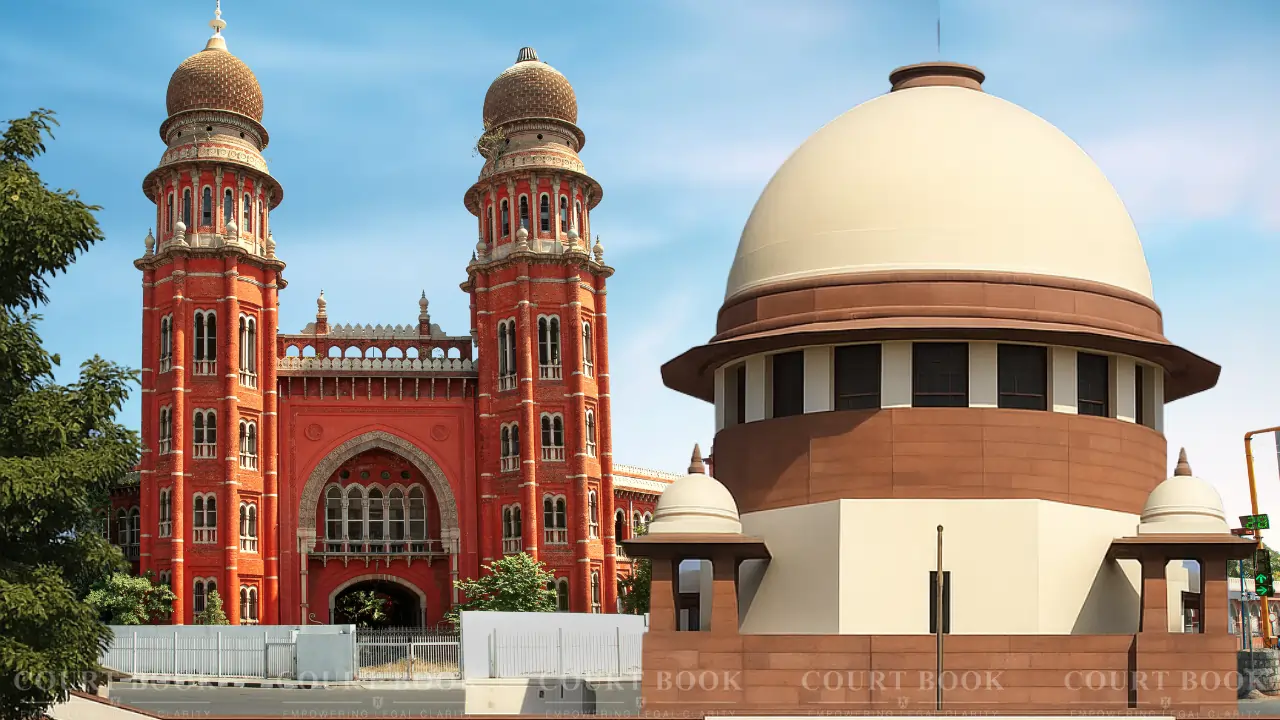
The Supreme Court has refused to interfere with a Madras High Court order directing reconsideration of property valuation in a long-running debt recovery dispute. The Court held that examining whether the mortgaged properties were undervalued during auction does not automatically invalidate the sale but ensures transparency in recovery proceedings.
A bench comprising Justices J.B. Pardiwala and R. Mahadevan dismissed the appeal filed by an auction purchaser challenging the High Court’s direction to the Debts Recovery Tribunal (DRT) to reassess the valuation of the properties involved in the case.
Background of the Case
The dispute traces back to recovery proceedings initiated by Indian Bank against a borrower company and its guarantors for defaulting on loan obligations. The bank had extended financial facilities in the early 1990s, and the guarantors mortgaged several properties as security.
When the borrower failed to repay the outstanding dues, the bank approached the Debts Recovery Tribunal (DRT), Chennai, seeking recovery of approximately ₹45.6 lakh along with interest.
In January 2010, the DRT issued a recovery certificate directing the borrowers and guarantors to pay the dues. Following attachment of the mortgaged properties, the Recovery Officer conducted a public auction on October 29, 2010.
The appellant in the present case emerged as the highest bidder with a bid of about ₹2.10 crore. The DRT confirmed the sale and issued a sale certificate in February 2011, transferring title of the properties to the auction purchaser.
The guarantors challenged the recovery order before the Debts Recovery Appellate Tribunal (DRAT), arguing that the recovery proceedings and auction process were improper.
However, in October 2017, the DRAT dismissed their appeal and upheld the validity of the auction sale. It observed that defaulters could not take advantage of internal disputes and that the interests of a bona fide third-party purchaser should also be protected.
The guarantors then approached the Madras High Court through a writ petition.
In February 2020, the High Court upheld the legality of the mortgage, the recovery proceedings, and the auction conducted by the DRT.
However, the High Court directed the DRT to reconsider the valuation adopted for the mortgaged properties during the auction process. It observed that if the properties were found to have been sold at a price lower than their actual value, the purchaser could be required to pay the difference.
Aggrieved by this limited direction, the auction purchaser approached the Supreme Court.
The appellant contended that the High Court’s order effectively unsettled a concluded auction sale more than a decade after it had been confirmed.
Read also:-Calcutta High Court Enhances Compensation for Parents Who Lost Two Sons in 2015 Road Accident
Counsel argued that the appellant was a bona fide purchaser who had participated in a public auction with multiple bidders and had paid the entire consideration in accordance with the law.
The appellant also relied on earlier Supreme Court decisions emphasizing that the rights of a third-party auction purchaser should ordinarily be protected and that confirmed court sales should not be reopened except in cases involving fraud or material irregularities.
On the other hand, the respondents argued that the auction itself was illegal and that the purchaser had not complied with certain mandatory payment requirements.
The bank, while supporting the legality of the auction process, stated that it would abide by any direction issued by the Court.
The Supreme Court noted that the recovery proceedings were initiated under the Recovery of Debts Due to Banks and Financial Institutions Act, and the auction was conducted by the Recovery Officer following the statutory procedure.
The Court observed that a valuation report had been obtained before the proclamation of sale and that multiple bidders had participated in the auction. The appellant ultimately emerged as the successful bidder and the sale was confirmed after full payment of the bid amount.
At the same time, the bench clarified that although courts generally protect the rights of bona fide auction purchasers, such protection is not absolute.
“The principle of finality attached to court-confirmed auction sales cannot operate to shield the process from judicial examination where the question relates to the adequacy of valuation,” the Court observed.
The Court emphasized that recovery proceedings must ensure that secured assets fetch the best possible price and that fairness and transparency remain central to the auction process.
After examining the record, the Court held that the High Court had not set aside the auction sale but had only directed a limited reconsideration of the valuation by the DRT.
The bench observed that such a direction merely allows the tribunal to examine whether the reserve price and valuation were properly determined based on available materials.
Finding no legal error in the High Court’s approach, the Supreme Court dismissed the appeal and allowed the DRT to examine the valuation issue in accordance with law.
Case Title: Om Sakthi Sekar v. V. Sukumar & Others
Case No.: Civil Appeal No. 3362 of 2026 (Arising out of SLP (C) No. 2122 of 2022)
Decision Date: March 13, 2026
Download Judgment

