

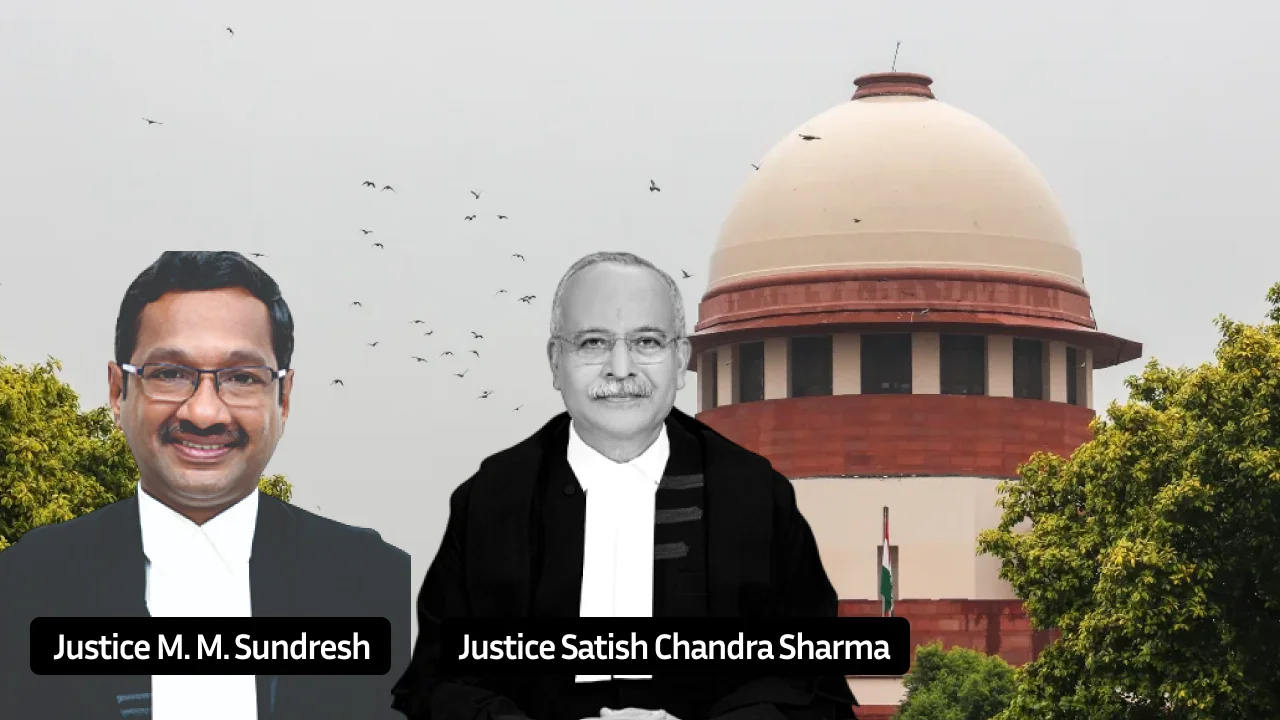
The Supreme Court has restored the conviction of nine persons in the 2013 murder of Chennai-based doctor Dr. Subbaiah, overturning a Madras High Court judgment that had acquitted all accused in the case. A Bench of Justice M. M. Sundresh and Justice Satish Chandra Sharma held that the High Court had wrongly discarded important prosecution evidence and adopted an approach inconsistent with settled criminal law principles.
Seven convicts were sentenced to life imprisonment, while the sentences of two elderly accused were suspended for eight weeks to allow them to seek pardon from the Governor of Tamil Nadu under Article 161 of the Constitution.
Dr. Subbaiah, a doctor associated with Billroth Hospital in Chennai, was attacked outside the hospital on September 14, 2013. According to the prosecution, three assailants attacked him with a sickle, causing severe injuries. He later died during treatment on September 23, 2013.
Read Also:- SC Says Multiple FIRs on Same Allegations Cause Prejudice, Orders Consolidation
The prosecution alleged that the murder stemmed from a long-running property dispute involving a two-acre land parcel in Kanyakumari district. Dr. Subbaiah had allegedly initiated criminal proceedings against members of the accused family over the disputed property, which, according to the prosecution, led to a conspiracy to eliminate him.
The Trial Court had convicted all nine accused, awarding death sentences to several of them. However, the Madras High Court later acquitted all accused in June 2024, prompting appeals before the Supreme Court by the State of Tamil Nadu and the complainant.
At the beginning of the judgment, the Bench quoted Rabindranath Tagore’s words on greed and human conduct, observing that the case reflected “how humans tend to surpass all limits of sound human behavior.”
The Court carefully re-examined eyewitness testimonies, conspiracy evidence, financial transactions, recoveries, and electronic evidence.
On eyewitnesses PW2 and PW3, the Bench found their testimonies reliable and consistent on material particulars. It observed that minor contradictions highlighted by the defence were natural and did not affect the core prosecution case.
Read Also:- SC Rules Criminal Trial Cannot Continue Without Specific Allegations Against Accused Officer
The Court also upheld the credibility of the approver, PW12, and faulted the High Court for comparing his testimony with earlier statements recorded when he was still an accused.
“The phrase ‘true and full disclosure’ contains within its sweep an inherent acknowledgement that the accused had not disclosed truthfully and fully prior thereto,” the Bench observed while explaining the legal position regarding approver testimony.
The Supreme Court agreed with the High Court that the call detail records and CCTV-based gait analysis report could not be relied upon because procedural safeguards relating to electronic evidence had not been properly followed.
However, the Court clarified that exclusion of those materials did not weaken the prosecution case because there was sufficient other evidence supporting the conspiracy and execution of the crime.
The Bench also addressed the issue of crime scene re-enactment and the protection against self-incrimination under Article 20(3) of the Constitution.
“If the re-enactment is merely based on a direction to walk or to act a certain way or to imitate a visual sequence, it does not necessarily involve any personal testimony,” the Court observed.
The Supreme Court strongly criticised the High Court’s reasoning while acquitting the accused. It said criminal courts cannot adopt speculative theories or exaggerated doubts while assessing evidence.
“The job of a criminal court is not to order loose acquittals by entertaining such vague and ordinary doubts, convoluted theories and suppositions,” the Bench remarked.
The Court held that the prosecution had successfully established the conspiracy, financial trail, motive, and execution of the offence through a consistent chain of evidence.
Allowing the appeals, the Supreme Court set aside the Madras High Court judgment and restored the convictions recorded by the Trial Court.
All accused were sentenced to imprisonment for life, with sentences directed to run concurrently, after the State informed the Court that it was not pressing for the death penalty.
The Court, however, granted limited relief to P. Ponnusamy (A1) and Mary Pushpam (A2), elderly parents of two co-conspirators. Taking note of their age and limited role, the Bench suspended their sentences for eight weeks to enable them to approach the Governor of Tamil Nadu seeking pardon under Article 161.
The remaining convicts were directed to surrender before the Trial Court within two weeks to serve their life sentences.
Case Title: The State of Tamil Nadu v. Ponnusamy & Ors.
Case Number: Criminal Appeal Nos. 2493-2502 of 2025 with Criminal Appeal Nos. 2503-2512 of 2025
Judges: Justice M. M. Sundresh and Justice Satish Chandra Sharma
Decision Date: May 19, 2026
Download Judgment

