

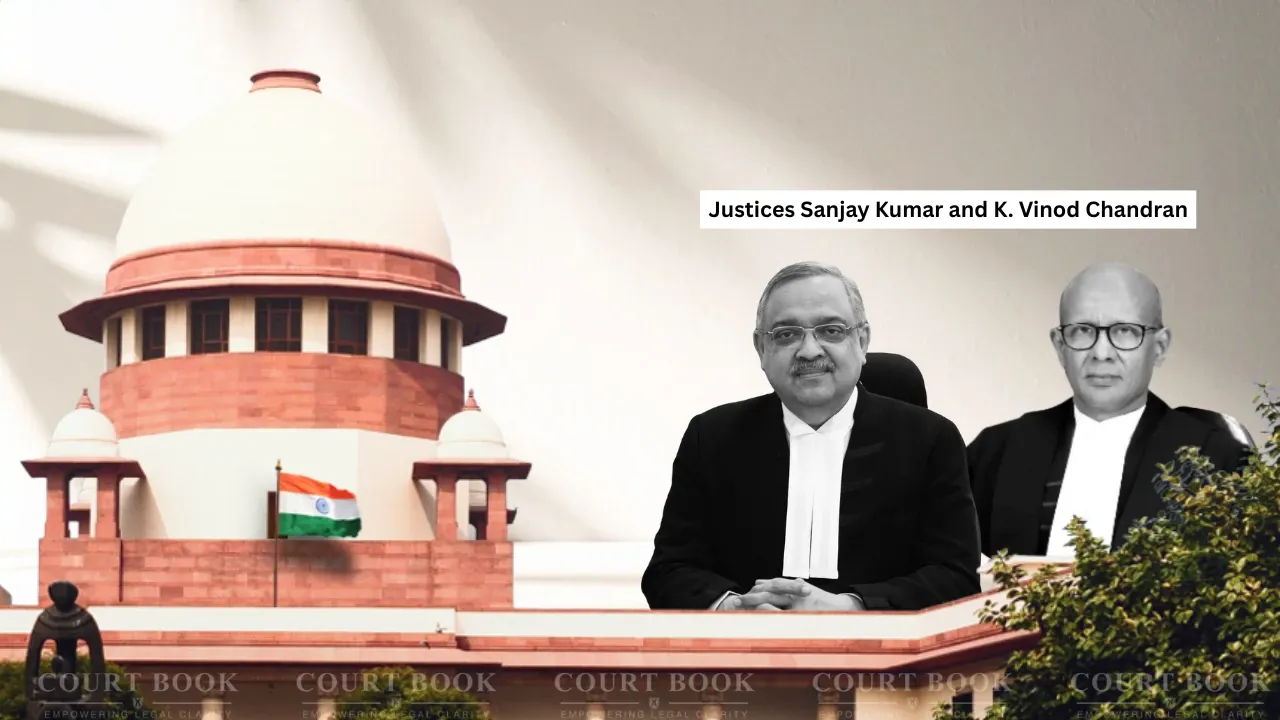
The Supreme Court modified an arbitral award in a long-running redevelopment dispute between a Delhi property-owning family and a builder, holding that the owners were entitled to limited contractual compensation for delay in construction.
At the same time, the Court refused to reopen other parts of the award that had already attained finality because they were never challenged earlier by the owners.
Background of the Case
The dispute arose from a 2010 redevelopment agreement under which the Bhayana family allowed a builder, late Vinod Seth, to reconstruct their old property in Delhi. In return, the builder was to retain the second floor and pay ₹64 lakh to the owners in installments.
The agreement also contained a penalty clause stating that if construction was delayed beyond the agreed period, the builder would pay ₹10,000 per day.
However, construction stopped in 2011 before completion of the project. The owners terminated the agreement later that year, leading to arbitration proceedings that continued for more than a decade.
An arbitrator initially awarded damages to the owners but also directed refund of certain amounts to the builder. Later, the Delhi High Court reduced the compensation, and eventually a Division Bench completely denied damages to the owners, holding that they had failed to prove actual loss.
The Supreme Court disagreed with the Delhi High Court’s view that the owners were not entitled to compensation merely because they had not separately proved actual damage.
The bench observed that the contract itself clearly provided for a daily penalty in case of delay, and therefore the loss suffered by the owners was “implicit” in the agreement.
“The Division Bench was, therefore, in error in holding that the owners would be disentitled to compensation,” the Court said while examining Clause 7 of the agreement.
At the same time, the Court clarified that compensation could only run for the period between September 9, 2011 and November 11, 2011, because the agreement itself had been terminated after that date.
The Court calculated that the owners were entitled to ₹6.3 lakh for 63 days of delay at the agreed rate of ₹10,000 per day.
The bench also noted that the arbitral award contained multiple legal errors and described parts of it as “patently illegal.” However, it refused to set aside the award entirely because the parties had already been litigating since 2012.
Referring to the Supreme Court’s earlier Constitution Bench ruling in Gayatri Balasamy v. ISG Novasoft Technologies Limited, the judges said courts could modify arbitral awards in limited situations to avoid further delay and hardship.
The Supreme Court finally held that the respondents were entitled to recover ₹81.92 lakh, while the owners were entitled to ₹6.3 lakh as contractual penalty. After adjustment, the balance amount payable came to ₹25.62 lakh because ₹50 lakh had already been released earlier pursuant to Supreme Court orders.
The Court further directed that neither side would be entitled to claim interest and ordered parties to bear their own costs.
Case Details
Case Title: Bhupesh Bhayana and Another v. Kunal Seth and Another
Case Number: Civil Appeal Nos. … of 2026 arising out of SLP (C) Diary No. 20732 of 2024
Judges: Justice Sanjay Kumar and Justice K. Vinod Chandran
Decision Date: May 26, 2026


