

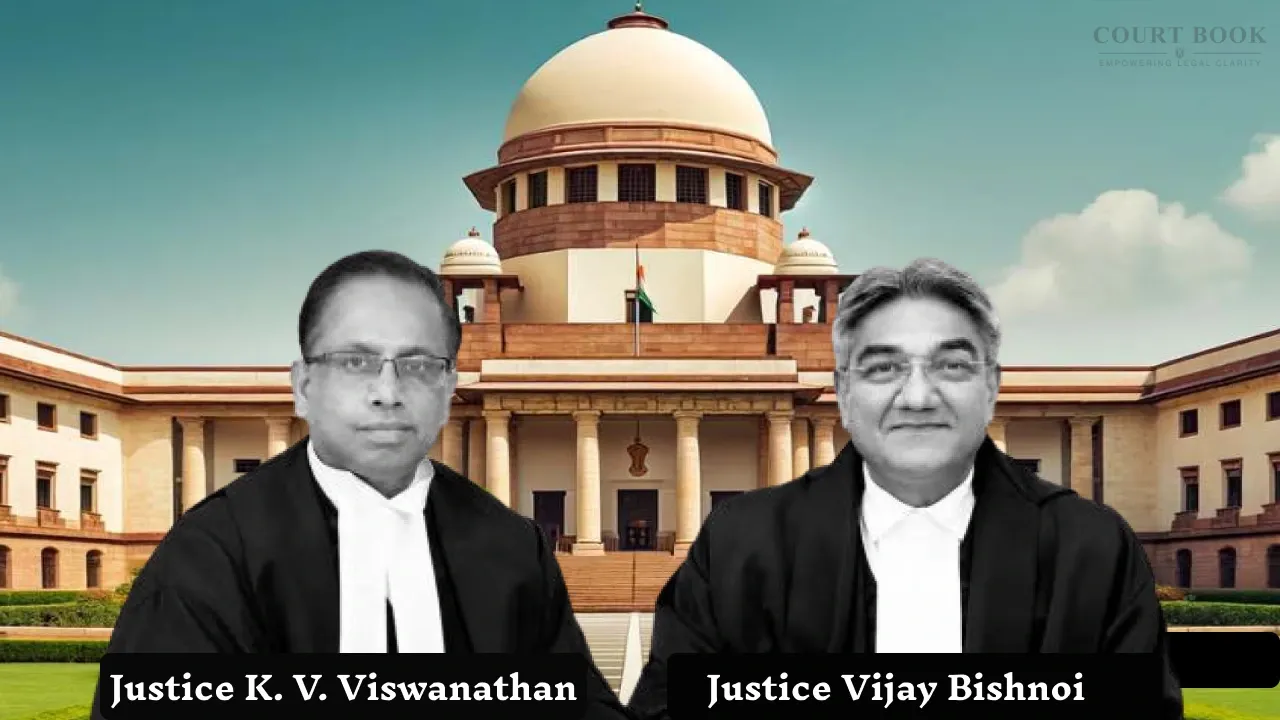
The Supreme Court has clarified an important procedural issue in criminal law, holding that when a High Court overturns an acquittal and convicts an accused for the first time, it must itself hear the accused on sentencing and pass the punishment order. The appellate court cannot send the matter back to the trial court only for deciding the sentence.
The ruling came in an appeal filed by Mukesh Kumar Yadav after the Calcutta High Court’s Circuit Bench at Port Blair reversed his acquittal in a rape and abortion-related case.
Background of the Case
The appellant had originally faced trial for offences under Sections 376, 312 and 417 of the Indian Penal Code. In April 2024, the Sessions Judge at Port Blair acquitted him of all charges.
Later, appeals were filed by both the State and the victim before the High Court. The High Court set aside the acquittal and convicted the accused under Sections 376 and 312 IPC. It observed that the victim’s consent was allegedly obtained on a false promise of marriage and that pills had allegedly been given to terminate the pregnancy.
However, after recording the conviction, the High Court directed the accused to surrender before the trial court and asked the trial judge to hear him on sentence and impose punishment.
Supreme Court’s Observation
The Supreme Court found fault with this procedure and said the High Court had adopted a course “unknown to law.”
Justice K. V. Viswanathan, writing for the Bench, examined Sections 235 and 386 of the Criminal Procedure Code and noted that a person convicted for the first time must be given a proper opportunity to address the court on sentencing.
Referring to earlier judgments, the Bench explained that the hearing on sentence is part of the principles of natural justice. The Court quoted previous rulings which held that an accused must be allowed to place material before the court regarding punishment.
The Bench further observed that appellate courts reversing acquittals are legally empowered not only to convict but also to impose sentence themselves.
“The appellate court cannot relegate the matter to the court below only for the purpose of imposing a sentence after the appellate court had recorded a conviction,” the Court held.
Decision of the Court
The Supreme Court set aside the portion of the High Court judgment that directed the trial court to impose sentence after the accused’s surrender.
The matter has now been sent back to the High Court. The Supreme Court directed the High Court to fix a date for hearing the accused on the question of sentence and thereafter pass an appropriate sentencing order in accordance with law.
The Bench also clarified that after sentencing is imposed, the appellant would remain free to challenge both the conviction and the sentence through legal remedies available under law.
Case Details
Case Title: Mukesh Kumar Yadav v. The State (UT of Andaman & Nicobar Islands) & Ors.
Case Number: Criminal Appeal Nos. 2863-2864 of 2026
Judge: Justice K. V. Viswanathan and Justice Vijay Bishnoi
Decision Date: May 26, 2026


