

The Supreme Court has set aside a Ministry of Home Affairs (MHA) order rejecting the premature release of life convict Rohit Chaturvedi, holding that the Centre’s decision was “non-speaking”, arbitrary, and legally unsustainable.
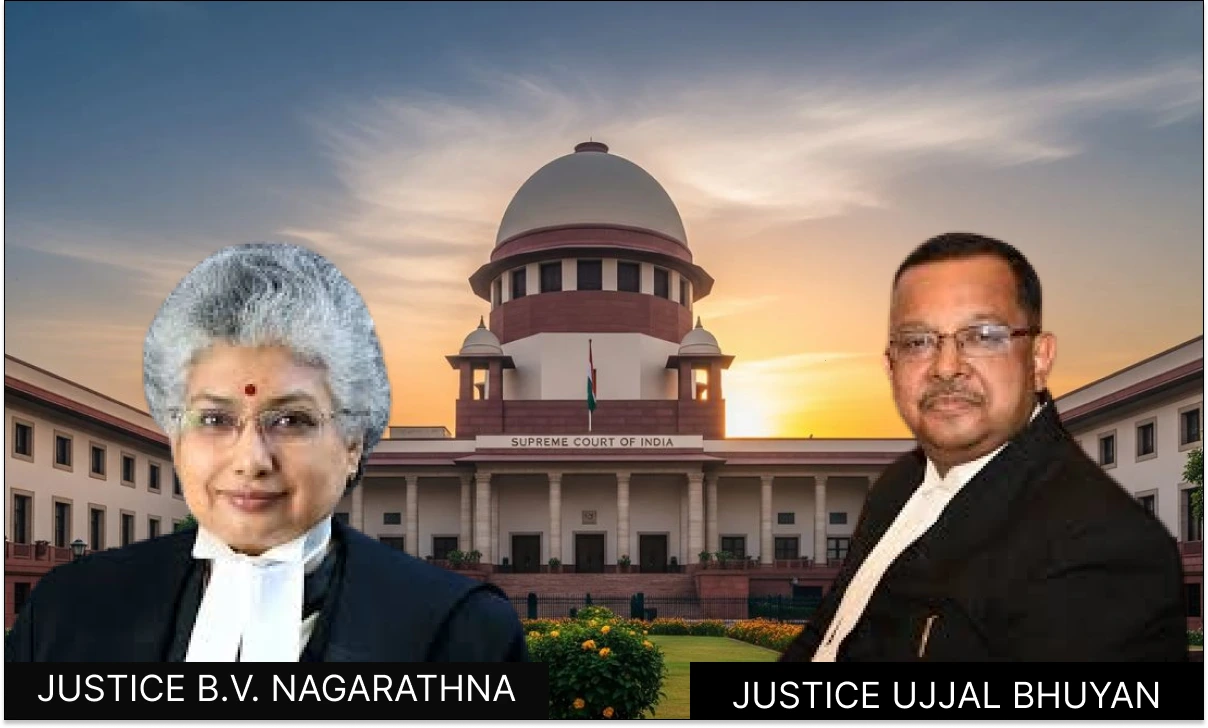
A Bench of Justice B.V. Nagarathna and Justice Ujjal Bhuyan ruled that remission decisions affecting personal liberty must contain clear reasons and demonstrate proper application of mind.
The Court directed that Chaturvedi, who has already spent more than 22 years in prison, be treated as prematurely released and exempted him from surrendering back to custody.
Background of the Case
The case arose from the 2003 Murder Case prosecution registered in Lucknow against Rohit Chaturvedi and others under Section 302 IPC. The investigation was later transferred to the Central Bureau of Investigation, and the trial was shifted to Dehradun by the Supreme Court.
Chaturvedi was convicted in 2007 by a Special Court in Dehradun for offences under Sections 120B and 302 IPC and sentenced to life imprisonment. His conviction was later upheld by the Uttarakhand High Court and the Supreme Court.
After serving over two decades in prison, Chaturvedi sought premature release. The State of Uttarakhand eventually recommended remission, but the MHA later declined to concur with Uttarakhand’s recommendation for premature release..
What Happened During the Hearing
Before the Supreme Court, the petitioner argued that the MHA rejection letter dated July 9, 2025 did not disclose any reasons for denying remission. It was also pointed out that co-convict Amarmani Tripathi had already been granted premature release by the Uttar Pradesh Government after undergoing a shorter period of incarceration.
The Union Government defended its decision, contending that the petitioner played a significant role in the crime and therefore did not deserve remission.
However, Uttarakhand supported the recommendation for premature release before the Court.
Court’s Key Observation
The Supreme Court strongly criticised the MHA’s rejection order, observing that it merely stated that the Centre “does not concur” with the State’s recommendation without explaining why.
The Bench held that liberty-related decisions cannot be taken through cryptic executive orders.
“Recording of reasons is not an empty formality, it is a safeguard against arbitrariness and ensures transparency, fairness, and accountability in decision-making.”
The Court further clarified that remission cannot be denied solely because the offence was heinous.
“Justice does not permit permanent incarceration of an individual in the shadow of their worst act.”
The Bench also emphasised the reformative purpose of criminal law and noted the petitioner’s satisfactory conduct in prison.
Court’s Decision
Allowing the writ petition, the Supreme Court quashed the MHA’s July 9, 2025 letter rejecting remission.
The Court held that remanding the matter back to the Centre would serve no useful purpose because the Union Government had already clearly stated its stand before the Court.
Considering the petitioner’s long incarceration, good prison conduct, and parity with a co-accused already released, the Bench ordered that he be treated as prematurely released.
Case Details
Case Title: Rohit Chaturvedi v. State of Uttarakhand & Others
Case Number: Writ Petition (Criminal) No. 446 of 2023
Court: Supreme Court of India
Judge: Justice B.V. Nagarathna and Justice Ujjal Bhuyan
Date: May 15, 2026
Download Judgment

