

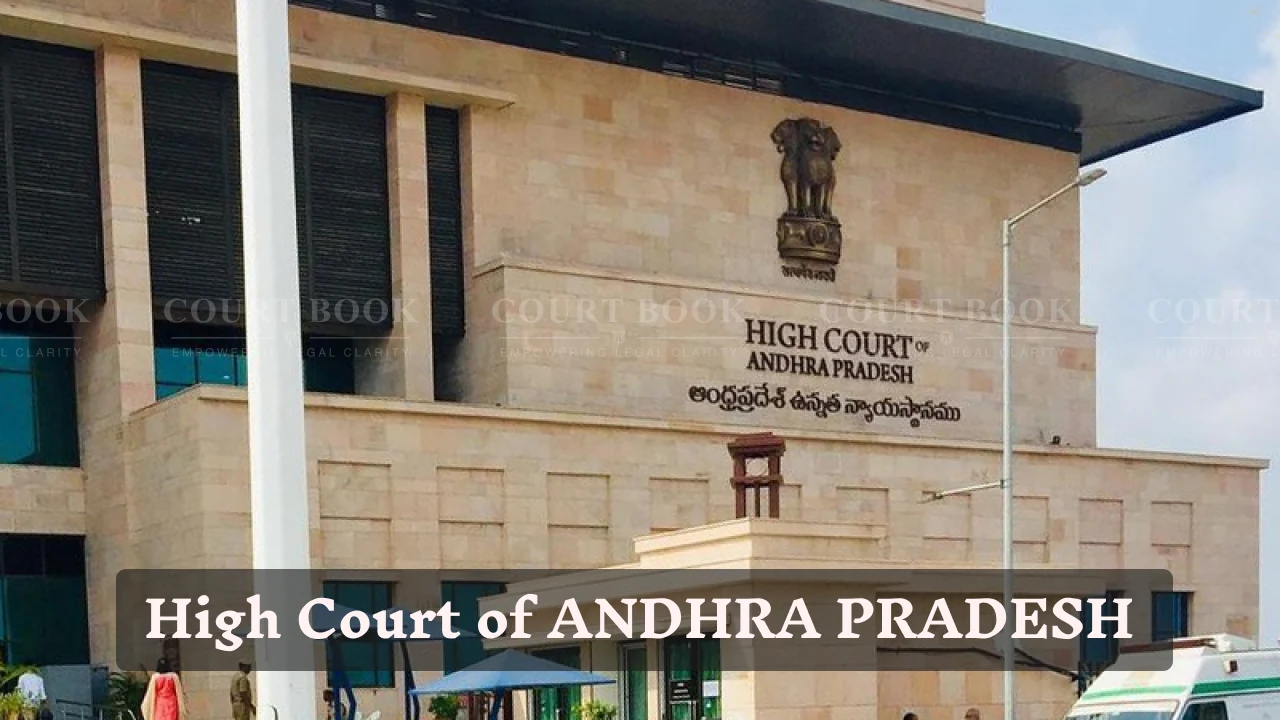
The High Court of Andhra Pradesh has clarified that decrees passed in fatal accident compensation proceedings under the Fatal Accidents Act, 1855 can be challenged through a regular first appeal under Section 96 of the Code of Civil Procedure (CPC).
The Division Bench Justice Ravi Nath Tilhari and Justice Balaji Medamalli directed that future proceedings under Section 1A of the Fatal Accidents Act should be registered as Original Suits instead of Fatal Accident Original Petitions (FAOPs).
Background of the Case
The matter arose after the family of a deceased person filed a compensation claim under Section 1A of the Fatal Accidents Act, 1855 before the Principal District Judge, Visakhapatnam. The trial court allowed the claim and awarded ₹20 lakh compensation with 9% annual interest from the date of filing till realization.
The first respondent in that case later approached the High Court challenging the decree. However, the registry raised objections regarding the maintainability of the appeal, arguing that the original proceedings were registered as an FAOP and not as a civil suit.
Read also:- Delhi High Court Acquits Man in 1 Kg Heroin Case, Cites Major Procedural Lapses by DRI
The appellant then refiled the matter as an Appeal Suit under Section 96 CPC and paid ad valorem court fees.
The Bench undertook an extensive examination of the meaning of “suit,” “action,” and “decree” under civil law and the Fatal Accidents Act.
The judges noted that proceedings under Section 1A of the Fatal Accidents Act are initiated through a plaint, heard by a civil court, decided after recording evidence, and culminate in a judgment and decree. Because all essential features of a civil suit are present, the court held that such proceedings are effectively suits in law.
The Bench observed,
“Under Section 1A of the Act, 1855 suit and ‘action’ have been used as synonymous and action is not different from suit.”
The court further stated that merely because the matter was registered as an FAOP instead of an Original Suit, the decree would not lose its character as a decree passed in a suit.
Read also:- Consumers Cannot Be Forced To Pay For Power Plant After Electricity Supply Stopped: Supreme Court
Referring to earlier precedents, the judges emphasized that when civil rights are adjudicated by ordinary civil courts, the normal rules of civil procedure, including appeal rights, would apply unless specifically barred by statute.
The High Court held that an appeal under Section 96 CPC is maintainable against decrees passed in proceedings under Section 1A of the Fatal Accidents Act, 1855. The registry was directed to register the appeal accordingly.
The Bench also issued wider directions for courts across Andhra Pradesh:
• Claims under the Fatal Accidents Act must be instituted before competent civil courts.
• Such matters must be registered as Original Suits and not as FAOPs.
• Pending FAOPs should be converted into Original Suits.
• Appropriate court fees must be collected under the Andhra Pradesh Court Fees and Suits Valuation Act, 1956.
The court finally directed the Registrar (Judicial) to circulate the judgment to all Principal District Judges in the State.
Case Details
Case Title: Birendra Prasad Jain v. Matcha Rama Krishna & Ors.
Case Number: Civil Miscellaneous Appeal (SR) No. 9643 of 2026
Judges: Justice Ravi Nath Tilhari and Justice Balaji Medamalli
Decision Date: April 29, 2026
Download Order

