

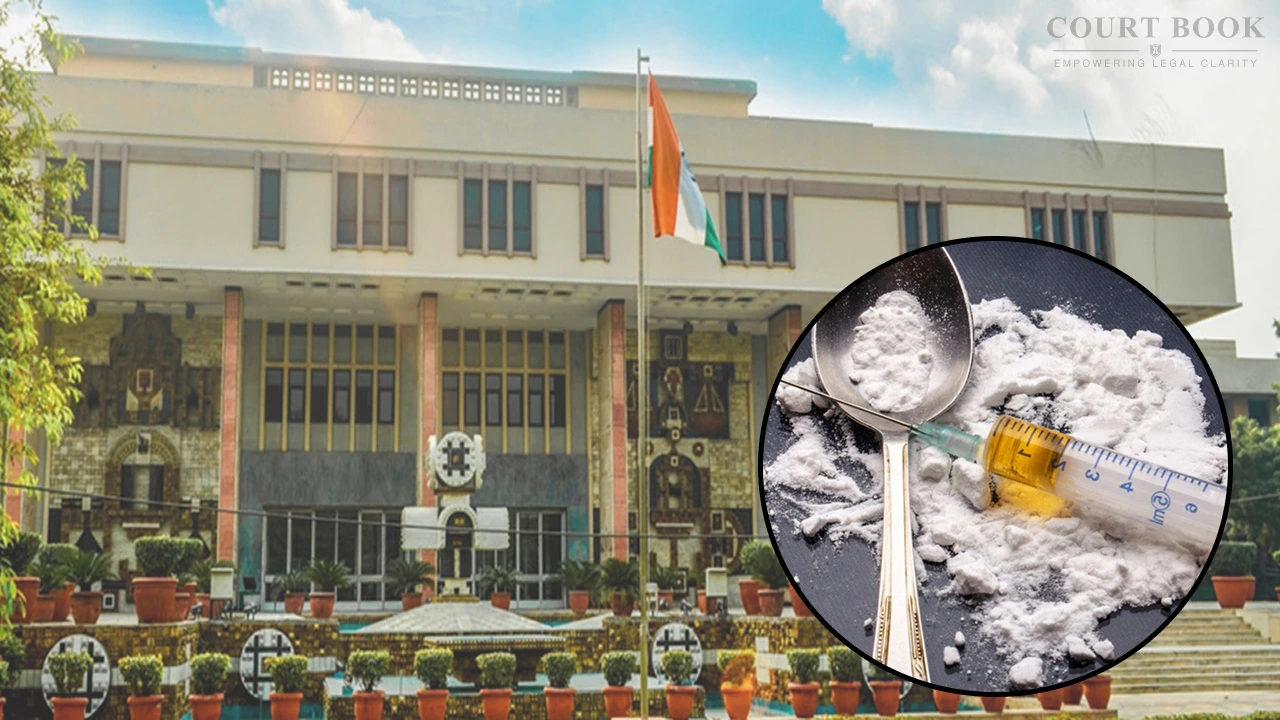
The Delhi High Court has overturned the conviction of a man sentenced to 10 years in prison under the Narcotic Drugs and Psychotropic Substances (NDPS) Act after finding serious gaps in the prosecution’s handling of seized contraband and procedural compliance.
Background of the Case
According to the prosecution, DRI officers intercepted a Honda Civic car near the Singhu Border in Delhi on May 18, 2012, after receiving secret information that heroin was being transported in the vehicle. The agency claimed that one kilogram of heroin was recovered from beneath the car’s bonnet.
A trial court had convicted Sunil under Section 21(c) of the NDPS Act in 2016 and sentenced him to rigorous imprisonment for 10 years along with a fine of ₹1 lakh.
Before the High Court, the appellant argued that he had been falsely implicated and alleged that he was picked up from near his residence by DRI officials, forced to sign documents, and made to write statements under pressure.
During the hearing, the High Court first examined whether the trial had followed the correct legal procedure because the case had originated from a complaint filed by a DRI officer. The court referred to the Supreme Court’s ruling in Tofan Singh v. State of Tamil Nadu and held that NDPS cases before Special Courts are governed by the procedure applicable to Sessions trials under Chapter XVIII of the Criminal Procedure Code.
The court then turned to the merits of the prosecution case and closely examined compliance with Section 52A of the NDPS Act, which governs the handling, inventory, sampling, and certification of seized narcotic substances.
Justice Chandrasekharan Sudha noted that the prosecution failed to strictly comply with mandatory safeguards under Section 52A. The court pointed out that the application under Section 52A was moved nearly five months after the alleged seizure, without any explanation for the delay.
The judgment also recorded uncertainty regarding the quantity of contraband produced before the Magistrate and observed that relevant documents, including the inventory and panchnama referred to during proceedings, were not properly available before the court.
The bench further observed that there was no documentary proof showing that the seized material was handed over by the investigating officer to the authorised DRI officer immediately after seizure, despite oral claims made by officials during trial.
“The provisions of Section 52A have not been strictly complied with,” the court observed while noting that procedural safeguards in NDPS cases carry significant importance because of the stringent punishments prescribed under the law.
After analysing the evidence and procedural record, the High Court concluded that the prosecution had failed to establish an unbroken chain of custody and had not satisfactorily removed doubts surrounding the handling of the seized substance.
The court ultimately granted the benefit of doubt to the appellant and set aside the conviction and sentence imposed by the trial court.
Case Details
Case Title: Sunil @ Sunil Sharma v. Directorate of Revenue Intelligence
Case Number: CRL.A. 356/2016
Judge: Justice Chandrasekharan Sudha
Decision Date: May 7, 2026
Download Judgment

