

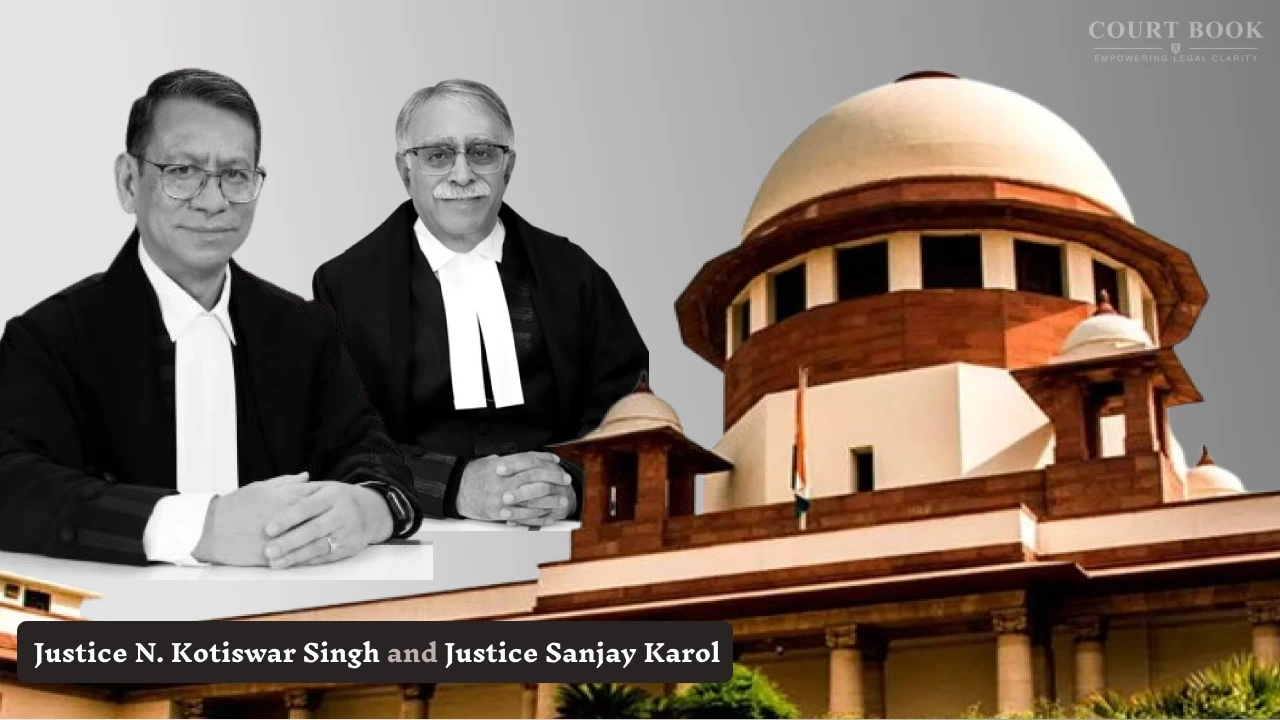
The Supreme Court has held that taking cognizance under an incorrect legal provision does not automatically invalidate criminal proceedings if the court otherwise has the authority to examine the alleged offence. While dealing with a case involving alleged non-disclosure of assets in a municipal election affidavit in Gujarat, the Court set aside the Magistrate's cognizance order and directed the trial court to reconsider the matter under the appropriate legal provisions.
Background of the Case
The appeal was filed by Chandrikaben Kishor Dafda, who challenged the Gujarat High Court's refusal to quash criminal proceedings initiated against her.
The dispute arose from a complaint alleging that while contesting the 2015 municipal elections for the post of Councillor, the appellant failed to disclose the complete details of immovable properties allegedly owned by her husband in the election affidavit. After an earlier representation did not result in further action, the complainant filed a private complaint before the Additional Chief Judicial Magistrate, Gandhidham.
In November 2017, the Magistrate issued summons by taking cognizance under Section 125A of the Representation of the People Act, 1951. The High Court declined to interfere, observing that the proceedings were still at an initial stage.
Court's Observations
Before the Supreme Court, the appellant argued that the Representation of the People Act did not govern municipal elections and therefore the Magistrate had invoked a provision that was legally inapplicable. It was also argued that the complaint was barred by limitation and that the Gujarat Municipal Election Rules did not require disclosure of properties exclusively owned by the spouse.
The Bench rejected the interpretation of the election affidavit rules advanced by the appellant. It examined Rule 7A of the Gujarat Municipalities (Conduct of Elections) Rules and held that the disclosure requirement clearly extends to the assets of the candidate, the spouse and dependents.
Explaining the wording of the rule, the Bench observed:
"The 'comma' does not create any separate meaning, distinction, or exclusion; it serves only a grammatical and structural function."
The Court concluded that the appellant was required to disclose the properties owned by her spouse as well.
However, the Court also noted that Section 125A of the Representation of the People Act applies to parliamentary and state legislative elections, not municipal elections. Since the affidavit requirement in municipal elections flows from the Gujarat Municipalities Act and Rules, the applicable penal provisions would instead have to be considered under the Indian Penal Code wherever appropriate.
The Bench clarified that taking cognizance under an incorrect legal provision is generally a curable procedural defect. Referring to earlier Supreme Court precedents and Section 465 of the Code of Criminal Procedure, it held that such an error does not invalidate proceedings unless it causes a failure of justice.
"The issue is that a false affidavit has been filed in the electoral process. That is an offence against society at large and has to be investigated,"
the Court observed while explaining why the proceedings could not be quashed solely because the Magistrate relied on the wrong statutory provision.
Supreme Court's Decision
Allowing the appeal in part, the Supreme Court set aside the cognizance order and remanded the matter to the concerned Magistrate for fresh consideration in accordance with law.
The Court clarified that it had expressed no opinion on the merits of the allegations and that its findings were confined to the legality of the cognizance order. The Magistrate has now been directed to take cognizance afresh under the appropriate legal provisions and proceed in accordance with law.
Case Details:
Case Title: Chandrikaben Kishor Dafda vs State of Gujarat & Anr.
Case Number: Criminal Appeal of 2026 (@ Special Leave Petition (Criminal) No. 16030 of 2025)
Judge: Justice Sanjay Karol and Justice Nongmeikapam Kotiswar Singh
Decision Date: July 1, 2026


