

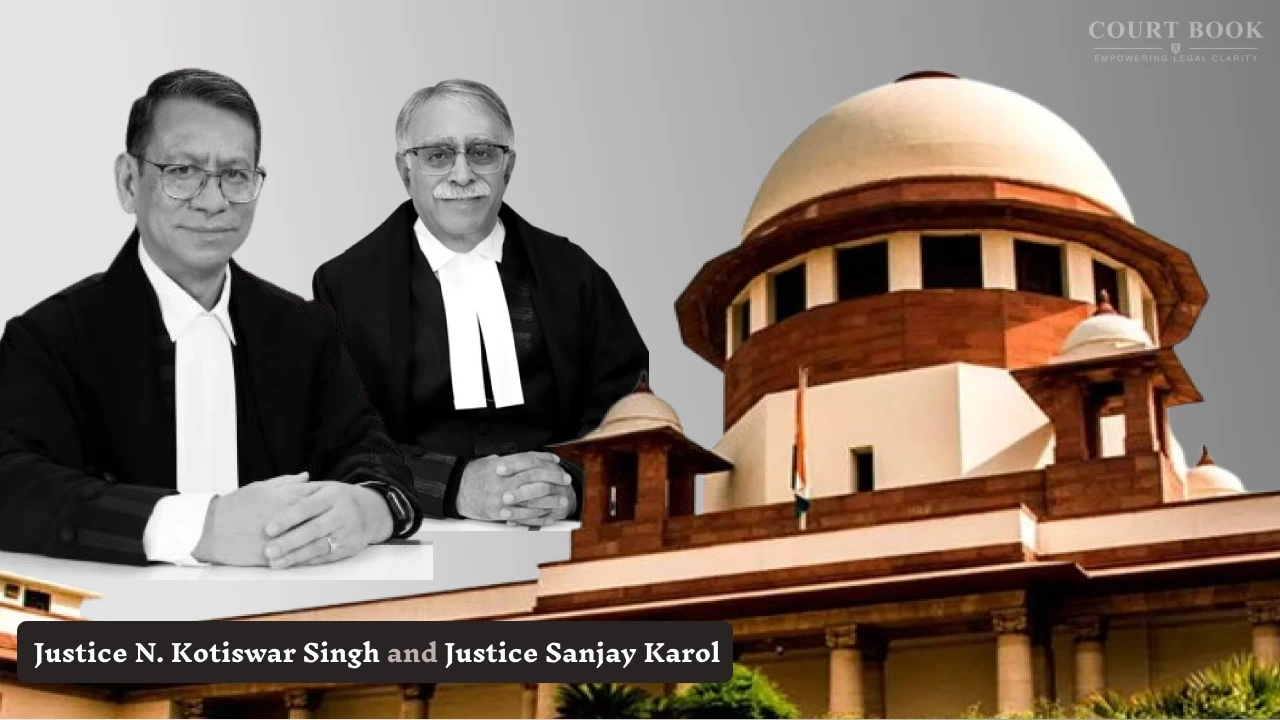
The Supreme Court has held that landlords are entitled to seek enhancement of rent from government tenants under the Uttar Pradesh Urban Buildings (Regulation of Letting, Rent and Eviction) Act, 1972. At the same time, the Court set aside an Allahabad High Court order that had directly fixed enhanced rent, observing that there was insufficient material on record to justify such a determination.
A Bench of Justice Sanjay Karol and Justice N. Kotiswar Singh delivered the judgment on May 29, 2026.
Background of the Case
The dispute concerned a property in Bahraich that had been leased to the Trade Tax Department of the Uttar Pradesh Government in 1966. Over the years, the landlords sought enhancement of rent under Section 21(8) of the UP Rent Act.
The Rent Control Authority had fixed rent at ₹14,400 per month, relying on the property's prime location and rent paid for comparable premises. Later, an appellate court remanded the matter for fresh consideration, directing examination of issues such as the effective date of enhancement and periodic increases.
The landlords challenged the remand before the Allahabad High Court. The High Court modified the earlier determination and directed payment of rent at ₹14 per square foot from the date of the original application, citing concerns about further delay.
The State of Uttar Pradesh then approached the Supreme Court.
Court’s Observations
The Supreme Court examined whether the deletion of certain provisions from the UP Rent Act had affected a landlord’s right to seek rent enhancement from government tenants.
The Bench concluded that the statutory proviso permitting rent enhancement continued to operate despite the deletion of earlier clauses referred to in Section 21(8).
Explaining its reasoning, the Court observed:
“The proviso is the only recourse available to the landlord and bonafide requirement as a ground stands completely extinguished.”
The Court further noted that accepting the State’s interpretation would leave landlords without any effective remedy.
“No bonafide requirement; no enhancement of rent: means no way for the landlord to reclaim his own property either physically or financially.”
High Court’s Powers Under Article 227
The Bench also considered whether the High Court could itself determine enhanced rent while exercising supervisory jurisdiction under Article 227 of the Constitution.
While recognising that High Courts possess wide supervisory powers, the Supreme Court stressed that such jurisdiction must be exercised sparingly, particularly in matters governed by special statutes like rent control laws.
The Court found that the High Court had relied on a statement regarding rent paid for an adjoining property without sufficient supporting material on record. In those circumstances, the direct enhancement ordered by the High Court could not be sustained.
Decision
Allowing the appeals in part, the Supreme Court held that an application for rent enhancement under Section 21(8) of the UP Rent Act is maintainable even where the tenant is the Government. The Court also affirmed that High Courts may exercise supervisory jurisdiction in exceptional rent-control matters, but found that such intervention was not justified on the facts of the present case.
Accordingly, the Court set aside the High Court’s order and remanded the matter to the Rent Control Officer, Bahraich, for fresh determination of the rent payable.
The authority has been directed to decide the matter within four months, and any order passed will operate from the date of the original application filed in 2008.


