The Supreme Court has upheld the constitutional validity of provisions governing the computation of royalty under the Mines and Minerals (Development and Regulation) Act, 1957 (MMDR Act), ruling that royalty, District Mineral Foundation (DMF) contributions and National Mineral Exploration Trust (NMET) payments can continue to form part of the sale value while calculating the Average Sale Price (ASP) of minerals.
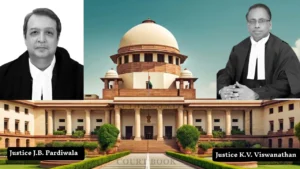
A Division Bench of Justice J.B. Pardiwala and Justice K.V. Viswanathan dismissed a writ petition filed by Kirloskar Ferrous Industries Ltd. and another, holding that the challenged provisions neither violate Articles 14 and 19(1)(g) of the Constitution nor exceed the rule-making powers conferred under the MMDR Act.
Background of the Case
The dispute centred on the Explanation to Rule 38 of the Minerals (Other than Atomic and Hydro Carbons Energy Minerals) Concession Rules, 2016 and the identical Explanation to Rule 45(8)(a) of the Mineral Conservation and Development Rules, 2017.
These provisions stipulate that while computing the sale value of minerals, no deduction is to be made for royalty, DMF contributions or NMET payments. Since the sale value is used to determine the Average Sale Price (ASP), the petitioners argued that this resulted in a cascading effect by effectively requiring miners to pay royalty on amounts already paid towards royalty and statutory contributions.
The present petition arose after an earlier round of litigation. In November 2024, the Supreme Court had noted that the Union Government was reconsidering the royalty computation framework through a public consultation process and granted it time to take a final policy decision. Subsequently, the Central Government decided not to amend the existing rules, citing concerns over the impact on State revenues. The Court then granted liberty to the petitioners to challenge that policy decision, leading to the present writ petition.
Petitioners' Arguments
Kirloskar Ferrous Industries contended that the impugned explanations were inconsistent with Section 9 of the MMDR Act, which prescribes royalty on an ad valorem basis, meaning according to the value of the mineral.
According to the petitioners, the sale value should not include royalty, DMF and NMET payments because these are statutory levies rather than part of the mineral's intrinsic value. They argued that retaining these amounts in the sale value artificially inflated the ASP and resulted in a cascading financial burden.
The petitioners also pointed out that the Union Government had earlier recognised this issue while considering amendments to the MMDR Act and had even initiated a public consultation proposing the exclusion of royalty, DMF and NMET from the ex-mine price. They submitted that the government's subsequent decision to retain the existing framework was arbitrary and violative of Articles 14 and 19(1)(g) of the Constitution.
Union Government's Stand
Opposing the petition, the Union Government maintained that the challenged provisions were part of a policy framework designed to prevent under-invoicing and price manipulation, particularly in the iron ore sector.
It argued that the Average Sale Price mechanism was introduced after instances where reported sale values did not accurately reflect market prices, resulting in revenue losses. According to the government, including royalty and related statutory payments in the sale value was part of a broader mechanism to protect public revenue.
The Union also distinguished iron ore from coal, explaining that the pricing mechanisms governing the two minerals are fundamentally different. It submitted that different methods of royalty computation for different minerals do not amount to unconstitutional discrimination.
Court's Observations
After examining the statutory framework, the earlier proceedings and the government's decision-making process, the Supreme Court found no constitutional infirmity in the impugned rules.
The Bench observed that economic legislation is entitled to greater judicial deference, particularly where the government has adopted a fiscal measure to safeguard public revenue. It noted that policy decisions involving taxation or royalty computation cannot be invalidated merely because another approach may also be possible.
The Court accepted the Union's explanation that the ASP mechanism was intended to address the problem of under-reporting of mineral prices and referred to material placed before it indicating instances where dispatch patterns allegedly affected the published ASP.
The Bench also clarified that the recommendations made by expert committees constituted by the Government were recommendatory in nature and did not create a legal obligation to amend the statutory rules. The Court held that the Central Government was entitled to take a different policy decision after considering the competing interests involved.
Rejecting the petitioners' reliance on the earlier judgment delivered in November 2024, the Bench observed that the previous decision had not ruled on the constitutional validity of the provisions but had merely allowed the government to complete its policy review. Since the government ultimately decided to retain the existing framework, the Court independently examined the fresh challenge and found no merit in it.
Decision
Dismissing the writ petition, the Supreme Court held that the Explanations to Rule 38 of the 2016 Rules and Rule 45(8)(a) of the 2017 Rules are constitutionally valid.
The Bench ruled that the provisions do not violate Articles 14 and 19(1)(g) of the Constitution and are not ultra vires Section 9 of the MMDR Act. It also rejected the contention that the royalty computation mechanism breached the three-year limitation under Section 9(3), observing that the statutory rate of royalty had not been revised and only the methodology of computation was under challenge.
Accordingly, the Court dismissed the writ petition and made no order as to costs.
Case Details:
Case Title: Kirloskar Ferrous Industries Ltd. and Anr. v. Union of India & Anr.
Case Number: Writ Petition (Civil) No. 733 of 2025
Judges: Justice J.B. Pardiwala and Justice K.V. Viswanathan
Decision Date: 13 July 2026






-300x169.webp)