

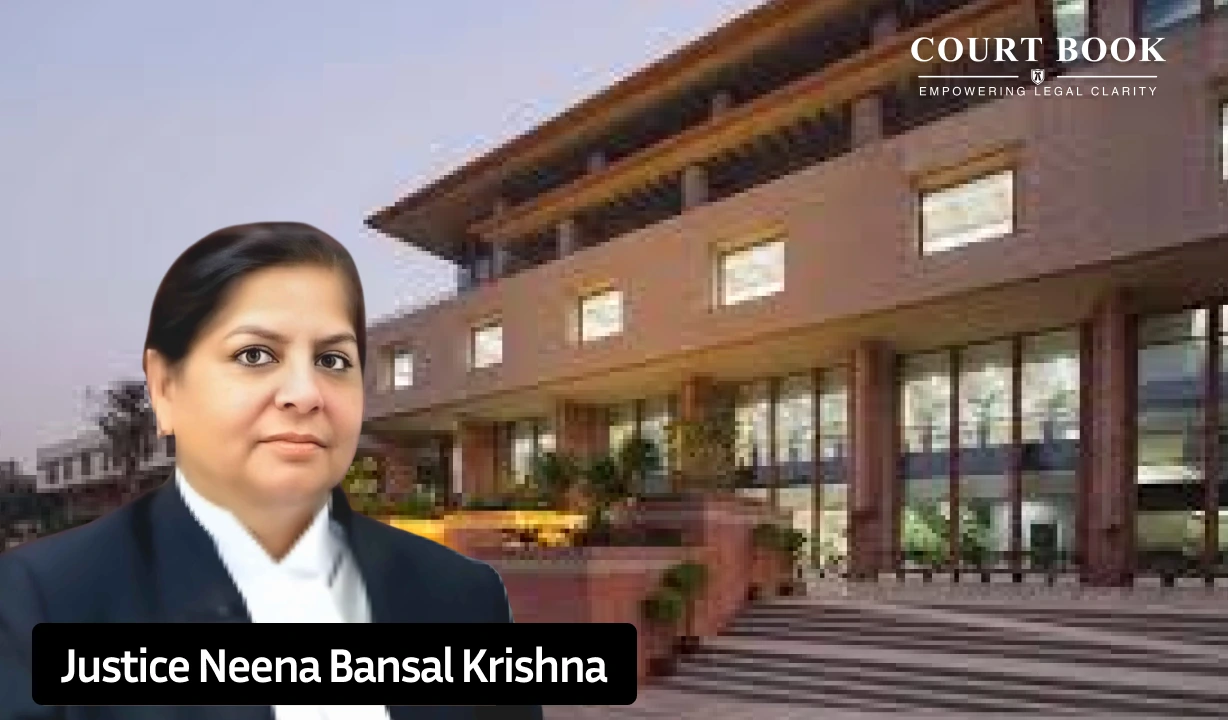
The Delhi High Court has dismissed a second appeal filed by a woman seeking protection of possession over a property in Bijwasan village, holding that she failed to establish either legal title or actual possession of the disputed premises.
Justice Neena Bansal Krishna observed that both the trial court and the appellate court had already returned concurrent findings of fact against the appellant, leaving no substantial question of law for consideration in the second appeal.
The appellant, Suraj Mukhi, had filed a civil suit seeking permanent and mandatory injunctions against her late husband’s brothers over a 50-square-yard property situated in Lal Dora Abadi, Village Bijwasan, New Delhi.
She claimed that the property had been gifted to her and her husband by her father-in-law through documents dated August 20, 1986, including a GPA, Gift Deed, Affidavit and Will. She further alleged that the respondents threatened to dispossess her and demolished a wall of the property in October 2018.
The defendants denied her claims and asserted that the property had fallen to their father’s share in a family settlement long ago. They also alleged that the documents relied upon by the plaintiff were forged and fabricated.
The trial court dismissed the suit in 2022, and the appellate court later upheld that decision in 2025.
Before the High Court, the appellant argued that even though the Gift Deed was unregistered, it could still be considered for collateral purposes. She also contended that the trial court wrongly examined questions of title in a suit for injunction.
However, the High Court did not accept these submissions.
“The learned Civil Judge had rightly observed that an unregistered Gift Deed cannot create any right, title, interest in favor of the Plaintiff,” the Court noted.
The bench further observed that the Will relied upon by the plaintiff had not been proved in accordance with the Evidence Act and therefore could not be read in evidence.
On the issue of possession, the Court said there was no convincing evidence showing that the plaintiff was actually occupying the property. It noted that the plaintiff herself admitted during cross-examination that the site plan relied upon by her was incorrect.
The Court also recorded that the defendants had consistently maintained that the disputed structure was merely a dilapidated room being used for storing fodder and household articles.
Dismissing the appeal, the High Court held that both lower courts had correctly concluded that the plaintiff failed to establish title, possession, or any right to seek reconstruction of the alleged demolished wall.
The Court ultimately ruled that the appeal raised no substantial question of law under Section 100 of the Code of Civil Procedure and therefore could not be entertained. The second appeal was dismissed along with pending applications.
Case Title: Suraj Mukhi v. Kaptan Singh & Ors.
Case Number: RSA 56/2026
Download Judgment

