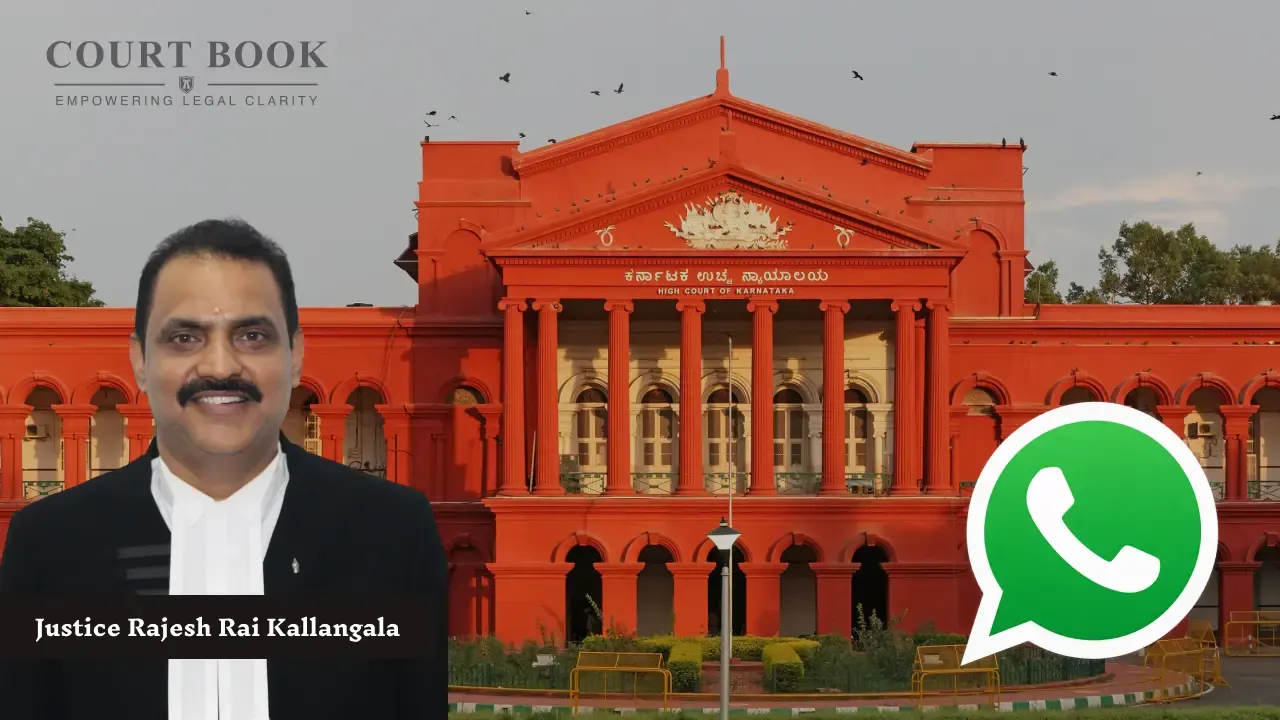
The Karnataka High Court at Bengaluru has quashed an FIR registered against Sri Venkappa Gowda over a WhatsApp status posted shortly after the announcement of the 2024 Lok Sabha election results. Justice Rajesh Rai K held that the allegations did not disclose the necessary ingredients of Section 505(2) of the Indian Penal Code (IPC).
Background of the Case
The case arose from a complaint lodged by respondent No. 2, identified in the judgment as Sri Venkappa N.P., on June 7, 2024. The complaint concerned a WhatsApp status allegedly uploaded by the petitioner on June 5, 2024, following the announcement of the Lok Sabha election results.
The status stated: “Modi ji has not lost, he has won and the people who have lost are born to Muslims.” The complainant alleged that the statement created enmity between communities, following which Subramanya Police registered Crime No. 38/2024 under Section 505(2) IPC.
The petitioner approached the High Court under Section 482 of the Code of Criminal Procedure (CrPC), seeking quashing of the FIR. His counsel argued that the WhatsApp status neither disclosed an intention to cause disorder or incite violence nor satisfied the requirements of Section 505(2) IPC. The State opposed the petition, contending that the complaint disclosed the ingredients of the alleged provision and that the investigation was still pending.
Court’s Observation
Justice Rajesh Rai K examined the contents of the complaint and the WhatsApp status. The Court found no apparent intention or motive to cause disorder or incite people to violence. It also considered the nature of a WhatsApp status in the circumstances of the case.
The Court observed:
“A careful reading of the said WhatsApp status does not disclose any semblance of intention or motive on the part of the petitioner to cause disorder or incite people to violence so as to attract the ingredients of Section 505(2) of IPC.”
The Court held that the essential requirement of publication or circulation under Section 505(2) IPC was absent, observing that the WhatsApp status, in the circumstances of the case, did not satisfy that requirement. It relied on the Supreme Court’s decision in Bilal Ahmed Kaloo v. State of A.P., which explains the distinction between Section 153-A and Section 505(2) IPC and the requirement of mens rea, meaning the necessary intention behind the alleged act.
Referring to the Supreme Court precedent, the High Court noted:
“The main distinction between the two offences is that while publication of the words or representation is not necessary under the former, such publication is sine qua non under Section 505.”
The Court also noted that Section 505(2) concerns promotion of enmity, hatred or ill will between different groups or communities, and that the provision requires the relevant statutory ingredients to be established.
Decision
Finding that there was no publication or circulation sufficient to attract Section 505(2) IPC on the complaint's averments, the High Court held that continuation of the criminal proceedings would amount to an abuse of the process of law.
The Court therefore quashed the FIR registered in Crime No. 38/2024 by Subramanya Police Station against the petitioner under Section 505(2) of the IPC. The petition was accordingly allowed.
Case Title: Sri Venkappa Gowda v. State of Karnataka & Another
Case Number: Criminal Petition No. 5909 of 2024













-300x169.webp)