

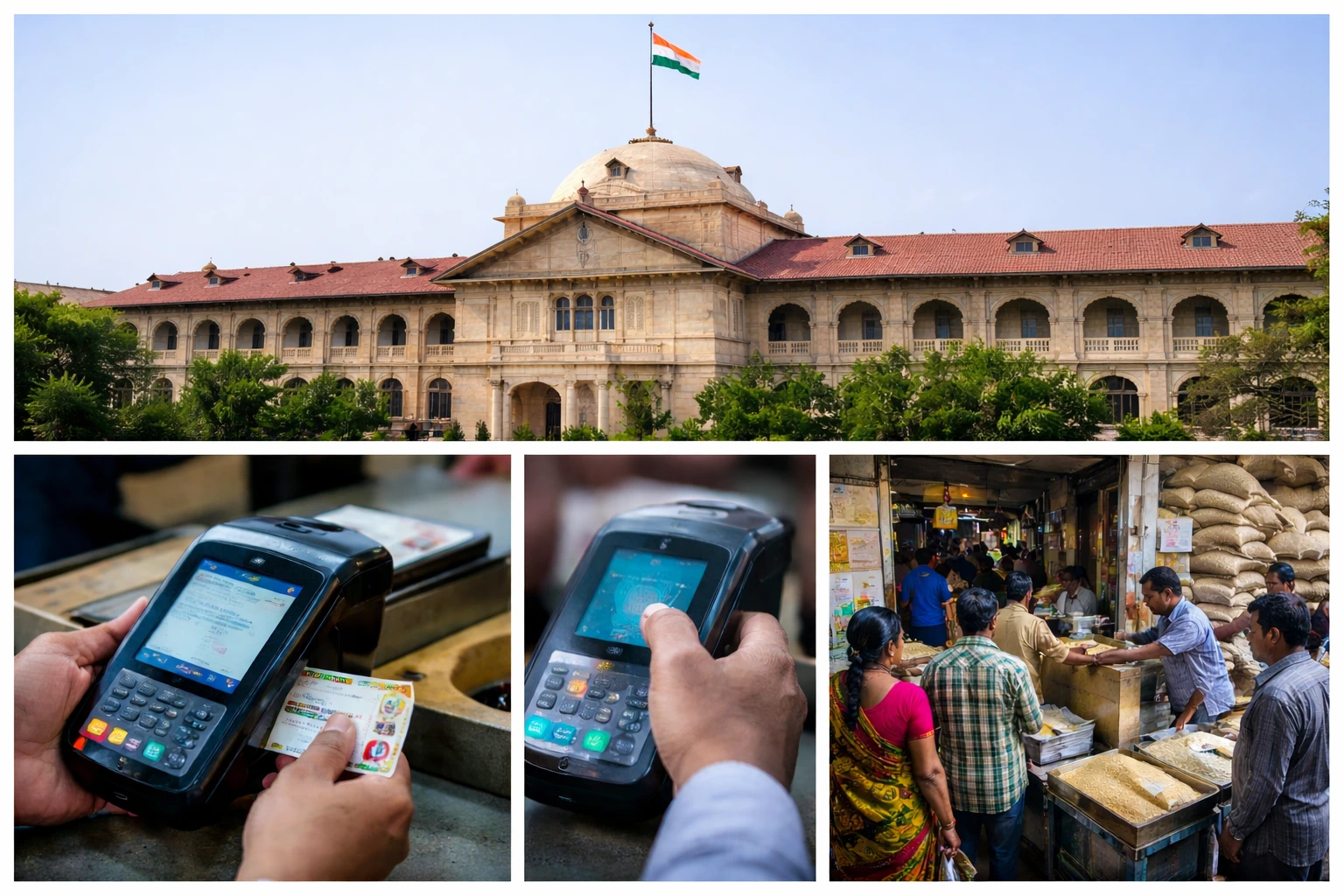
The Allahabad High Court has refused to interfere with the cancellation of a fair price shop licence after finding no satisfactory explanation for the alleged misuse of Aadhaar-linked ration distribution. Justice Arun Kumar dismissed a writ petition filed by Smt. Shahin Begum, who challenged the cancellation of her dealership following allegations that ration meant for hundreds of beneficiaries was withdrawn using only three Aadhaar numbers.
Background of the Case
The case arose from a large-scale verification exercise conducted in July 2018, when the National Informatics Centre (NIC) flagged irregularities in ration distribution across 43 districts of Uttar Pradesh. According to official records, ration meant for 697 cardholders was withdrawn using just three Aadhaar cards from the petitioner’s fair price shop in Ghaziabad.
Read also:- Gujarat High Court Declines to Relax GST Appeal Deadline, Dismisses Petition Over 6-Day Delay
Acting on this data, the Supply Inspector conducted an inquiry, following which an FIR was registered against the petitioner under provisions of the Information Technology Act and the Essential Commodities Act. The District Supply Officer suspended the petitioner’s dealership in August 2018 and later cancelled it on 10 January 2019. Her statutory appeal was dismissed on 2 September 2019, prompting her to approach the High Court.
Petitioner’s Stand
Before the Court, the petitioner denied any wrongdoing. She argued that no spot inspection had been carried out and that the alleged manipulation was technically impossible at her end. According to her, the Electronic Point of Sale (E-PoS) machine used for ration distribution was Aadhaar-enabled and biometric-based, leaving no scope for one Aadhaar number to be used multiple times.
Read also:- Gujarat High Court Sets Aside Income Tax Demand Against Swagat Infrastructure, Citing Time-Barred Assessment
She also claimed that during July 2018, the E-PoS machine had faced authentication errors and was sent briefly for repair. The petitioner attributed the irregular entries to a possible technical glitch in the NIC server. To support her claim, she produced affidavits from 162 cardholders, stating they had regularly received ration from her shop.
State’s Arguments
The State government strongly opposed the plea, asserting that the dealership was cancelled not merely because of the FIR, but due to concrete data showing abnormal transactions. The Additional Advocate General pointed out that the petitioner failed to explain how ration for 697 beneficiaries could be drawn using only three Aadhaar numbers.
The State relied on earlier judicial findings explaining how, during the transition phase of Aadhaar “feeding and seeding” in E-PoS machines, dealers had access to modify Aadhaar details during daytime operations before final locking in the evening. This vulnerability, the State argued, was exploited to siphon off ration meant for dormant or inactive cardholders.
Court’s Observations
After examining the record and earlier precedents, the Court found the petitioner’s defence unconvincing. It noted that the affidavits filed by 162 beneficiaries did not address the core allegation involving 697 cardholders.
The bench observed, “The use of three Aadhaar card numbers for withdrawal of ration meant for 697 cardholders has not been reasonably explained by the petitioner.”
The Court also rejected the argument of a mere “technical glitch,” holding that the pattern of transactions could not be brushed aside as a software error. It further clarified that the Government Order requiring a preliminary inquiry, relied upon by the petitioner, came into force after the cancellation order and therefore did not apply retrospectively.
Final Decision
Concluding that the authorities had acted within the framework of law and that no perversity or violation of natural justice was made out, the High Court dismissed the writ petition. The cancellation of the fair price shop dealership and the appellate order were allowed to stand, bringing the litigation to a close.
Case Title: Smt. Shahin Begum vs State of Uttar Pradesh & Others
Case Number: Writ – C No. 37032 of 2019
Download Order

