

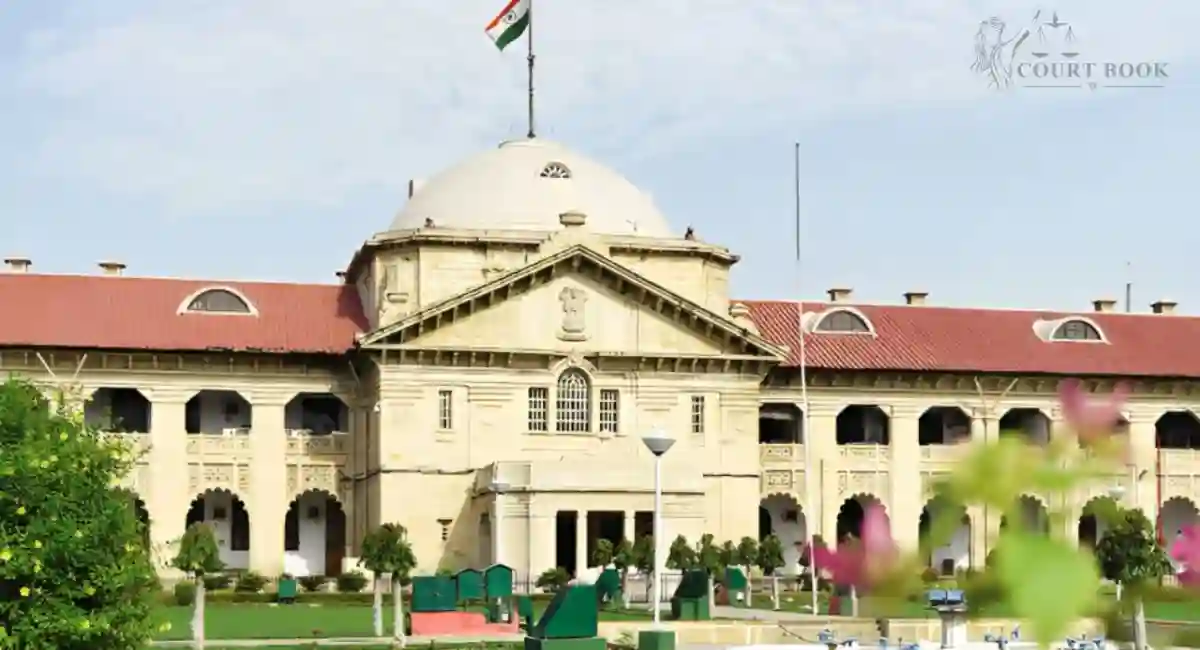
The Allahabad High Court has upheld the life imprisonment awarded to Ranjeet Patel for the murder of his cousin Ram Asrey, holding that minor inconsistencies in the testimony of family members do not weaken an otherwise reliable prosecution case. The Court found that the eyewitness accounts remained consistent on the core facts and were fully supported by medical evidence.
Background of the Case
The appeal arose from a judgment dated March 28, 2019, passed by the Sessions Judge, Jaunpur, convicting Ranjeet Patel under Section 302 of the Indian Penal Code (IPC) and sentencing him to life imprisonment with a fine of ₹10,000.
According to the prosecution, the incident occurred around 3:30 a.m. on May 26, 2015, in Village Lakhamipur, Jaunpur. The prosecution alleged that a dispute over money led Ranjeet Patel to confront his cousin Ram Asrey. After abusing him, the appellant allegedly struck Ram Asrey on the head with an iron weapon. The injured man was taken for medical treatment but was declared dead at BHU Hospital. An FIR was subsequently registered under Sections 302 and 504 IPC.
During the trial, the Sessions Court acquitted the appellant of the charge under Section 504 IPC but convicted him for murder under Section 302 IPC. Challenging that conviction, Ranjeet Patel approached the High Court.
Arguments Before the High Court
The defence argued that the conviction rested solely on the testimony of interested witnesses, as all eyewitnesses were close family members of the deceased. It also pointed to alleged contradictions regarding the sequence of events after the assault, the description of the weapon used, and the nature of injuries.
The appellant further contended that these inconsistencies made the prosecution version unreliable and that the trial court had failed to properly appreciate the evidence.
The State opposed the appeal, maintaining that the appellant had been specifically named in the FIR from the beginning and that the eyewitnesses had consistently described the assault. It submitted that the alleged contradictions were insignificant and did not affect the credibility of the prosecution case.
Court's Observations
After examining the evidence, the Division Bench found no material contradiction in the testimonies of the eyewitnesses. It observed that while there were slight differences regarding whether the injured was first taken to the police station or directly to the hospital, such discrepancies related only to subsequent events and not to the actual assault.
The Bench observed,
"The contradictions which figure in the evidence of this witness, are very minor ones, which... do not affect the prosecution story or worth of the evidence."
The Court also rejected the argument that the witnesses should be disbelieved merely because they were relatives of the deceased. Referring to settled principles laid down by the Supreme Court, it held that evidence of family members must be scrutinised carefully but cannot be discarded solely on the ground of relationship if it is otherwise reliable.
The Bench noted that the appellant alone had been named in the FIR despite several family members living together, which strengthened the prosecution's case against allegations of false implication.
On the issue of the weapon, the Court found no significant difference between the descriptions of an iron rod and a rambha (iron digging bar), observing that both were iron implements capable of causing the fatal injury reflected in the post-mortem report.
The medical evidence, particularly the fracture of the left temporal bone and the doctor's opinion regarding the cause of death, fully supported the prosecution version.
The Court further held that the witnesses could easily identify the appellant despite the incident occurring in the early hours of the morning because he was a close relative living in the same family premises.
Decision
Finding no illegality, perversity or infirmity in the trial court's appreciation of evidence, the Allahabad High Court dismissed the criminal appeal and affirmed the conviction and sentence imposed on Ranjeet Patel under Section 302 IPC. The Court directed that the trial court be informed and the lower court records be transmitted accordingly.
Case Details:
Case Title: Ranjeet Patel v. State of U.P.
Case Number: Criminal Appeal No. 4487 of 2019
Judge: Justice J.J. Munir and Justice Vinai Kumar Dwivedi
Decision Date: July 1, 2026


