

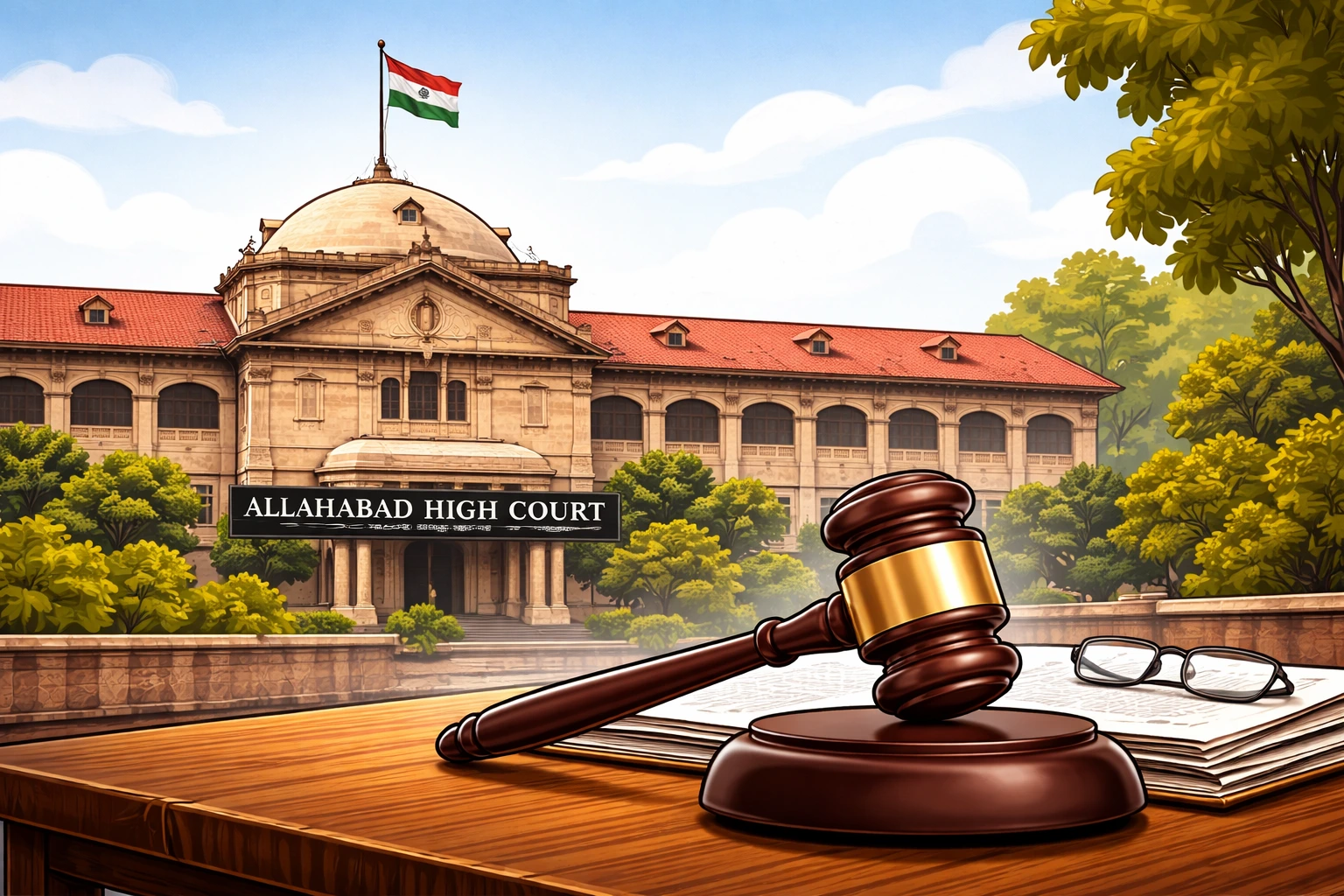
The Allahabad High Court has upheld the dismissal of a Provincial Armed Constabulary (PAC) constable who remained absent from duty for nearly five months without valid authorization. The Court ruled that the disciplinary action taken against him was lawful, well-reasoned, and supported by evidence, rejecting his claim that illness and personal hardship justified the prolonged absence.
Background of the Case
The case involved Ramesh Chandra Singh, a constable posted with the 25th Battalion of the PAC in Raebareli. In May 1999, he was granted two days’ casual leave. However, instead of returning on the scheduled date, he remained absent for 160 consecutive days, from 15 May to 20 October 1999.
Read also:- Father Living With Second Woman Can’t Seek Child Custody: Chhattisgarh HC Upholds Family Court Order
A departmental inquiry was initiated after repeated absence without permission. The charge sheet accused him of gross misconduct and negligence of duty. Singh claimed he could not rejoin due to illness and the collapse of his house, and later submitted medical certificates in support of his explanation.
Despite this, the disciplinary authority removed him from service in April 2000. His departmental appeal and revision were both rejected. He later approached the Allahabad High Court challenging the dismissal.
Court’s Observations
The High Court closely examined the inquiry records, witness statements, and medical evidence placed by the petitioner.
The Court noted that:
• The petitioner had not informed his superiors about illness in time.
• His initial leave extension application mentioned house damage, not illness.
• Medical certificates were issued later and contained inconsistencies.
• He was never admitted to a hospital during the claimed illness period.
• His absence stretched far beyond the period covered by medical documents.
Read also:- Supreme Court to Form Expert Panel on Aravalli Definition, Seeks Names of Environmentalists and Forest Experts
The Court also took note of his past service record, which showed repeated instances of unauthorized absence.
“The inquiry officer examined the evidence in detail and rightly concluded that the explanation offered was unreliable and contradictory,” the Bench observed.
On the Claim of Illness and Forced Absence
The petitioner relied on Supreme Court judgments stating that absence due to genuine illness cannot be treated as misconduct. However, the High Court clarified that such protection applies only when illness is genuine and properly proved.
The Bench noted:
“Unauthorized absence can be excused only when compelling circumstances are clearly established. In the present case, the petitioner failed to do so.”
The Court also observed that the medical certificates were not supported by hospital records and appeared to have been obtained later to justify the absence.
Read also:- Police Can’t Parade Accused as Criminals: Rajasthan High Court Orders Removal of Arrest Photos from
Disciplinary Process Found Fair
Rejecting the argument of procedural unfairness, the Court held that:
• The charge sheet was properly served
• The petitioner was given full opportunity to defend himself
• Witnesses were examined in his presence
• He chose not to reply to the show-cause notice
The Court ruled that there was no violation of natural justice or service rules.
Final Decision
Dismissing the writ petition, the High Court held that:
• The absence was willful and unjustified
• The inquiry was conducted fairly
• The punishment of removal from service was proportionate
• No interference was warranted under Article 226
The Court concluded:
“The disciplinary authority committed no error in awarding the punishment. The writ petition is devoid of merit and stands dismissed.”
Case Title: Ramesh Chandra Singh vs State of Uttar Pradesh
Case Number: Writ-A No. 6218 of 2004
Decision Date: 20 January 2026
Download Judgment

