

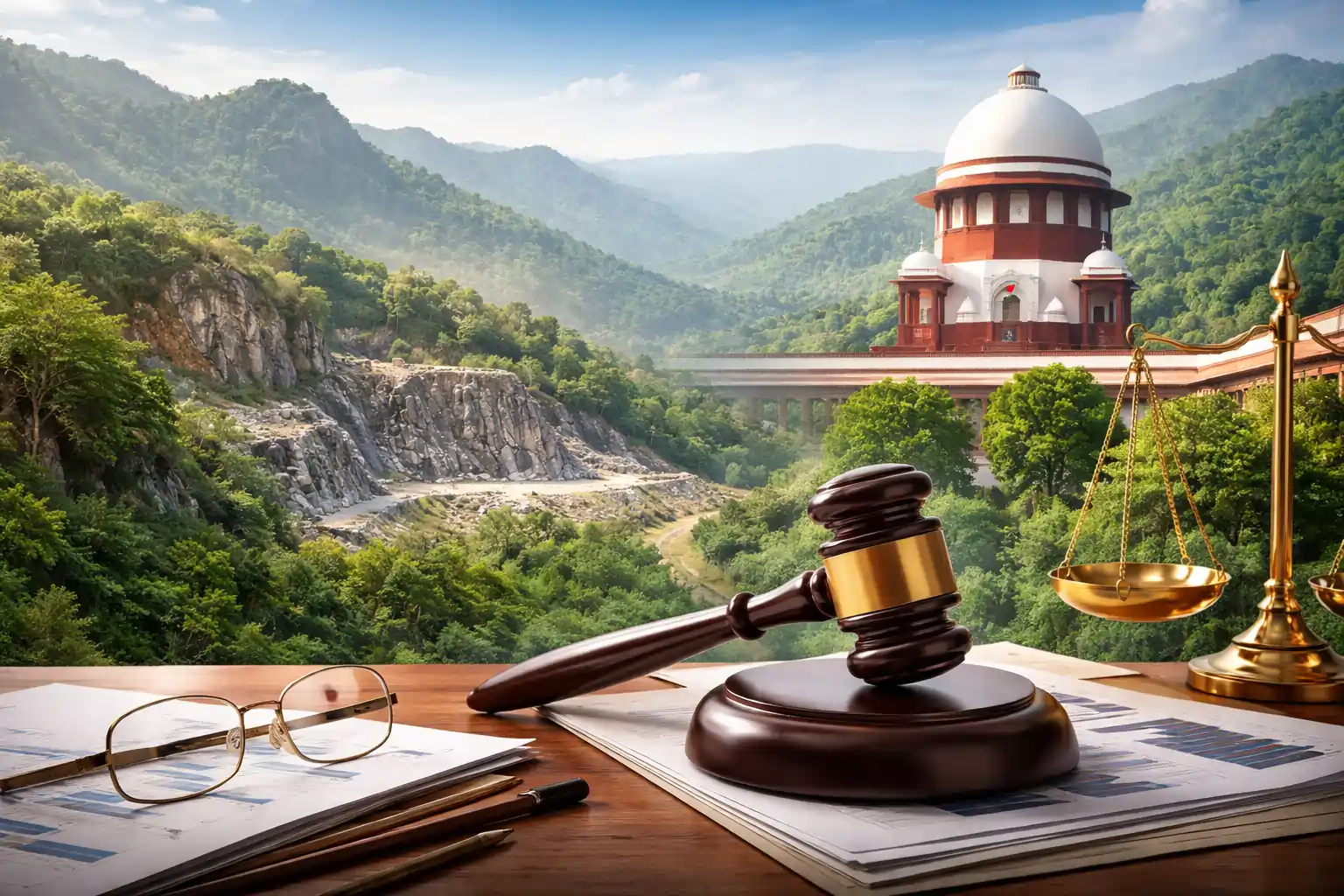
The Supreme Court on Tuesday moved a step closer to resolving the long-standing dispute over the definition of the Aravalli Hills and the environmental impact of mining in the region. The top court said it would constitute an expert committee to examine the issue in depth and sought suggestions of eminent environmentalists and forest experts for the panel.
The court made it clear that the proposed committee would function under its direct supervision, signalling the seriousness with which it intends to deal with concerns surrounding mining and ecological degradation in the Aravalli range.
Read also:- Allahabad High Court Upholds Life Term in 1987 Murder Case, Dismisses Appeal After 35 Years
Background of the Case
The matter traces back to November last year, when the Supreme Court had approved a technical definition of the Aravalli Hills based on recommendations of an expert body. The definition stated that any landform with an elevation of 100 metres or more would qualify as an Aravalli hill, and a range would exist where two such hills were located within 500 metres of each other.
However, the decision triggered widespread concern among environmentalists and civil society groups, who warned that nearly 90 percent of the Aravalli region could fall outside protection and become open to mining.
In an unusual move, the Court stayed its own earlier order on December 29, 2025, and took up the matter suo motu after public outcry and reports of continued mining activity.
Read also:- Delhi High Court Upholds POCSO Conviction, Modifies Sentence in Child Abuse Case
Court’s Observations
During the latest hearing, a Bench led by Chief Justice of India Surya Kant, along with Justices Joymalya Bagchi and Vipul Pancholi, noted that illegal mining could cause irreversible damage.
“The expert committee shall work under the direct control and supervision of this Court,” the Bench observed, while directing the amicus curiae and law officers to suggest suitable experts for the panel.
Senior Advocate Raju Ramachandran, appearing for farmers from Rajasthan, informed the Court that fresh mining leases had been granted in some areas. Responding to this, the Chief Justice said:
“Illegal mining can lead to irreversible consequences. It is an ex facie crime and must be stopped.”
Senior Advocate Kapil Sibal, representing an intervenor, questioned whether mountain ranges could be defined rigidly.
“Mountains cannot be defined. There is sub-tectonic movement which keeps changing. Defining the Aravallis may open a larger problem,” he told the Bench.
Read also:- Karnataka High Court Quashes Rape FIR in Live-In Relationship Case, Calls It Consensual, Not Criminal
Assurance from Rajasthan Government
Additional Solicitor General K.M. Nataraj, appearing for Rajasthan, assured the Court that no illegal mining would be allowed in the Aravalli region. The Court recorded this assurance and directed that the interim order restraining mining would continue.
The Bench also clarified that all intervention applications would be examined in a non-adversarial manner by the amicus curiae.
Court’s Decision
The Supreme Court directed:
• Formation of an expert committee to examine the definition of the Aravalli Hills and related environmental issues
• Names of environmentalists and forest experts to be suggested by the amicus and law officers
• The committee to function under the Court’s supervision
• Continuation of interim orders restraining mining activities
• Listing of the matter after four weeks
The Court reiterated that any illegal mining would be dealt with strictly and that protecting the fragile ecology of the Aravalli range remains a priority.
Case Title: In Re: Definition of Aravalli Hills and Ranges and Ancillary Issues
Case Number: SMW (C) No. 10/2025


