

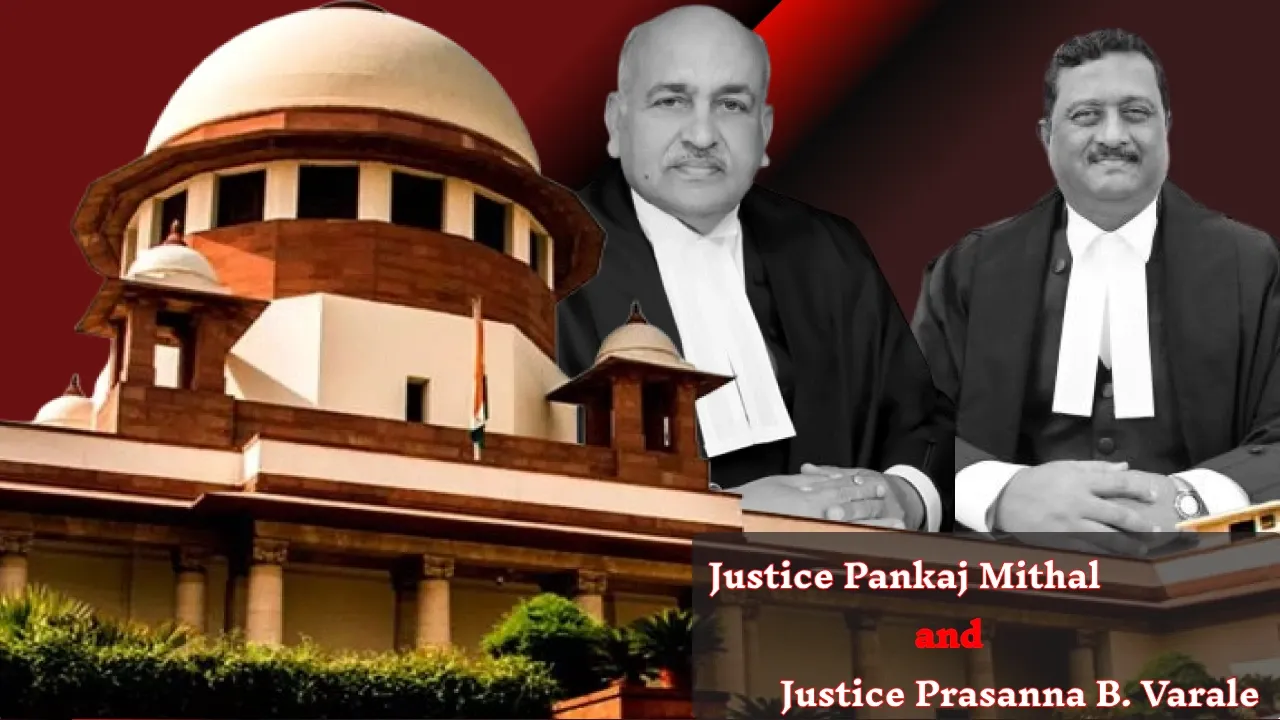
The Supreme Court has refused to interfere with the acquittal of several Central Excise officials accused in a 1995 bribery case, observing that the prosecution failed to prove the essential ingredients of demand and acceptance of illegal gratification.
A Bench of Justice Pankaj Mithal and Justice Prasanna B. Varale dismissed the appeals filed by the State of Uttar Pradesh against a 2019 Allahabad High Court judgment that had acquitted the accused officers.
Background of the Case
The case originated from a complaint made by Kuldeep Tiwari, a consultant connected with M/s Amoli Ceraplast Ltd. According to the prosecution, officials of the Central Excise Department had inspected the factory premises in Barabanki in January 1995 and allegedly seized records without issuing acknowledgment receipts.
The complainant later alleged that officer R.K. Srivastava demanded ₹80,000 for returning the documents. A trap was then arranged by the CBI, following which cash was allegedly recovered during a raid conducted on January 14, 1995.
In 2014, the Special Judge at Lucknow convicted several accused officers under provisions of the Indian Penal Code and the Prevention of Corruption Act. However, the Allahabad High Court later acquitted them after re-examining the evidence.
Court’s Observations
The Supreme Court agreed with the High Court’s conclusion that the prosecution evidence was unreliable and insufficient to sustain conviction.
“The evidence was wholly insufficient to establish even the basic requirements such as demand and acceptance,” the Bench observed.
The Court reiterated that proof of demand for bribe is mandatory in corruption cases under the Prevention of Corruption Act.
“It is a well settled position of law that the demand for the bribe money is sine qua non to convict the accused,” the judgment said.
The Bench also noted that several prosecution witnesses, including independent witnesses, did not support the prosecution case. The Court found that mere recovery of tainted money could not automatically establish guilt unless demand and voluntary acceptance were proved beyond reasonable doubt.
Missing Evidence and Conspiracy Charge
A major issue highlighted by the Court was the prosecution’s failure to produce an alleged tape recording of the conversation in which the demand for bribe was supposedly made.
The High Court had earlier observed that the tape recorder was “concealed by the prosecution,” and the Supreme Court noted that withholding such material evidence justified drawing an adverse inference against the prosecution.
The Bench further held that the charge of criminal conspiracy under Section 120-B IPC was also not established.
According to the Court, there was no clear evidence showing a “meeting of minds” between the accused officers to carry out an illegal act.
Decision
After examining the record, the Supreme Court held that the High Court’s acquittal order was a “possible and plausible view” based on the evidence available.
“The prosecution has failed to establish beyond reasonable doubt the essential ingredients of demand, acceptance and criminal conspiracy,” the Bench concluded while dismissing the appeals filed by the State.
The criminal appeals were accordingly dismissed.
Case Details
Case Title: State of Uttar Pradesh v. A.K. Gaba & Ors.
Case Number: Criminal Appeal Nos. 3383-3385 of 2025
Judge: Justice Pankaj Mithal and Justice Prasanna B. Varale
Decision Date: May 27, 2026


