

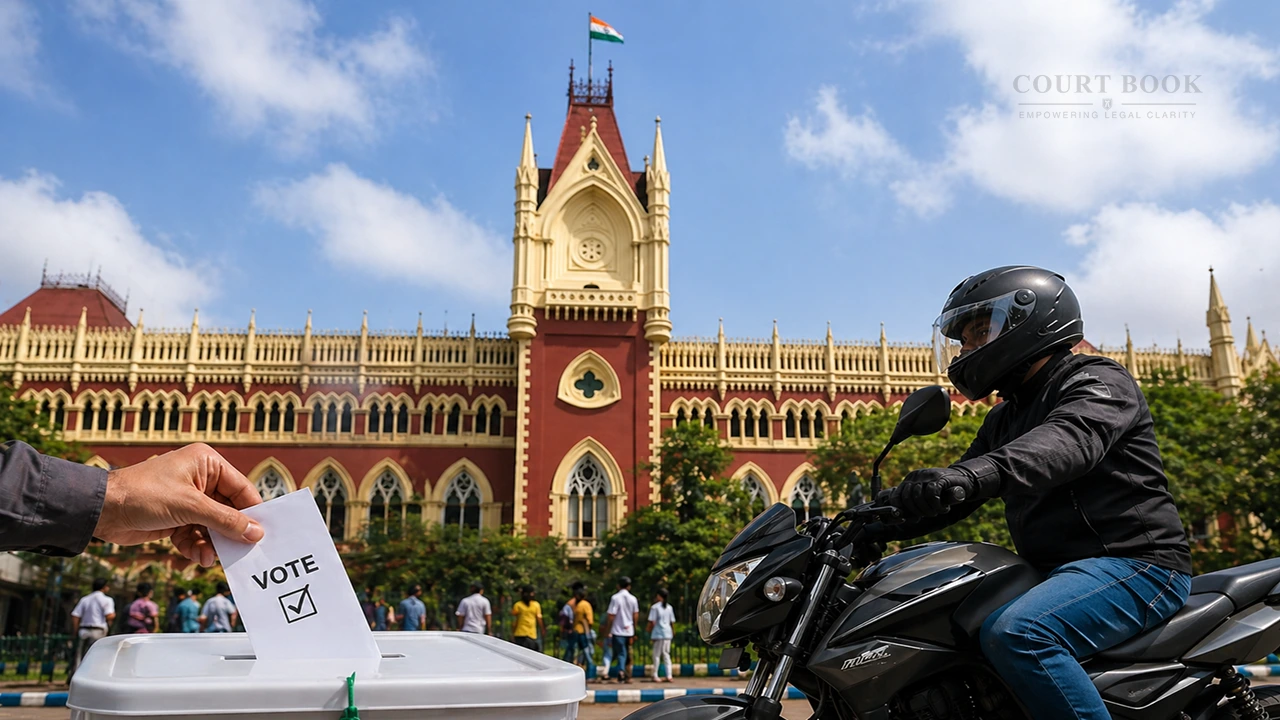
In a significant ruling ahead of the West Bengal elections, the Calcutta High Court stepped in to partially modify restrictions imposed on motorcycle movement during polling days. The court made it clear that while maintaining law and order is important, sweeping restrictions without legal backing cannot stand.
Background of the Case
The matter arose from a petition filed by Ritankar Das, who challenged an order dated April 20, 2026, issued by the Chief Electoral Officer. The order placed broad restrictions on motorcycle riding starting two days before polling and on the polling day itself.
The petitioner argued that the directive lacked legal authority and violated fundamental rights. He also pointed out that even after a modification on April 21 which allowed exemptions for delivery services and office commuters the core restrictions on general motorcycle use remained unchanged.
Justice Krishna Rao examined whether such restrictions were supported by existing election laws. The court acknowledged the wide powers of the Election Commission under Article 324 of the Constitution but emphasized that these powers must align with statutory provisions.
The bench noted that neither the Representation of the People Act, 1951 nor the standard operating procedures (SOPs) for elections specifically authorize a blanket restriction on motorcycle riding.
“The authorities failed to justify under which provision of law such restrictions were imposed,” the court observed.
It further stated that while preventing bike rallies may be reasonable to curb potential violence, restricting individual motorcycle use for 48 hours before polling lacked justification.
“In the name of free and fair poll, the authorities cannot pass a blanket restriction,” the court remarked.
The Election Commission defended the order, saying it was issued to ensure peaceful and violence-free elections. It cited past incidents where vehicles were allegedly used to intimidate voters and influence polling.
The Commission also relied on its constitutional powers and provisions under election laws to justify preventive measures. However, the court found that these provisions did not extend to a complete restriction on motorcycle movement.
After hearing all sides, the High Court modified the impugned orders instead of striking them down entirely.
The court ruled that:
• Motorcycle rallies will remain prohibited from two days before polling.
• Pillion riding will be restricted only during the 12 hours before polling, with exceptions for emergencies and essential needs.
• On polling day, family pillion riding is permitted between 6 a.m. and 6 p.m. for voting and essential purposes.
• Exemptions for delivery services and office commuters with valid identification will continue.
With these modifications, the writ petition was disposed of.
Download Order

