

The Calcutta High Court on Tuesday examined a Public Interest Litigation (PIL) challenging large-scale transfer orders issued by the Election Commission of India (ECI) ahead of elections. The petition alleges that the transfers were arbitrary and lacked proper justification.
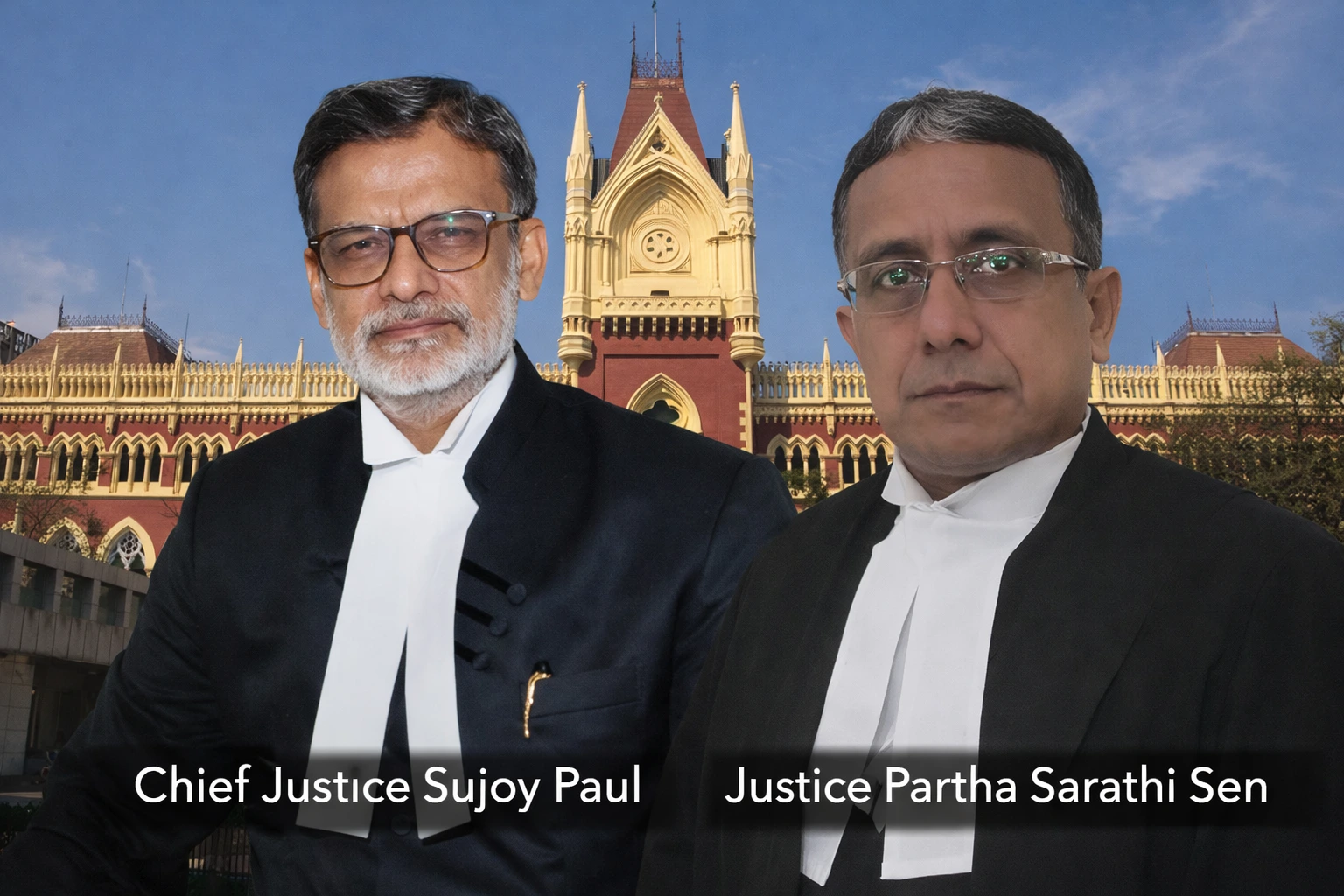
The matter was heard by a Division Bench led by Chief Justice Sujoy Paul and Justice Partha Sarathi Sen.
Background of the Case
The petitioner, an advocate, approached the Court questioning the legality of multiple transfer orders issued shortly after the ECI announced elections on March 15, 2026.
According to the plea, several senior officials including the Chief Secretary, Home Secretary, Director General of Police, District Magistrates, and Superintendents of Police were shifted. It was argued that these officers were actively involved in governance and development work in the State.
The petitioner contended that such widespread transfers could disrupt administrative functioning and affect governance during a crucial period.
Petitioner’s Arguments
Senior Advocate Kalyan Bandopadhyay, appearing for the petitioner, argued that the ECI’s powers under Article 324 of the Constitution are not unlimited.
He told the Court that,
“The Commission may ensure free and fair elections, but it cannot act in an arbitrary or mala fide manner.”
The petitioner further claimed that the scale of transfers created a situation similar to central interference in State functioning. It was also pointed out that some officers were moved despite earlier directions stating they should not be engaged in election duties.
Read also:- Can Women Aged Above 50 Years Seek IVF Treatment Despite Legal Restrictions? Bombay High Court To Consider
Another key argument was that statutory provisions under the Representation of the People Acts, 1950 and 1951, govern such actions. The petitioner maintained that the ECI must act within these legal boundaries and cannot override them through executive instructions.
State Government’s Stand
Supporting the petitioner, Advocate General Kishore Datta argued that the ECI’s actions risked weakening the State administration.
He submitted that the Commission’s authority is limited to election-related supervision and does not extend to controlling the entire State machinery. Emphasising constitutional limits, he stated that only specific officers assigned to election duties can be placed under the ECI’s control.
“The attempt appears to be to ‘numb’ the State machinery,” he argued, questioning the scale and timing of the transfers.
Read also:- Kerala High Court Flags Mediation Gaps, Secures ₹11 Crore Victim Compensation Fund
ECI’s Defence
Senior Counsel D.S. Naidu, representing the ECI, defended the transfers, stressing the Commission’s constitutional responsibility to ensure free and fair elections.
He argued that the ECI is an independent body and its decisions are guided by the need to maintain neutrality during elections. Allegations of arbitrariness were strongly denied.
The ECI also questioned the maintainability of the PIL, pointing out that the petitioner was associated with the State government and had not approached the Court with complete transparency.
Court’s Observations
The Bench noted the competing arguments regarding the scope of Article 324 and the interplay between constitutional powers and statutory provisions.
Read also:- Exaggerated Income Claims in Maintenance Cases Not Enough for Perjury Action: Allahabad HC
It recorded that the issue raised involved significant questions about the balance between the Election Commission’s authority and the functioning of an elected State government.
The Court also took note of submissions regarding the requirement of assigning reasons for administrative decisions such as transfers.
Decision
After hearing the parties at length, the Court reserved its judgment on March 27, 2026, and delivered its decision on March 31, 2026.
Case Details
Case Title: Arka Kumar Nag vs. Election Commission of India & Ors.
Case Number: WPA (P) 141 of 2026
Court: Calcutta High Court
Judges: Chief Justice Sujoy Paul & Justice Partha Sarathi Sen
Decision Date: 31 March 2026
Download Order

