

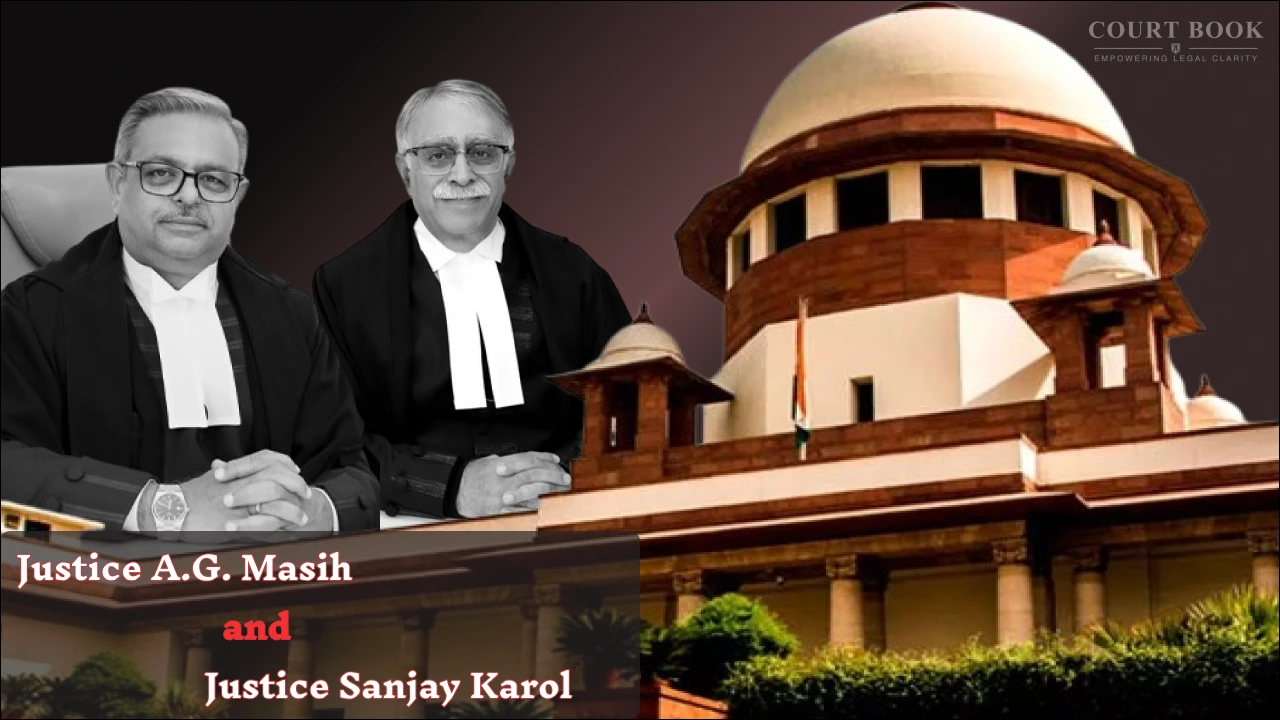
The Supreme Court has altered the conviction of a Madhya Pradesh man from murder to attempt to murder, holding that the prosecution failed to prove he shared a “common intention” with the main accused in a 1999 firing incident that led to a man’s death.
A bench of Justice Sanjay Karol and Justice Augustine George Masih observed that mere presence at the crime scene could not automatically attract liability under Section 34 of the Indian Penal Code unless there was clear evidence of a prior meeting of minds.
Background of the Case
The case arose from a firing incident that took place on May 12, 1999, in Ratlam district of Madhya Pradesh. According to the prosecution, Deshpal Singh was attacked by multiple persons using firearms and other weapons. He later died during treatment, following which the offence was converted from attempt to murder to murder.
Sanjay Singh and another accused were convicted by the trial court under Section 302 read with Section 34 IPC and sentenced to life imprisonment in 2001. The Madhya Pradesh High Court later upheld the conviction.
Before the Supreme Court, Sanjay Singh argued that no fatal injury had been attributed to him and that there was no evidence showing he acted with a shared intention to commit murder.
The Supreme Court closely examined the dying declaration, witness testimonies, and circumstances surrounding the incident.
The bench noted that the prosecution evidence did not clearly establish that Sanjay Singh fired the fatal shot or caused injuries leading to the victim’s death. The Court also found that he had allegedly arrived at the spot after the principal accused and from a different direction, weakening the prosecution’s claim of a pre-planned attack.
Referring to earlier judgments on Section 34 IPC, the Court reiterated that common intention requires proof of prior concert or a shared plan.
“The evidence on record falls short of establishing either a prior meeting of minds or any active participation on the part of the Appellant in the infliction of the fatal injury,” the bench observed.
The Court further said that mere presence at the place of occurrence could not be treated as proof of common intention.
At the same time, the bench noted that the appellant was present at the scene with a firearm and was aware of the serious nature of the incident. Because of this, his involvement could not be treated as insignificant.
The Supreme Court partly allowed the appeal and set aside Sanjay Singh’s conviction under Section 302 read with Section 34 IPC. Instead, the Court convicted him under Section 307 IPC for attempt to murder.
Considering that the appellant had already spent about nine years and nine months in custody without remission, the bench reduced his sentence to the period already undergone.
The Court also directed that since he was already on bail during the appeal, he would not be required to surrender unless wanted in any other case.
Case Details
Case Title: Sanjay Singh v. State of Madhya Pradesh
Case Number: Criminal Appeal No. 440 of 2013
Judges: Justice Sanjay Karol and Justice Augustine George Masih
Decision Date: May 8, 2026
Download Judgment

