

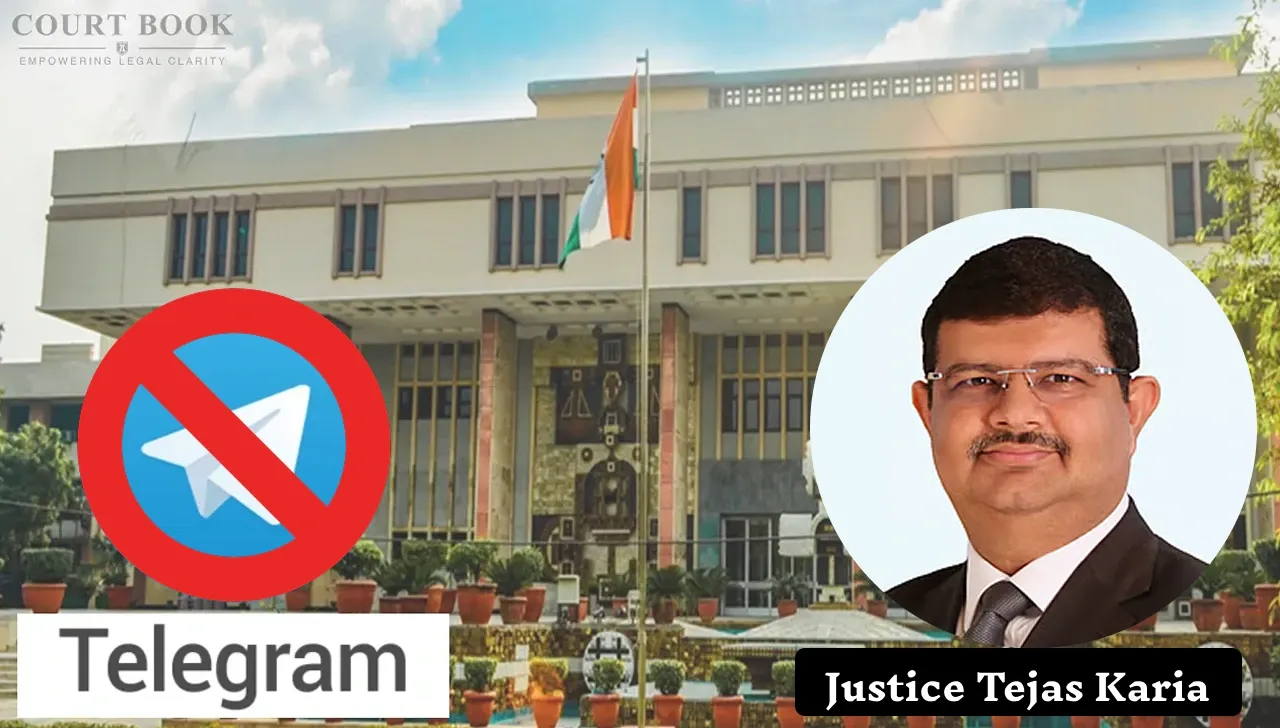
The Delhi High Court on Friday refused to interfere with the Centre's decision to temporarily block Telegram across India during the NEET-UG 2026 re-examination period, holding that the government had acted within its powers under the Information Technology Act and that the measure satisfied the constitutional test of proportionality.
Justice Tejas Karia dismissed a petition filed by Telegram FZ LLC challenging the blocking orders issued by the Ministry of Electronics and Information Technology (MeitY), which had cited widespread misuse of the platform for examination-related fraud and misinformation.
Background of the Case
The dispute arose after the National Testing Agency (NTA) informed MeitY that several Telegram channels and bots were allegedly being used to circulate fake examination papers, misleading information, and fraudulent schemes linked to NEET-UG 2026.
Following complaints from the NTA and the Ministry of Home Affairs, MeitY initiated discussions with Telegram and shared lists of channels and URLs that were allegedly involved in examination-related misconduct.
Despite Telegram removing hundreds of reported channels and accounts, government agencies maintained that new channels and backup networks continued to emerge. On June 16, 2026, MeitY issued an emergency order directing the temporary blocking of Telegram in India until June 22, 2026, and ordered the platform to disable its message-editing feature until June 30, 2026.
Telegram challenged the decision before the High Court, arguing that the government had imposed an excessive and disproportionate restriction affecting millions of lawful users.
Telegram's Arguments Before the Court
Telegram contended that it had cooperated with Indian authorities throughout the process and had already taken down a substantial number of reported channels.
The company argued that a platform-wide ban was an extreme step and that less restrictive alternatives, such as removing specific channels or posts, could have addressed the government's concerns.
It further submitted that Section 69A of the Information Technology Act permits blocking of specific information and not an entire communication platform.
According to Telegram, the blocking order affected more than 150 million users in India who relied on the platform for legitimate purposes, including educational discussions and study-related activities.
Government's Stand
The Centre defended the action, stating that Telegram's architecture allowed rapid re-creation of channels, migration of subscribers, use of bots, and widespread dissemination of information.
Government lawyers argued that repeated takedown efforts had failed because operators could quickly establish mirror channels and continue their activities.
The government also highlighted concerns regarding Telegram's message-editing feature, claiming it could be used to alter old messages and create the false impression that examination papers had been leaked before the exam.
It maintained that the temporary restriction was necessary to protect the integrity of the NEET-UG re-examination and prevent public disorder.
Court's Observations
The Court first rejected Telegram's argument that the blocking order suffered from non-application of mind.
Justice Karia noted that the government had considered material placed before it and had recorded reasons for its decision. The Court observed that emergency blocking orders under Section 69A are followed by a post-decisional hearing process, and the final order contained detailed reasons supporting the government's action.
"The reasons supplied in arriving at the decision were sufficient," the Court observed.
On the issue of statutory power, the Court held that the term "information" under the Information Technology Act is broad enough to include software, codes, computer programs, and databases. As a result, the government's power under Section 69A was not limited to individual posts or messages.
The Court held that an application such as Telegram falls within the scope of the statutory framework governing computer resources and information.
Court on Proportionality of the Ban
Addressing the central challenge, the Court examined whether the temporary ban met the constitutional requirement of proportionality.
The judgment noted that Telegram's technical features—including large public channels, cloud-based storage, automated bots, and rapid audience migration mechanisms—allowed information to spread quickly and made enforcement against individual channels difficult.
The Court recorded that authorities had already attempted narrower measures, including channel-specific removals, but these efforts had not succeeded in preventing re-emergence of the alleged fraudulent networks.
"The requirements of proportionality stand fulfilled," the Court said, adding that the restrictions were temporary, linked to a specific examination event, and limited in duration.
According to the Court, the government had identified a legitimate objective, established a rational connection between the measure and that objective, and adopted what it considered the least restrictive option available in the circumstances.
Decision
Dismissing Telegram's petition, the Delhi High Court upheld both the interim and final blocking orders issued under Section 69A of the Information Technology Act.
The Court concluded that the government possessed the legal authority to block the platform and that the temporary restrictions imposed in connection with the NEET-UG 2026 re-examination were lawful and proportionate.
The writ petition, along with pending applications, was accordingly dismissed.
Case Details:
Case Title: Telegram FZ LLC & Anr. v. Union of India & Ors.
Case Number: W.P.(C) 8259/2026
Judge: Justice Tejas Karia
Decision Date: 19 June 2026


