

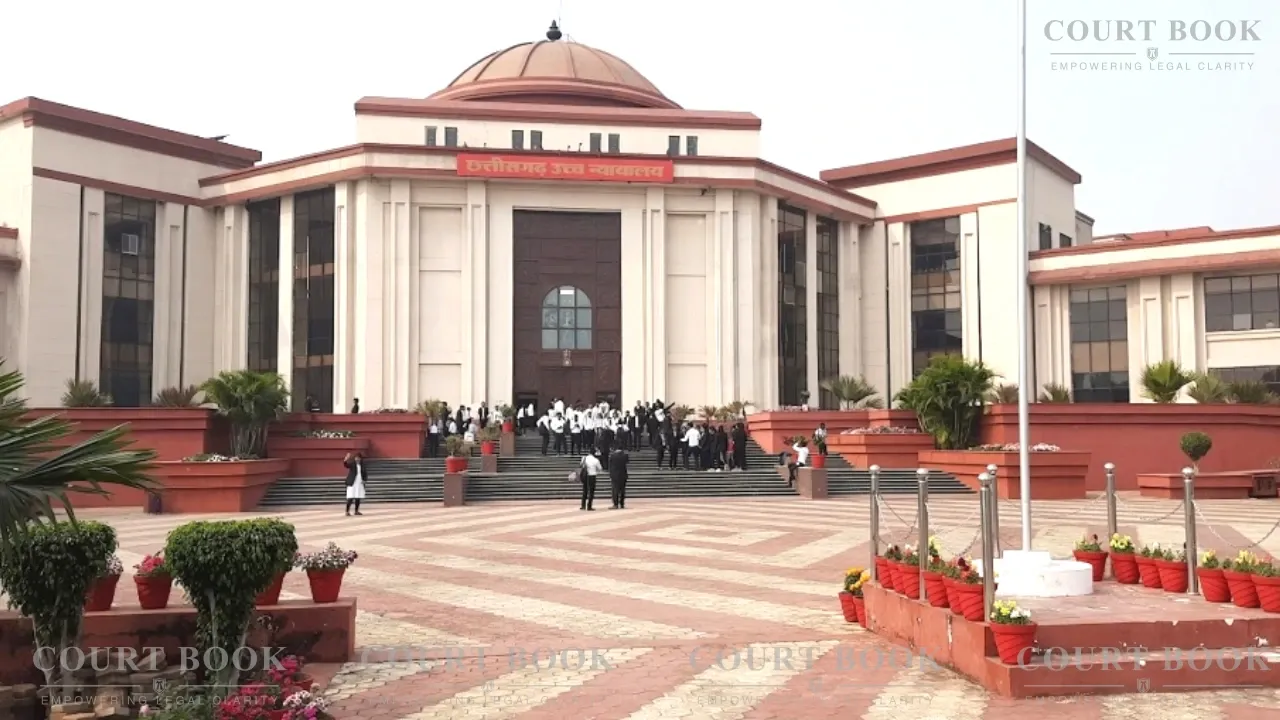
The Chhattisgarh High Court has refused to excuse a delay of 583 days in filing a writ appeal by the State government, holding that routine administrative procedures and departmental formalities cannot justify such an extraordinary delay. The Division Bench emphasized that government departments are bound by the same law of limitation as every other litigant and cannot expect automatic relaxation merely because they are State authorities.
Background of the Case
The appeal was filed by the State of Chhattisgarh, the Directorate of Higher Education, and the management of C.M.D. College against an order passed by a Single Judge on August 20, 2024, in a batch of service matters concerning retired Assistant Professor Dr. S. N. Tiwari.
The State sought condonation of a delay of 583 days before the appeal could be heard on merits. According to the government, the delay occurred because the proposal for filing the appeal had to pass through various departments before reaching the Advocate General's office, after which certified copies and relevant records were collected and the appeal was prepared.
Counsel for Dr. Tiwari opposed the application, pointing out that similar writ appeals filed by the State had already been dismissed by the High Court in 2023 and that the Special Leave Petition challenging those decisions had also been dismissed by the Supreme Court on the ground of delay in November 2025.
Court's Observations
The Division Bench, comprising Chief Justice Ramesh Sinha and Justice Ravindra Kumar Agrawal, examined whether the State had shown "sufficient cause" under the law for condoning such a substantial delay.
Referring to several Supreme Court decisions, including Postmaster General v. Living Media India Ltd., State of Madhya Pradesh v. Ramkumar Choudhary, and Shivamma v. Karnataka Housing Board, the Bench reiterated that delay cannot be condoned as a matter of routine simply because the applicant is a government department.
The Bench observed:
"Government departments are under a special obligation to discharge their duties with due diligence and commitment. Condonation of delay is an exception, not the rule, and cannot be claimed as a matter of right or anticipated privilege by Government entities."
The Court noted that merely stating the movement of files between departments and completion of official formalities did not constitute a satisfactory explanation for the delay.
It further held:
"The State has miserably failed to demonstrate sufficient cause warranting the condonation of an inordinate delay of 583 days."
According to the Bench, the explanation lacked specific facts showing why the appeal could not have been filed within the prescribed limitation period.
Court's Decision
Finding no convincing or bona fide explanation for the delay, the High Court declined to exercise its discretionary power to condone the 583-day delay.
The Bench also took note of the fact that the State's Special Leave Petition arising from similar matters had already been dismissed by the Supreme Court on the ground of delay.
Consequently, the application for condonation of delay was rejected, and the writ appeal was dismissed solely on the ground of delay and laches, without examining the merits of the underlying service dispute.
Case Details
Case Title: State of Chhattisgarh & Others v. Dr. S. N. Tiwari
Case Number: WA No. 533 of 2026
Judges: Chief Justice Ramesh Sinha and Justice Ravindra Kumar Agrawal
Decision Date: July 1, 2026


