

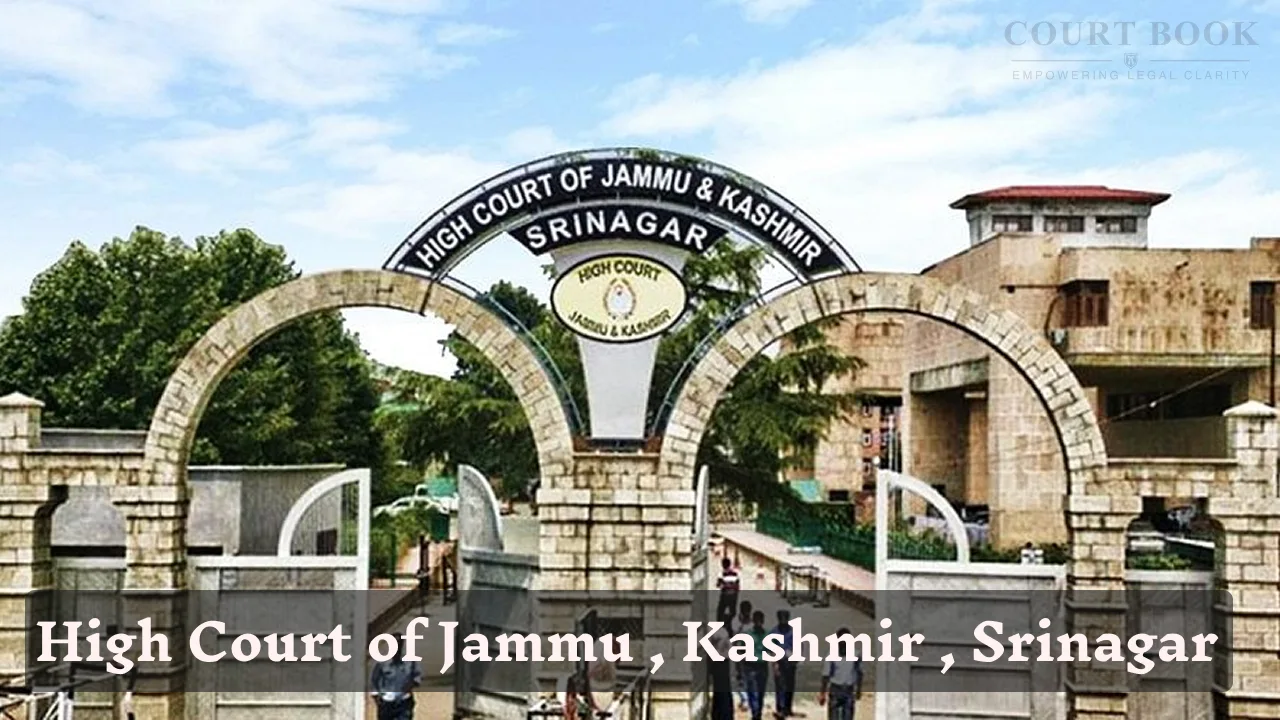
The High Court of Jammu & Kashmir and Ladakh has upheld the termination of a contractual employee working under the Ex-Servicemen Contributory Health Scheme (ECHS), ruling that the action was taken in accordance with the terms of his contract and was not punitive in nature.
A Division Bench comprising Justice Sindhu Sharma and Justice Shahzad Azeem dismissed the Letters Patent Appeal filed by Manzoor Ahmad Bhat, challenging an earlier decision of a Single Judge that had rejected his writ petition.
Background of the Case
Manzoor Ahmad Bhat was appointed as a Laboratory Assistant under the ECHS in October 2004. His engagement was contractual and was extended periodically through fresh agreements.
In 2007, the authorities issued a notice proposing termination of his services. After considering his reply, the competent authority terminated his engagement on 19 June 2007.
The employee approached the High Court, arguing that the termination order was illegal because no departmental inquiry had been conducted. He also claimed that the order carried a stigma and was based on allegations affecting his reputation.
A Single Judge dismissed the petition in August 2023, leading to the present appeal before the Division Bench.
Arguments Before the Court
The appellant contended that even a contractual employee cannot be removed on allegations amounting to misconduct without being given a proper opportunity to defend himself through a formal inquiry.
To support this argument, reliance was placed on the Supreme Court's decision in Anoop Jaiswal v. Government of India.
The Union of India and other respondents argued that the appellant was engaged purely on contractual terms and that the agreement specifically permitted termination after notice. They also pointed to several warnings issued regarding his conduct and work performance before the termination decision was taken.
Court’s Observations
After examining the record, the Bench noted that the appellant's engagement was governed entirely by contractual agreements executed from time to time.
The Court observed that the contract contained a clause allowing termination after notice, including in situations involving unsatisfactory performance or professional incompetence.
Referring to several Supreme Court judgments, the Bench reiterated that a contractual or temporary employee who has no right to hold a post does not automatically receive the protection available to regular civil servants under Article 311 of the Constitution.
The Bench observed,
“The appellant was not working on a civil post but was engaged on contractual basis.”
The Court further found that the termination was not founded on any specific allegation of misconduct. Instead, it was linked to the employee's overall performance, deficiencies noticed during inspections, and repeated warnings issued by the authorities.
Distinguishing the Supreme Court's ruling in Anoop Jaiswal, the Bench said that case involved a termination effectively based on misconduct, whereas the present matter concerned assessment of performance and professional suitability.
“The termination of the appellant is not founded on any specific charge of misconduct, but is based on overall unsatisfactory performance and lack of professional competence,” the Court observed.
Decision
Concluding that no stigma was attached to the termination order and that the action had been taken in accordance with the contractual terms, the High Court found no reason to interfere with the earlier judgment.
The Division Bench held that the Single Judge had correctly applied the law and appreciated the facts on record.
Accordingly, the Court dismissed the Letters Patent Appeal and upheld the termination of the appellant's contractual engagement.
Case Details
Case Title: Manzoor Ahmad Bhat vs Union of India & Ors.
Case Number: LPA No. 50/2024 in SWP No. 1077/2007
Court: High Court of Jammu & Kashmir and Ladakh at Srinagar
Judges: Justice Sindhu Sharma and Justice Shahzad Azeem
Decision Date: 06 June 2026


