

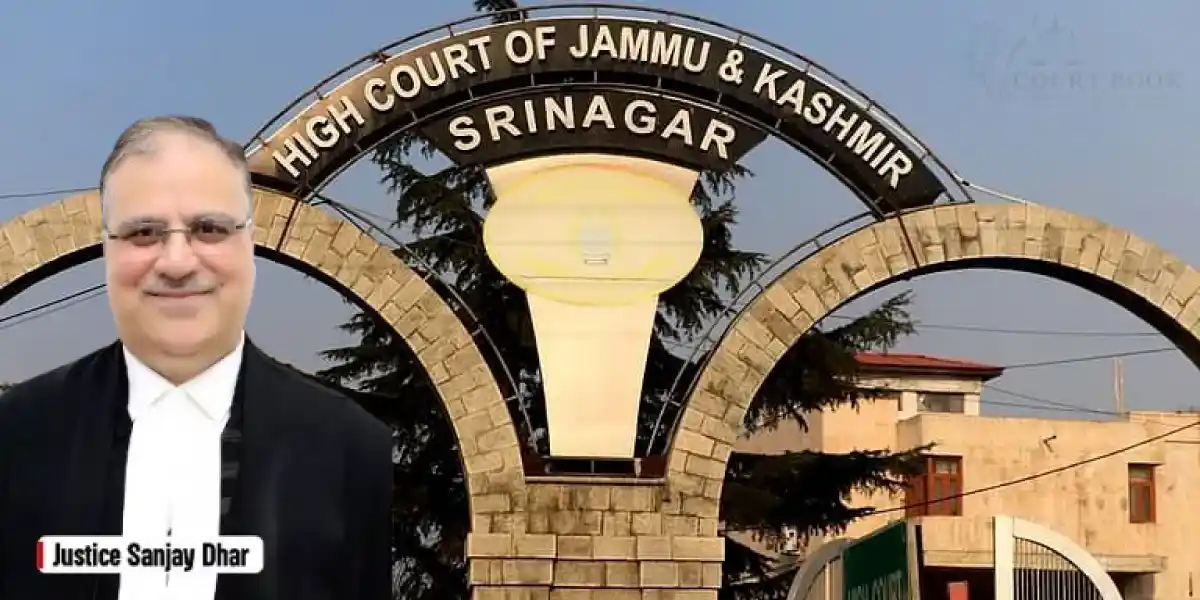
The High Court of Jammu & Kashmir and Ladakh has ruled that a government employee cannot be made to wait indefinitely for gratuity and leave encashment because of administrative correspondence between departments. Holding that retirement benefits must be released in accordance with the applicable service rules, the Court directed the concerned authorities to clear the dues along with interest.
Background of the Case
The petitioner, M. Naseer U Zaman, was appointed as a Techno Economic Analyst in the Jammu & Kashmir and Ladakh Financial Corporation (JKLFC). He was later deputed to the Jammu & Kashmir Power Development Corporation (JKPDC), where he served for several years before resigning and joining the State Bank of India.
Although his provident fund was released, the petitioner claimed that gratuity and leave salary remained unpaid even after his resignation, prompting him to approach the High Court. JKLFC maintained that the delay arose because the Finance Department had advised that the borrowing organisation should contribute proportionately towards the retirement benefits. On the other hand, JKPDC argued that the responsibility rested entirely with the parent organisation under the applicable service regulations.
Court's Observations
Justice Sanjay Dhar examined the provisions governing deputation under the Jammu & Kashmir Civil Service Regulations and found that the rules clearly distinguish the responsibilities of the parent and borrowing organisations.
The Court observed,
"The liability to release gratuity is that of the parent organisation, whereas the procedure governing leave salary requires the borrowing organisation to sanction and release the amount before seeking reimbursement from the parent department."
The Court further noted that JKLFC had unnecessarily delayed payment of gratuity by engaging in prolonged inter-departmental communication instead of performing its statutory duty.
Referring to the Payment of Gratuity Act, the Court also held that when gratuity is not paid within the prescribed period, the employer becomes liable to pay statutory interest on the delayed amount.
Decision
Disposing of the writ petition, the High Court directed JKLFC, the parent organisation, to immediately release the petitioner's gratuity in accordance with the applicable rules. It also ordered payment of 10% annual interest, calculated from 30 days after acceptance of the petitioner's resignation until the actual date of payment.
The Court further directed JKPDC, the borrowing organisation, to calculate and release the petitioner's leave salary within one month. After making the payment, JKPDC would be entitled to seek reimbursement from JKLFC.
The Court also ordered 6% annual interest on the delayed leave salary from the date of filing of the writ petition until its realization.
Case Details
Case Title: M. Naseer U Zaman v. Managing Director J&K and Ladakh Financial Corporation & Others
Case Number: WP(C) No. 2973/2022
Judge: Justice Sanjay Dhar
Decision Date: 30 April 2026


