

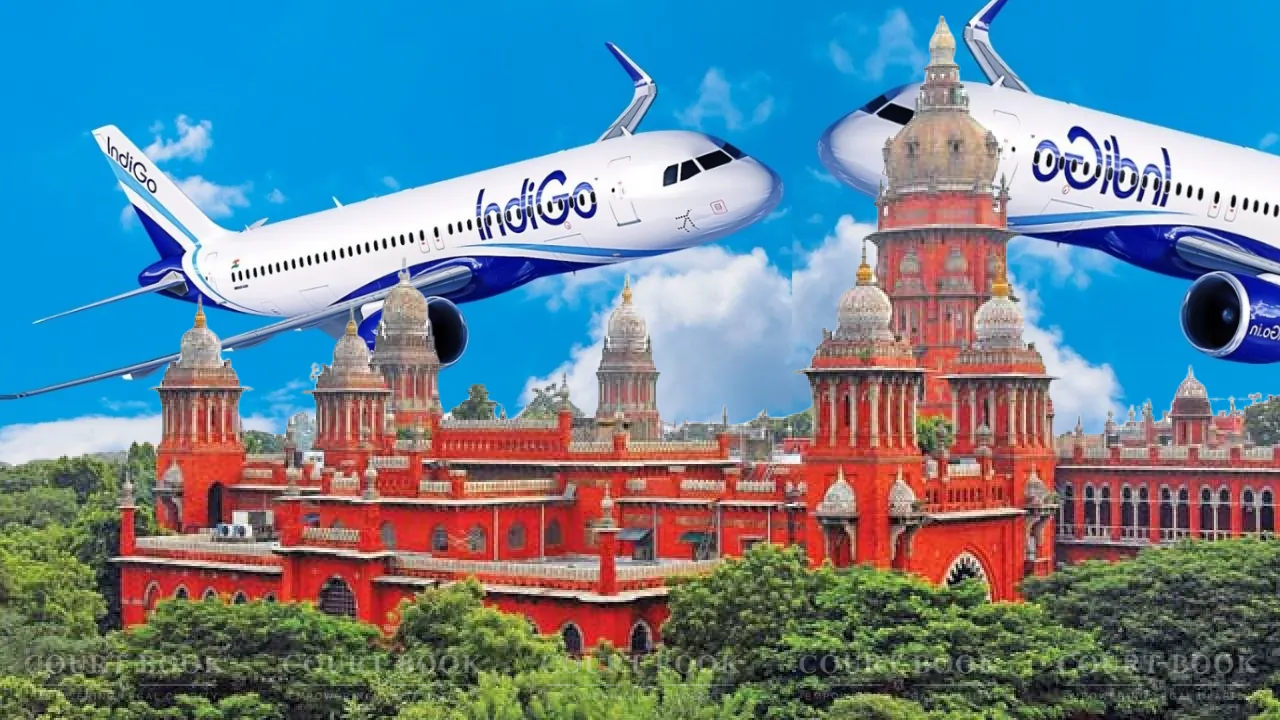
The Madras High Court on December 26 admitted a writ petition questioning the legality of an exemption granted by the aviation regulator to IndiGo Airlines, marking the beginning of judicial scrutiny over regulatory relaxations in civil aviation safety norms. The court issued notice to the authorities and called for official records, setting the stage for a detailed hearing in early January.
The matter was heard by Justice V. Lakshminarayanan, who passed the order after listening to arguments from both sides.
Background of the Case
The petition has been filed by Chennai resident Y.R. Rajaveni, who challenged an exemption order issued by the Directorate General of Civil Aviation (DGCA) on December 5, 2025. The exemption was granted in favour of InterGlobe Aviation Limited, which operates IndiGo Airlines.
According to the petitioner, the exemption allowed IndiGo additional time to comply with certain provisions of the Civil Aviation Requirements (CAR), specifically Paragraphs 3.11 and 6.14, applicable to a particular class of aircraft.
The writ petition seeks quashing of the exemption order on the ground that it is illegal, unconstitutional, and contrary to the Aircraft Act and Aircraft Rules.
Read also:-Supreme Court Rejects Goregaon Pearl Society's Curative Pleas, Ends Long-Running Housing Dispute
Senior advocate Sanjay Ghose, appearing for the petitioner, argued that the DGCA’s exemption violated Rule 133A of the Aircraft Rules, 1937. He submitted that while the DGCA has the power to issue directions, any exemption under Rule 133A cannot override or conflict with the parent legislation, namely the Aircraft Act, 1934.
“The impugned exemption is inconsistent with the statutory framework governing civil aviation safety,” the petitioner’s counsel contended before the court.
On the other hand, Additional Solicitor General A.R.L. Sundaresan, representing the DGCA, explained that the exemption was granted in exceptional circumstances. He told the court that IndiGo was facing operational constraints and immediate enforcement would have resulted in large-scale flight cancellations, causing hardship to passengers.
Court’s Observations
After hearing both sides, the bench admitted the writ petition and issued Rule Nisi. The court directed the DGCA to place the relevant records before it within four weeks.
Recording the regulator’s submission, the court noted that the DGCA is actively working with IndiGo to ensure compliance with the Civil Aviation Requirements. “The statement of the learned Additional Solicitor General that the DGCA is working with the second respondent to ensure compliance with CAR is recorded,” the bench observed.
The court, however, did not grant any interim relief at this stage, stating that the request for interim orders would be considered after hearing IndiGo.
The High Court directed the DGCA to file a detailed counter affidavit by January 5, 2026. The counter must specifically clarify whether the exemption granted on December 5, 2025, is proposed to be extended further.
The petitioner was also directed to complete service of notice on IndiGo. The court permitted private notice and allowed service through counsel, if any, representing the airline.
Court’s Decision
Admitting the writ petition, the Madras High Court called for records, issued notice, and scheduled the matter for further hearing on January 6, 2026, immediately after admission, leaving the question of interim relief open until the airline is heard Y.R.Rajaveni.
Case Title: Y.R. Rajaveni vs Director General of Civil Aviation & Anr.
Case No.: WP No. 50417 of 2025
Case Type: Writ Petition (Certiorari)
Decision Date: 26 December 2025
Download Judgment

