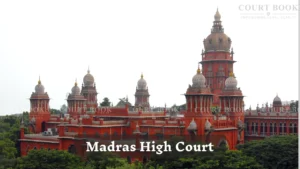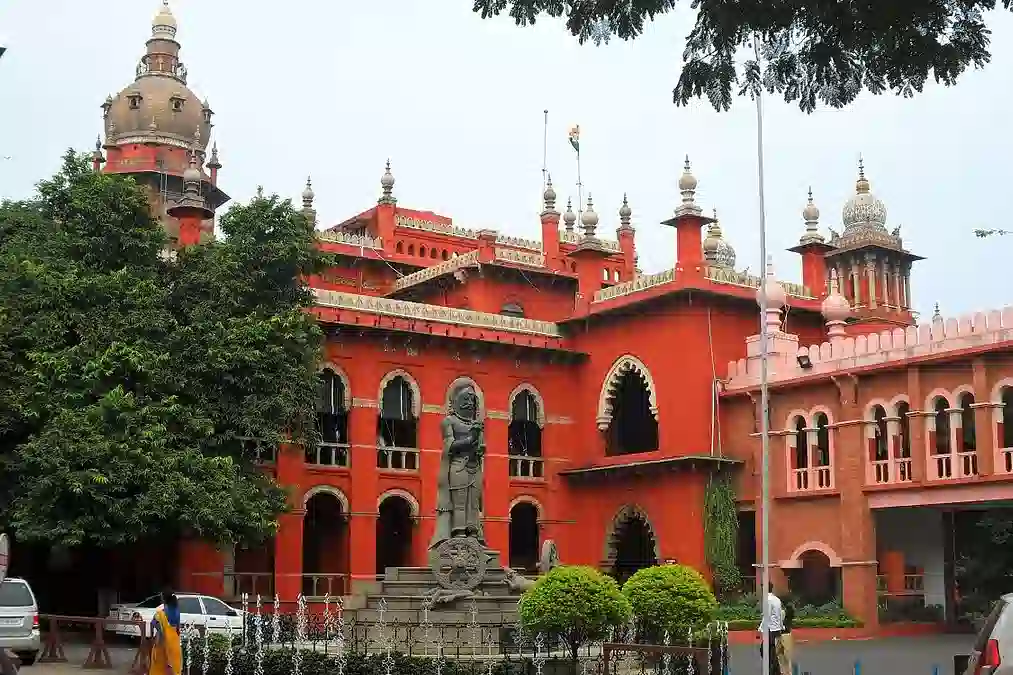
The Madras High Court has ruled that courts cannot expand the scope of a government welfare scheme beyond what the policy itself provides. Setting aside an earlier order of a single judge, a division bench held that judicial review cannot be used to modify or substitute an executive policy framed by the State.
The ruling came in a writ appeal filed by the Tamil Nadu government challenging a direction that sought to broaden the eligibility criteria of a marriage assistance scheme.
Background of the Case
The case arose from a dispute over the Moovalur Ramamirtham Ammaiyar Ninaivu Marriage Assistance Scheme, a welfare initiative meant to support women at the time of marriage. Under the scheme, financial assistance was available only to applicants whose family income did not exceed ₹6,000 per month (₹72,000 per year).
S. Chitra, the first respondent in the case, had applied for benefits under the scheme. However, her request was rejected after the income certificate issued by the Zonal Deputy Tahsildar recorded her annual income as ₹1,08,000, which translates to about ₹9,000 per month.
Since this amount was above the prescribed limit, authorities held that she was not eligible for the scheme.
Chitra then approached the High Court through a writ petition challenging the rejection of her claim. A single judge allowed her petition and went a step further, holding that the scheme’s benefit should extend to persons earning wages equivalent to the minimum wages notified under the law.
The Tamil Nadu government challenged this order before the division bench, arguing that the single judge had gone beyond the scope of the case.
Read also:- Supreme Court Issues Contempt Notice to 50+ Delhi Hospitals Over Alleged Violation of Free Treatment Rules
The Advocate General submitted that the only question before the court was whether Chitra’s claim had been rightly rejected based on her income certificate. There was no challenge to the policy itself or any request seeking expansion of the scheme’s eligibility criteria.
The government also argued that courts cannot alter the conditions of a welfare scheme formulated under the executive’s policy powers.
The division bench, headed by the Chief Justice, examined the pleadings in the original writ petition and agreed with the State’s arguments.
The court noted that Chitra’s entitlement depended entirely on proving that her monthly income was ₹6,000 or less. However, the income certificate issued by the competent authority showed a higher income, and there was no material placed before the court to challenge its correctness.
Read also:- Kerala High Court Upholds 498A Conviction in Dowry Harassment Case, but Reduces Jail Term
“The scope of the writ petition was only to examine whether the rejection of the petitioner’s claim was justified,” the bench observed.
The judges further pointed out that the single judge had expanded the scheme’s coverage by linking it with minimum wage levels, even though such relief had never been sought in the petition.
“The direction issued… amounts to substituting one executive policy for another,” the bench said.
The court emphasized that matters relating to policy decisions fall primarily within the executive domain, and judicial review in such cases is limited to examining legality or constitutional validity.
Read also:- Delhi High Court Grants Police Protection to Live-In Couple Facing Threats from Woman’s Father
Allowing the appeal, the division bench set aside the order passed by the single judge.
However, the court clarified that if Chitra is able to obtain a revised income certificate after a fresh inquiry proving that her income during the relevant period was below ₹6,000 per month, she would still be entitled to the benefit under the scheme.
The bench also recorded that the marriage assistance scheme itself had been discontinued from 2 August 2022.
With these observations, the appeal was allowed and the writ petition disposed of. There was no order as to costs.
Case Title: The Principal Secretary to Government & Another vs S. Chitra & Another
Case Number: Writ Appeal (WA) No. 3866 of 2025
Date of Judgment: 19 February 2026
Bench:
• Chief Justice Manindra Mohan Shrivastava
• Justice G. Arul Murugan
Download Judgment