The Madras High Court has dismissed a public interest litigation seeking restrictions on elected legislators who voluntarily resign from their seats and later seek to contest the resulting bye-election. The Division Bench held that courts cannot create a new electoral disqualification or impose a financial liability that is not provided under existing law.
Background
The petition was filed by advocate K. Suthan after six elected members of the Tamil Nadu Legislative Assembly resigned shortly after the 2026 Assembly elections. The resignations were attributed by the petitioner to political considerations, and he argued that the resulting bye-elections would impose an additional financial burden on the public exchequer.
The petitioner had sought directions to the Election Commission of India and the Chief Electoral Officer, Tamil Nadu, to introduce an “Election Expenditure Security”. Under the proposed mechanism, a legislator voluntarily resigning from the Assembly would have to deposit an amount corresponding to the public expenditure incurred on the resulting bye-election before contesting it.
He also sought a five-year disqualification preventing such legislators from contesting elections to Parliament or State Legislatures after a voluntary resignation. The petitioner acknowledged that the proposed mechanism was not presently part of Indian electoral law.
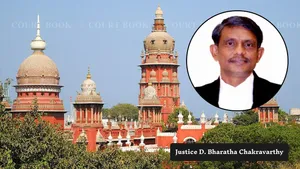
The Bench comprising Chief Justice Sushrut Arvind Dharmadhikari and Justice G. Arul Murugan examined whether the High Court could direct the Election Commission or Legislature to create these new electoral restrictions.
The Court held that the relief sought did not merely seek to fill a gap in an existing legal framework. Instead, it would require creation of a new financial obligation and a new five-year disqualification, neither of which presently exists under the Constitution or the Representation of the People Act, 1951.
The Court explained the limits of judicial power in matters requiring legislation:
“It is thus well settled that while exercising its writ jurisdiction, this Court may interpret and develop the law and may also indicate the necessity for legislative reform where the circumstances so warrant. However, the Court cannot issue a writ of mandamus directing the Legislature or the Government to enact a particular law or to introduce a Bill before the Legislature within a stipulated time frame.”
The Bench also distinguished the Supreme Court’s decision in Union of India v. Association for Democratic Reforms. That case concerned disclosure of candidates’ existing information, such as criminal antecedents, assets and educational qualifications. According to the High Court, it did not authorise creation of a fresh disqualification or financial condition for contesting elections.
The Court further relied on an earlier Madras High Court decision concerning recovery of bye-election expenses, noting that the absence of a statutory provision for such recovery meant that any such mechanism had to come through legislation.
The Madras High Court held that the proposed “Election Expenditure Security” and five-year disqualification could not be introduced through a judicial direction. It therefore dismissed the writ petition, closed the connected miscellaneous petitions and made no order as to costs.
Case Details:
Case Title: K. Suthan v. Union of India & Ors.
Case Number: W.P.No.36274 of 2026
Judge: Chief Justice Sushrut Arvind Dharmadhikari and Justice G. Arul Murugan
Decision Date: 24 September 2026