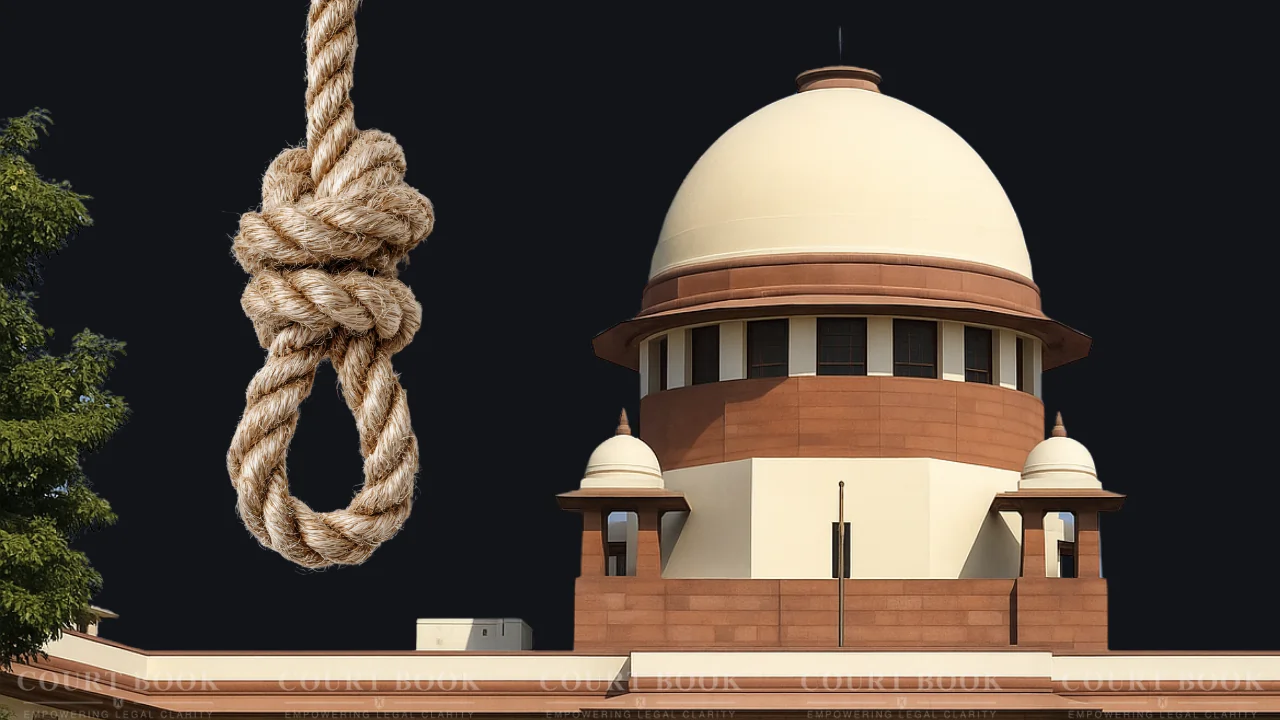
The Supreme Court on September 24, 2026, upheld the conviction of Waris for the sexual assault and killing of his six-year-old step-daughter but commuted the death sentence imposed upon him to imprisonment for the remainder of his natural life without remission.
A Bench comprising Justices Vikram Nath, Sandeep Mehta and Vijay Bishnoi delivered the judgment in Criminal Appeal Nos. 429-430 of 2020. The Court examined the entire evidentiary record, including a further cross-examination of the victim’s mother ordered by the Supreme Court in 2025.
Background
The prosecution case concerned the sexual assault of the child inside the matrimonial home and her subsequent death by throttling. The child’s mother was the principal eyewitness. The Trial Court had convicted Waris under Sections 302, 376(2)(f), 376(2)(n), 376AB and 201 of the IPC and Sections 5 and 6 of the POCSO Act, imposing the death penalty for the offences under Sections 302 and 376AB.
The Madhya Pradesh High Court later affirmed both the conviction and death sentence. However, during the appeal before the Supreme Court, concerns arose regarding the manner in which the mother’s cross-examination had originally been conducted. A legal aid counsel had been appointed on the same day that her evidence was recorded, leaving little opportunity for preparation.
The Supreme Court therefore directed a further cross-examination. This was conducted in June 2025 by counsel of the appellant’s choice, after the complete record had been supplied in advance.
The Court held that the defect concerning the original cross-examination had been adequately cured. It considered the mother’s original testimony together with her further cross-examination.
The Court also relied upon the medical evidence. The post-mortem examination found that the child had died from asphyxia caused by throttling and recorded an injury consistent with recent penetrative sexual assault. The Court treated these findings as independent medical support for the prosecution evidence.
On the reliability of the mother’s testimony, the Court noted that a conviction can legally rest upon the evidence of a single witness where that testimony is reliable. It further held that a witness cannot be rejected merely because she is related to the victim or accused.
The Court observed:
"The principle enshrined in the said provision is that evidence is to be weighed and not counted, and that the conviction of an accused may rest upon the testimony of a single witness if that testimony is found to be reliable and inspires confidence."
The Bench also found that the mother’s account was supported by medical evidence and other material on record. It ultimately found the prosecution case proved beyond reasonable doubt and upheld the conviction for all the offences for which Waris had been convicted.
The major question before the Supreme Court was whether the death sentence should continue.
While considering the sentence, the Court examined the mitigating circumstances placed before it. These included the appellant’s difficult childhood, early loss of his mother, poverty and deprivation, absence of previous criminal convictions, satisfactory conduct in custody and efforts towards self-improvement.
The Court also noted that the State had not produced material establishing that the appellant was beyond the possibility of reform. It stressed that the sentencing exercise requires courts to consider not only the circumstances of the crime but also the circumstances of the person being sentenced.
The Court stated:
"The sentence of death is reserved not for the gravest crimes as a class, but for those cases within the gravest class in which, after the circumstances of the criminal have been weighed, the alternative of life imprisonment is found to be unquestionably foreclosed."
The Supreme Court held that the death sentence could not be sustained. It commuted the death sentences imposed under Sections 302 and 376AB of the IPC to imprisonment for the remainder of Waris’s natural life, with no remission.
The Court affirmed the imprisonment and fine imposed for the remaining offences under Sections 376(2)(f), 376(2)(n) and 201 of the IPC and Sections 5 and 6 of the POCSO Act. It further directed that the substantive sentences would run concurrently.
The Court recorded that the sentence would confine the appellant for the whole of the remainder of his natural life without the possibility of release through remission.
The appeals were accordingly disposed of.
Case Details:
Case Title: Waris v. State of Madhya Pradesh
Case Number: Criminal Appeal Nos. 429-430 of 2020
Judge: Justice Vikram Nath, Justice Sandeep Mehta and Justice Vijay Bishnoi
Decision Date: September 24, 2026






-300x169.webp)
-300x169.webp)