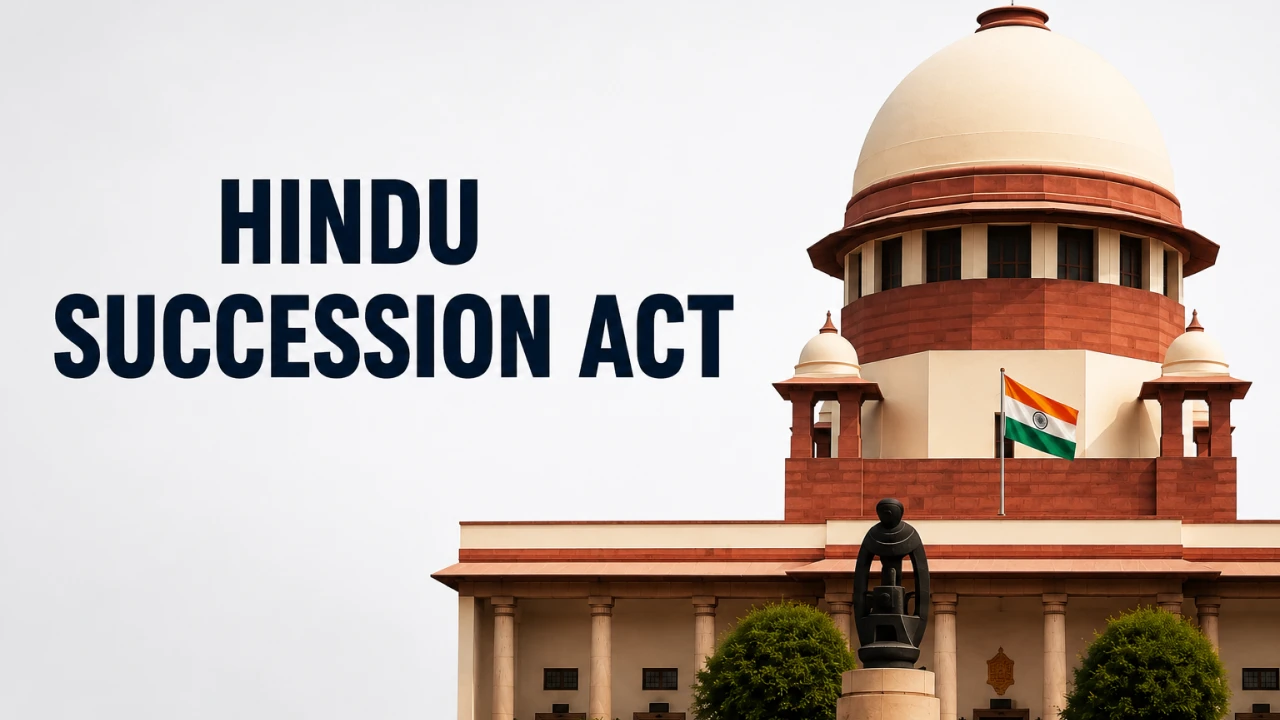
The Supreme Court on September 22, 2026, dismissed a civil appeal concerning the inheritance rights of a Hindu widow under the Hindu Women’s Rights to Property Act, 1937 and Section 14(1) of the Hindu Succession Act, 1956.
A Bench comprising Justice S.V.N. Bhatti and Justice N.V. Anjaria upheld the Karnataka High Court’s decision concerning properties originally belonging to Gangaram. The Court held that a partition between his son and widow was not a necessary condition for the widow’s limited interest to develop into absolute ownership.
Background
Gangaram died intestate in 1949, leaving behind his son Ganapati through his first wife and his second wife, Kashibai, who had two daughters. The dispute concerned two house properties bearing TMC Nos. 1074 and 1075 at Terdal Village in Karnataka.
After Kashibai’s death in 1986, her daughter Shakuntala obtained mutation of the properties in her name on the basis of a registered Will executed by Kashibai in 1984. During the pendency of the suit, Shakuntala also sold one of the properties to a third-party purchaser through a registered sale deed.
Ganapati challenged these transactions, claiming that he had exclusively succeeded to his father’s estate. The Trial Court accepted his claim, holding that Kashibai had only a limited interest and had not established any partition in her favour. The First Appellate Court affirmed that decision.
The Karnataka High Court took a different view. It held that, under Section 3(2) of the 1937 Act, Kashibai had acquired an interest in Gangaram’s property. The High Court further held that this interest became absolute under Section 14(1) of the 1956 Act.
The High Court therefore concluded that Kashibai could dispose of the property through her Will and that the subsequent purchaser had acquired title through Shakuntala.
The Supreme Court examined the relationship between Section 3(2) of the 1937 Act and Section 14(1) of the 1956 Act. It relied upon earlier decisions including V. Tulasamma v. Sesha Reddy and Raghubar Singh v. Gulab Singh.
The Court explained that the widow’s right under the 1937 Act was not extinguished merely because no formal partition had taken place.
“The partition between the Plaintiff and Kashibai, as is well settled, is not a sine qua non for continuing to enjoy the right as an independent or absolute owner of the property left behind by the prepositus.”
The Court further held that Section 14(1) enlarged Kashibai’s interest into absolute ownership. It observed that even assuming there had been no partition, the absence of partition did not amount to denial of her underlying right.
The Supreme Court found that the High Court had correctly applied the relevant statutory provisions and precedents while allowing the second appeal. It also held that the High Court’s exercise of jurisdiction was within the scope of Section 100 of the Code of Civil Procedure, 1908.
Accordingly, the Supreme Court dismissed the civil appeal and made no order as to costs.
Any pending application was directed to be disposed of accordingly.
Case Details:
Case Title: Ganapati (Dead) by His LRs v. Prabhakar & Others
Case Number: Civil Appeal No. 660 of 2019
Judges: Justice S.V.N. Bhatti and Justice N.V. Anjaria
Decision Date: September 22, 2026




-300x169.webp)
-300x169.webp)