

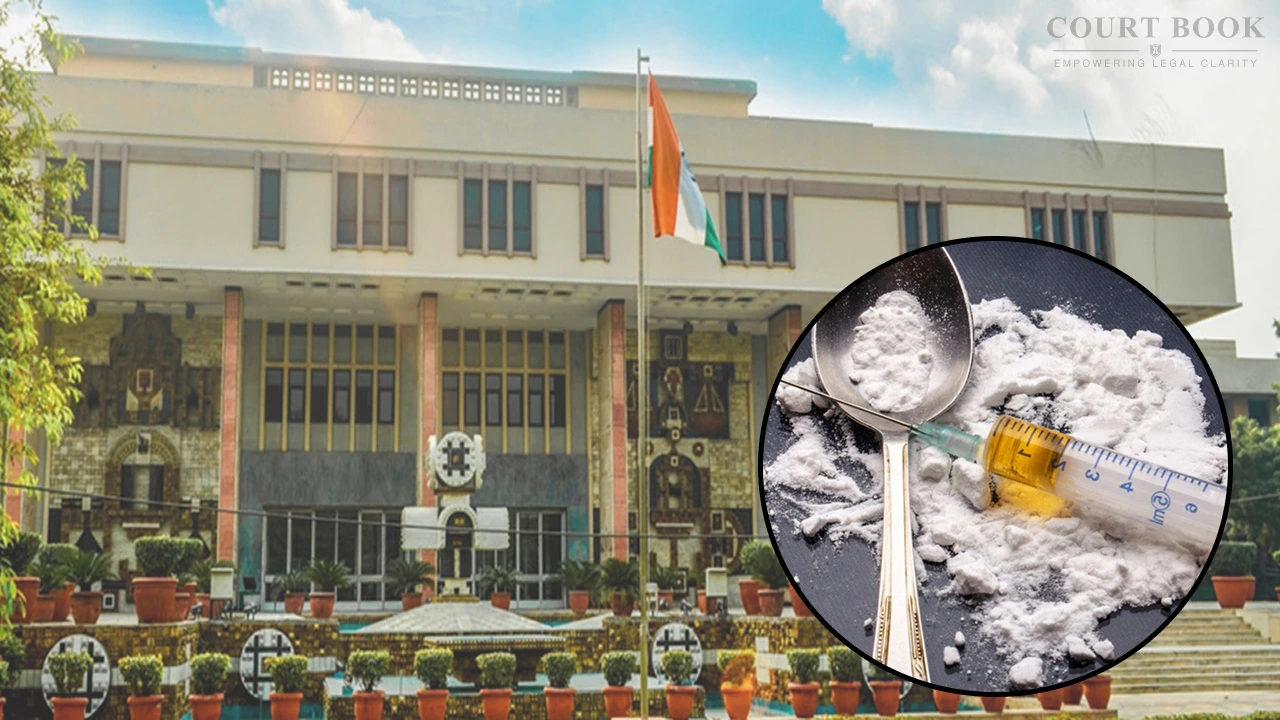
The Delhi High Court has refused regular bail to a man accused in a case involving the alleged recovery of 1.516 kg of charas, holding that the mere absence of separately supplied written grounds of arrest does not automatically entitle an accused to bail, particularly where no prejudice is shown and the case involves a commercial quantity under the NDPS Act. The Court observed that procedural safeguards must be balanced with the seriousness of the alleged offence and the realities of criminal investigation.
Background of the Case
The case arose from FIR No. 49/2025 registered at Police Station Kotla Mubarakpur under Sections 20 and 25 of the NDPS Act. According to the prosecution, the accused was apprehended on January 17, 2025, following specific secret information. During a search of a flat in Kotla Mubarakpur, police allegedly recovered two packets which, after field testing, were found to contain 1.516 kg of charas. The accused later sought regular bail before the High Court.
Before the Court, the defence argued that there were inconsistencies regarding the deposit of the seized material in the police malkhana, raising doubts about the recovery process. It also contended that the accused had not been furnished written grounds of arrest, relying on recent Supreme Court decisions dealing with Article 22(1) of the Constitution.
Court's Observations
Justice Girish Kathpalia noted that the alleged recovery involved a commercial quantity, making the stringent conditions for bail under Section 37 of the NDPS Act applicable. The Court found that the entries relating to the seizure, counter-sealing by the Station House Officer, and deposit of the parcels did not create reasonable grounds to believe that the accused was not guilty of the alleged offence.
On the issue of the grounds of arrest, the Court examined several Supreme Court rulings on the subject. It observed that while the requirement of informing an accused of the grounds of arrest is an important constitutional safeguard, the legal position requiring written communication for all arrests had evolved through later judgments.
The Court pointed out that the accused had been arrested in January 2025, whereas the Supreme Court's clarification regarding written grounds of arrest came subsequently. It further found that the arrest memo served upon the accused substantially informed him of the reasons for his arrest and that he had legal representation at the earliest stage of the proceedings.
"The compliance with the requirement to furnish grounds of arrest was substantial in the present case," the bench observed, adding that there was no legislatively prescribed format and that the accused had failed to demonstrate any actual prejudice caused by the alleged procedural lapse.
The Court also remarked that procedural defects, in the absence of demonstrated prejudice, cannot outweigh the gravity of allegations involving commercial quantities of narcotic substances.
Decision
Refusing to grant bail, the Court held that the accused had failed to satisfy the twin conditions required under Section 37 of the NDPS Act. It concluded that the alleged defects regarding the grounds of arrest did not justify release on bail in the facts of the case, especially when the investigation into the alleged supply network was still relevant.
Accordingly, the Delhi High Court dismissed the bail application.
Case Details
Case Title: Amar Thapa v. State of NCT of Delhi
Case Number: BAIL APPLN. 1865/2026
Judge: Justice Girish Kathpalia
Decision Date: 10 July 2026


