

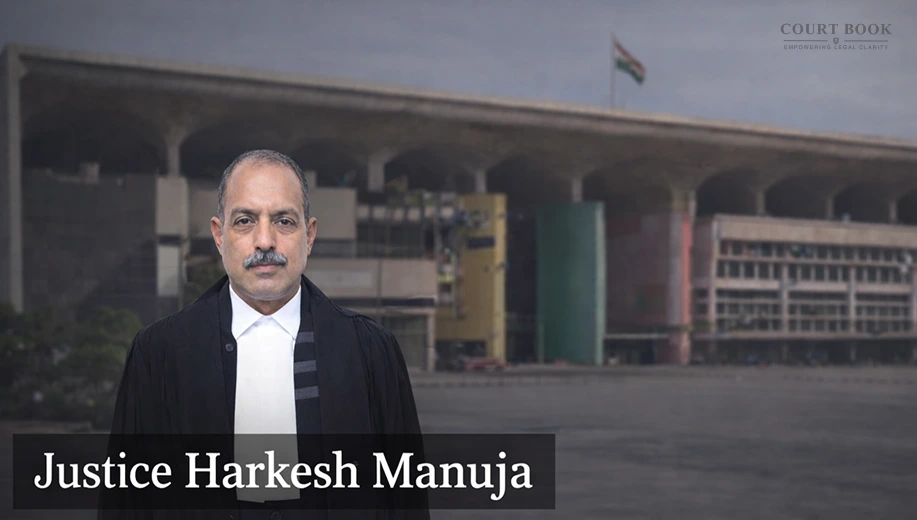
The Punjab and Haryana High Court has significantly enhanced compensation awarded to the parents of a young electrician who lost his life in a road accident, holding that the Motor Accident Claims Tribunal (MACT) had underestimated both his income and his contribution to the family. Justice Harkesh Manuja delivered the ruling on January 8, increasing the compensation from ₹13.52 lakh to ₹24.16 lakh.
Background of the Case
The case arose from a fatal motor vehicle accident that occurred on June 11, 2016, in which Bhupender alias Vicky, aged 30, died. His parents filed a claim before the MACT at Hisar. In May 2018, the Tribunal awarded ₹13,52,022 with 9% annual interest, calculating the deceased’s income at minimum wage levels.
Read also:- Scholarship received by wife before marriage cannot take away husband's rights: Rajasthan High Court
Dissatisfied with the amount, the parents approached the High Court, arguing that their son was a trained electrician with ITI qualifications and had a far higher earning capacity than what was assessed.
Arguments Before the Court
Counsel for the appellants contended that the deceased earned around ₹50,000 per month and that the Tribunal wrongly treated him as an unskilled labourer. It was also argued that deductions for personal expenses, the multiplier applied, future prospects, and compensation under conventional heads were not in line with settled Supreme Court law.
Read also:- Supreme Court Transfers Divorce Case to Haryana, Citing Wife’s Hardship and Minor Child’s Welfare
The insurance company, on the other hand, maintained that the Tribunal’s award was fair and required no interference.
Court’s Observations
After hearing both sides, Justice Manuja noted that while documentary proof of income was missing, courts cannot mechanically apply minimum wages in such cases. Referring to Supreme Court precedents, the Court observed that social status, skills, and the nature of work must be kept in mind.
“The proceedings before the Motor Accident Claims Tribunal are summary in nature and strict rules of evidence are not applicable,” the Court noted, adding that some realistic assessment is necessary when documentary proof is unavailable.
Read also:- Bombay High Court Dismisses Plea Against PSU Banks’ Right to Reject Candidates for Past Misconduct
Taking judicial notice of the fact that an ITI-trained electrician would have a steady income, the Court fixed the deceased’s monthly income at ₹12,000.
Deduction and Multiplier
Although the Supreme Court has generally held that 50% of income should be deducted as personal expenses in the case of a bachelor, the Court departed slightly from this rule. It observed that the deceased was the sole earning member and had aged parents dependent on him.
“In such circumstances, it can be reasonably inferred that the deceased would have saved a considerable portion of his income for the welfare of his parents,” the Court observed.
Accordingly, the deduction was limited to one-third. The Court applied a multiplier of 17, based on the deceased’s age of 30 years.
Read also:- Supreme Court Grants Pre-Arrest Bail, Orders ₹42 Lakh Release in Kerala Cheating Case
Compensation Under Conventional Heads
The Court also revised amounts awarded under conventional heads, granting:
• ₹18,000 for funeral expenses
• ₹18,000 for loss of estate
• ₹96,000 for loss of consortium (₹48,000 each to both parents as filial consortium)
Final Decision
Recalculating the compensation, the High Court fixed the total amount payable at ₹24,16,800, resulting in an enhancement of ₹10,64,778 over the Tribunal’s award. The Court upheld interest at 9% per annum from the date of filing of the claim petition, with a higher interest rate applicable in case of delay in payment.
With these modifications, the appeal was disposed of.
Case Title: Sharda and Another vs. Nagender Sharma and Another
Case Number: FAO-3943-2019 (O&M)
Date of Judgment: 08 January 2026
Download Order

