

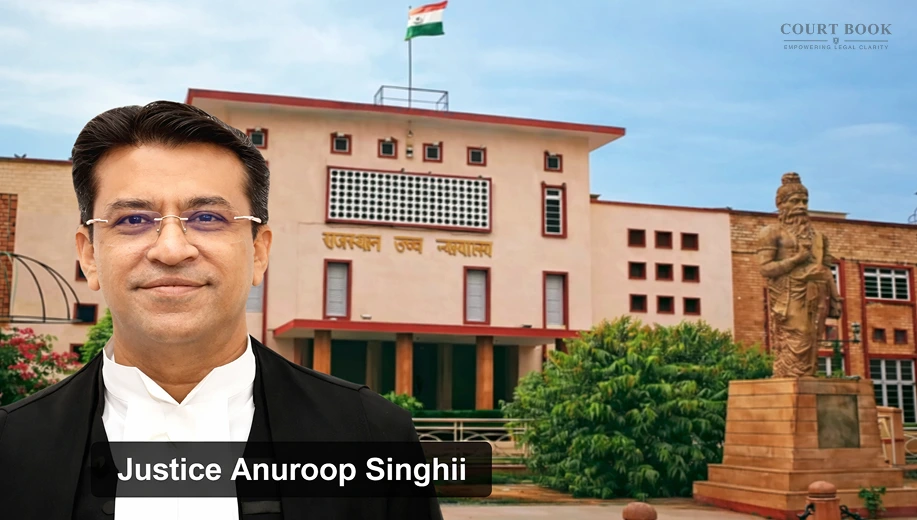
The Rajasthan High Court has ruled that a student cannot be denied a government scholarship simply because his wife had received the same benefit before their marriage. Calling the rejection “untenable in the eyes of law,” the court set aside the decision of the authorities and ordered a fresh consideration of the student’s application under the Swami Vivekananda Scholarship for Academic Excellence Scheme.
Background of the Case
The case was filed by Devendra Kumar Kothari, challenging the rejection of his son Prakhar Kothari’s scholarship application. Prakhar is pursuing an MBAi programme at the Kellogg School of Management, Northwestern University, USA.
Read also:- Bombay High Court Dismisses Plea Against PSU Banks’ Right to Reject Candidates for Past Misconduct
The scholarship application was rejected through a communication dated December 19, 2025. Initially, the rejection letter did not give any reasons. Later, the family was informed that the application was turned down because Prakhar’s wife, Aarushi Asawa, had received the same scholarship in September 2022 before her marriage with him in April 2023.
The authorities relied on Clause 9(ii) of the scheme, which states that in the E-3 income category, only one member of a family can receive the scholarship.
Arguments Before the Court
Counsel for the petitioner argued that the rejection was arbitrary and unfair. It was pointed out that when Aarushi Asawa received the scholarship, she was unmarried and a member of her parental family, not Prakhar’s. Denying the husband’s claim on this basis, the petitioner said, defeated the very purpose of a welfare scheme.
Read also:- Supreme Court Grants Pre-Arrest Bail, Orders ₹42 Lakh Release in Kerala Cheating Case
The State government opposed the plea. The Additional Advocate General argued that the scheme’s conditions were clear and could not be stretched beyond their wording. According to the State, once the wife had availed the benefit, the family unit after marriage was restricted to the couple, making the husband ineligible.
Court’s Observations
Justice Anuroop Singhii closely examined the scheme and its objectives. The court referred to its earlier rulings highlighting that scholarships are meant to bridge financial gaps and should not be interpreted in a rigid or hyper-technical manner.
Rejecting the State’s interpretation, the judge observed that accepting such an argument would defeat the very object of the scheme. The court noted that a woman belongs to her parental family before marriage and becomes part of her husband’s family only after marriage.
Read also:- Bombay High Court Upholds ₹2.97 Crore Compensation to Air India Crew Disabled in 2014 Road Accident
“The grant of scholarship to a person prior to her wedding, when she was a member of her father’s family, under no circumstances can render her husband ineligible post marriage,” the bench observed.
The court further clarified that a single scholarship received by a woman cannot be used to disqualify two separate families her parental family and her marital family.
The Decision
Holding the rejection to be legally unsustainable, the Rajasthan High Court quashed the communication dated December 19, 2025. The court directed the authorities to reconsider Prakhar Kothari’s application on its merits, strictly in accordance with the scholarship scheme and without being influenced by the earlier rejection.
With these directions, the writ petition was allowed and all pending applications were disposed of.
Case Title: Devendra Kumar Kothari v. State of Rajasthan & Ors.
Case Number: S.B. Civil Writ Petition No. 336 of 2026
Date of Decision: 15 January 2026
Download Order

