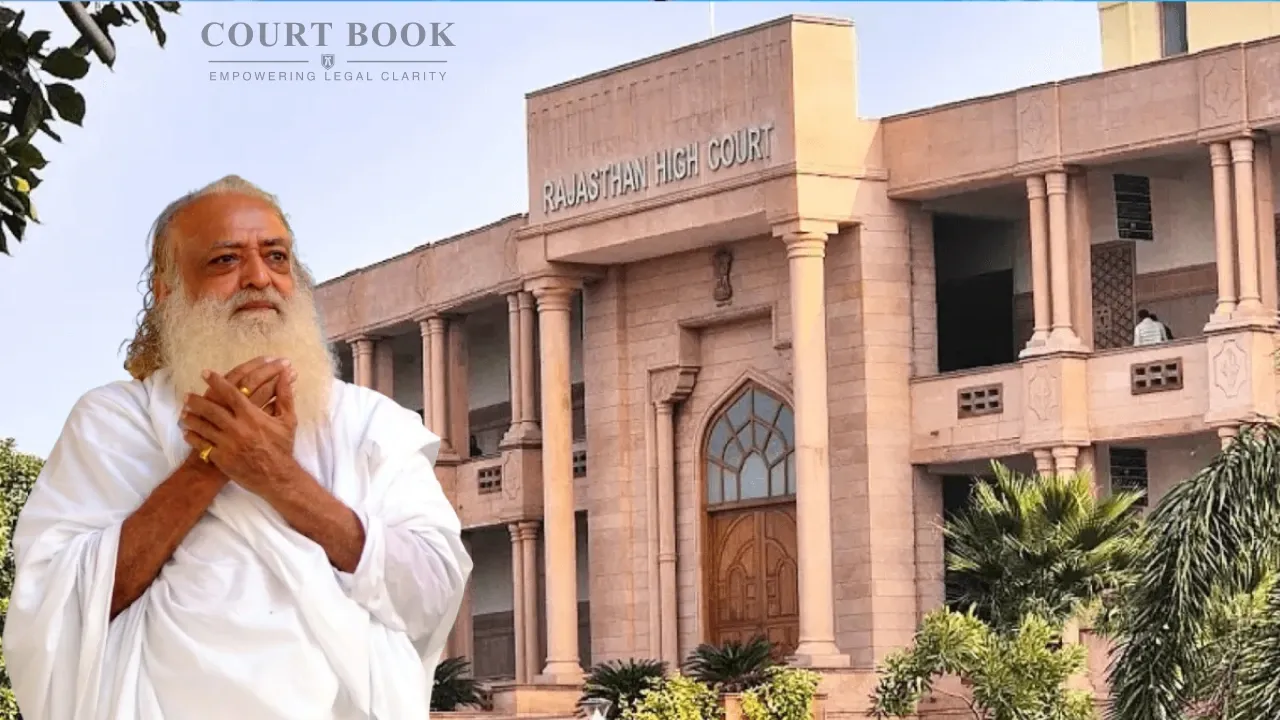
The Rajasthan High Court has directed jail authorities to continue medical facilities and accommodations previously granted to self-styled godman Asaram, who is serving a life sentence and is lodged in Central Jail, Jodhpur. The Court held that facilities extended because of a prisoner's medical condition cannot automatically be withdrawn merely because criminal proceedings have concluded.
Justice Sanjeet Purohit passed the order while deciding a writ petition seeking restoration of several facilities that had earlier been allowed through orders of the Supreme Court and the High Court in view of the petitioner's advanced age and health condition.
Background of the Case
The petitioner, aged about 85 years, approached the High Court claiming that certain facilities available to him during the pendency of criminal proceedings had been withdrawn after his appeal was decided and he surrendered before jail authorities. He sought continuation of those facilities and requested additional accommodations inside prison.
The Court noted that Asaram had been convicted in a case under provisions of the Indian Penal Code, the Juvenile Justice Act and the Protection of Children from Sexual Offences (POCSO) Act. His appeal was decided by a Division Bench on May 27, 2026, which partly upheld his conviction and directed him to undergo imprisonment for the remainder of his natural life.
During the hearing, counsel for the petitioner relied on medical records from AIIMS Jodhpur and certificates from treating doctors showing that he was suffering from several ailments, including coronary artery disease, diabetes, osteoporosis, renal disorders and severe mobility-related difficulties.
The Court undertook a detailed discussion on prisoners' rights under Article 21 of the Constitution and referred to several Supreme Court decisions emphasizing that incarceration does not deprive a person of fundamental rights except those necessarily restricted by law.
Justice Purohit observed:
“The rights of a prisoner do not stand eclipsed upon conviction, nor can they be diminished merely because the appellate proceedings have attained finality.”
The Court further held that medical facilities granted because of a prisoner's health condition cannot be linked solely to the pendency of an appeal.
According to the order,
“The disposal of the appeal does not furnish a valid ground for their withdrawal.”
The Court noted that previous directions issued by the Supreme Court and the High Court were based on medical necessity rather than status or privilege and there was no material showing misuse of those facilities.
While considering the request for a bed and bedding, the Court accepted medical material indicating osteoporosis, muscle weakness and difficulty in standing up from sitting or lying positions. Holding that the request arose from medical necessity rather than personal comfort, the Court directed prison authorities to provide a bed and bedding to the petitioner.
On the request for food from private sources, the Court declined any expansion of the existing arrangement. However, it allowed alkaline drinking water to be supplied along with privately sourced food, subject to the same safeguards already in force.
The Court also rejected the demand for attendants of the petitioner's own choice, observing that prison authorities had already provided attendants from among inmates. It nevertheless directed authorities to ensure that suitable inmates are assigned for assistance.
Regarding a private ambulance equipped with intensive care facilities, the Court found that existing emergency arrangements were adequate but directed authorities to make appropriate ambulance facilities available whenever medically necessary.
The request for a separate temperature-controlled ward was not accepted. However, the Court expected prison officials to remain sensitive to the petitioner's health condition and shift him to the jail hospital ward if circumstances required.
The Court also declined the plea for daily visits by a personal doctor. Instead, it directed that visits by Dr. Sachit Bhola be ordinarily permitted once every fortnight, while allowing additional visits in cases of medical necessity.
Disposing of the writ petition, the Rajasthan High Court ordered that all medical facilities, assistance, attendant support and accommodations previously granted through judicial orders shall continue during the period of custody unless modified because of a substantial change in medical condition or by a competent court.
The Court additionally directed provision of a bed and bedding and permitted supply of alkaline drinking water under existing conditions, while rejecting certain other requests for expanded facilities.
Case Details
Case Title: Asharam Alias Ashumal v. State of Rajasthan & Anr.
Case Number: S.B. Criminal Writ Petition No. 2541/2026
Judge: Justice Sanjeet Purohit
Decision Date: June 4, 2026








-300x169.webp)