The Supreme Court of India has clarified that properties held under a government grant cannot be treated like ordinary tenancies. The Court set aside eviction orders passed against the Union of India, holding that rent control law did not apply in the case.
Background of the Case
The dispute arose from residential premises at Sujan Singh Park in New Delhi, originally governed by a perpetual lease executed in 1945. The property belonged to Sir Sobha Singh & Sons Pvt. Ltd., while the Union of India occupied several flats to house government officials.
The landlord claimed that the Centre was a tenant paying monthly rent and had defaulted on payments between 1989 and 1991. Based on this, eviction proceedings were initiated under the Delhi Rent Control Act.
Read also:- Supreme Court Upholds Bar on Civil Suits in Municipal Limits Dispute, Dismisses Uchgaon Panchayat Appeals
The Union of India, however, argued that its occupation flowed from a government grant and not a standard landlord-tenant arrangement.
An Additional Rent Controller ordered eviction after finding non-payment of rent. The Rent Control Tribunal upheld the decision.
The Delhi High Court also refused to interfere, concluding that a landlord-tenant relationship existed and that rent control law applied.
This led the Union of India to approach the Supreme Court.
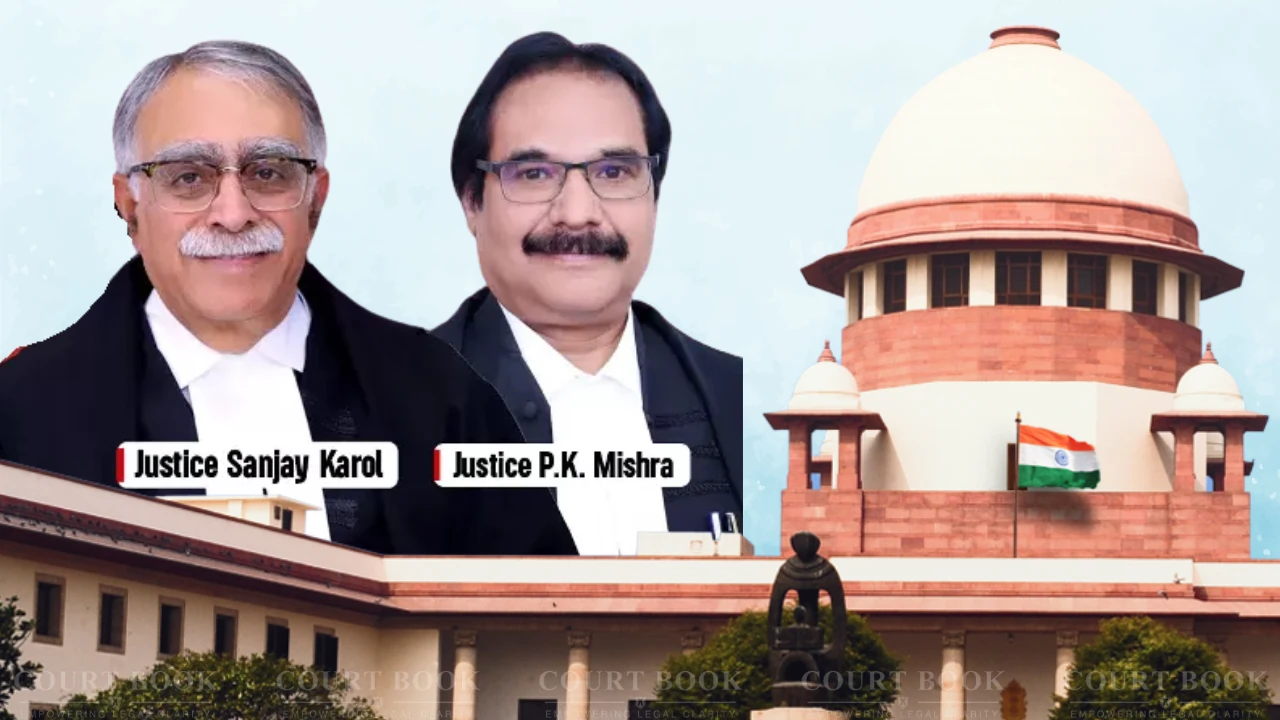
The Bench of Justices Sanjay Karol and Prashant Kumar Mishra closely examined the nature of the original lease.
The Court noted that the lease was rooted in a government grant, which carries special legal protection. It emphasized that such grants are governed by the Government Grants Act, 1895.
“The rights and obligations of the parties must be determined strictly according to the tenor of the grant,” the Bench observed.
Importantly, the Court held that this law overrides conflicting statutes, including rent control legislation.
It also pointed out that earlier forums treated the arrangement as a regular tenancy without properly considering the grant’s legal character. This, the Court said, was a fundamental error.
Read also:- J&K High Court: Only Candidates Can Be Parties in Election Petitions, Officials Must Be Dropped
The Court made it clear that:
• The Delhi Rent Control Act does not apply to properties governed by government grants.
• The relationship between the parties cannot be reduced to a simple landlord-tenant framework.
• Rights must flow strictly from the lease terms, not external statutes.
On eviction, the Bench noted there was no clause in the lease allowing eviction for non-payment of rent.
“The grant must operate according to its tenor, and its silence cannot be converted into a ground of forfeiture,” the Court stated.
Allowing the appeal, the Supreme Court set aside the Delhi High Court’s 2020 judgment and the eviction orders passed by lower authorities.
However, the Court clarified that the respondent company is free to pursue other legal remedies, such as recovery of dues, in accordance with law.
Case Details:
Case Title: Union of India vs Sir Sobha Singh & Sons Pvt. Ltd.
Case Number: Civil Appeal No. 4686 of 2026 (arising out of SLP (C) No. 5629 of 2022)
Judges: Justice Sanjay Karol, Justice Prashant Kumar Mishra
Decision Date: April 22, 2026
Download Judgment



-300x169.webp)
-300x169.webp)